
Humanities & Social Sciences
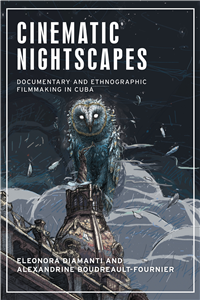
Cinematic nightscapes
Documentary and ethnographic filmmaking in Cuba
by Eleonora Diamanti, Alexandrine Boudreault-Fournier
Description
Cinematic Nightscapes explores how the darkness of night in contemporary Cuba becomes a powerful site for political expression, cultural imagination and artistic experimentation. As the rhythms of the day give way to night, a different Cuba emerges, one where protests take shape, marginalized voices reclaim space, and filmmakers reimagine ethnographic and documentary storytelling. This book offers a sensorial and creative journey through Cuban documentary films that engage with the night not just as backdrop, but as a central character-shaping emotions, aesthetics and socio-political discourse. Blending theory with rich visual analysis, Cinematic Nightscapes asks: How does the night alter ethnographic practice? How do Cuban filmmakers use the night to imagine new futures? Through a reflexive, multimodal approach, the book invites readers to experience the complexities of nocturnal life in Cuba, where darkness illuminates new possibilities.
More Information
Rights Information
Albania, Algeria, Angola, Argentina, Armenia, Australia, Austria, Bahrain, Belgium, Belize, Benin, Bolivia, Bosnia and Herzegovina, Botswana, Brazil, Bulgaria, Burkina Faso, Burundi, Cameroon, Canada, Cape Verde, Central African Republic, Chad, Chile, China, Colombia, Comoros, Congo [DRC], Congo, Republic of the, Costa Rica, Ivory Coast, Croatia, Czech Republic, Denmark, Djibouti, Ecuador, Egypt, El Salvador, Equatorial Guinea, Eritrea, Estonia, Ethiopia, Faroe Islands, Finland, France, French Guiana, Gabon, Gambia, Georgia, Germany, Ghana, Greece, Guatemala, Guinea, Guinea-Bissau, Guyana, Honduras, Hongkong, Hungary, Iceland, India, Indonesia, Iran, Iraq, Ireland, Israel, Italy, Japan, Jordan, Kazakhstan, Kenya, Kuwait, Latvia, Lebanon, Lesotho, Liberia, Libya, Lithuania, Luxembourg, Macau, China, Macedonia [FYROM], Madagascar, Malawi, Malaysia, Mali, Malta, Mauritania, Mauritius, Mayotte, Mexico, Mongolia, Montenegro, Morocco, Mozambique, Namibia, Netherlands, New Zealand, Nicaragua, Niger, Nigeria, Norway, Oman, Pakistan, Panama, Paraguay, Peru, Philippines, Poland, Portugal, Puerto Rico, Qatar, Reunion, Romania, Russia, Rwanda, Saint Helena, Sao Tome and Principe, Saudi Arabia, Senegal, Serbia, Seychelles, Sierra Leone, Singapore, Slovakia, Slovenia, Somalia, South Africa, South Korea, Spain, Sri Lanka, Sudan, Suriname, Swaziland, Sweden, Switzerland, Syria, Taiwan, Tanzania, Thailand, Timor-Leste, Togo, Tokelau, Tunisia, Turkey, Uganda, Ukraine, United Arab Emirates, United Kingdom, United States, Uruguay, Venezuela, Vietnam, Western Sahara, Yemen, Zambia, Zimbabwe, South Sudan, Cyprus, Palestine, Bangladesh, Cambodia, Liechtenstein, Azerbaijan, Jamaica, Kyrgyzstan, Dominican Republic, Myanmar, Monaco
Endorsements
Cinematic nightscapes is a sensorial, creative and audio-visual exploration of the night in twenty-first century ethnographic and documentary film in Cuba. Cuba has recently undergone a series of growing nation-wide blackouts that plunged the country into an everlasting night, a condition that has become central for political reclamation, imaginary formation and aesthetic experimentation. From the politics of fun and desire, the political reclamation of the night by protests and marginalised groups to sensory and material nocturnal experiences, the book brings the reader, the viewer and the listener through a deep dive into the obscurity of the Cuban night in all its complexities. Two fundamental sets of questions guide the book. The first concerns ethnographic practices and aesthetic experimentations: How does night, with its own atmosphere and sensibilities, reshape and reconfigure sensorial, multimodal and creative-based ethnographic practices? The second connects audio-visual practices and representation to imaginary formation and socio-political issues: How does documentary and ethnographic film in Cuba engage with the night as a site of political reclamation and aesthetic experimentation that the day precludes? By reflexively engaging with ethnographic practice and connecting with recent documentary films produced by Cuban directors, the book offers a creative way to engage with the aesthetics, politics and the imaginary of the night in contemporary Cuba.
Reviews
Cinematic nightscapes is a sensorial, creative and audio-visual exploration of the night in twenty-first century ethnographic and documentary film in Cuba. Cuba has recently undergone a series of growing nation-wide blackouts that plunged the country into an everlasting night, a condition that has become central for political reclamation, imaginary formation and aesthetic experimentation. From the politics of fun and desire, the political reclamation of the night by protests and marginalised groups to sensory and material nocturnal experiences, the book brings the reader, the viewer and the listener through a deep dive into the obscurity of the Cuban night in all its complexities. Two fundamental sets of questions guide the book. The first concerns ethnographic practices and aesthetic experimentations: How does night, with its own atmosphere and sensibilities, reshape and reconfigure sensorial, multimodal and creative-based ethnographic practices? The second connects audio-visual practices and representation to imaginary formation and socio-political issues: How does documentary and ethnographic film in Cuba engage with the night as a site of political reclamation and aesthetic experimentation that the day precludes? By reflexively engaging with ethnographic practice and connecting with recent documentary films produced by Cuban directors, the book offers a creative way to engage with the aesthetics, politics and the imaginary of the night in contemporary Cuba.
Author Biography
Eleonora Diamanti is Lecturer in Communications and Media Studies at John Cabot University Alexandrine Boudreault-Fournier is Professor of Anthropology at the University of Victoria
 Trusted Partner

Manchester University Press
Manchester University Press is a leading UK publisher known for excellent research in the humanities and social sciences.
View all titlesBibliographic Information
- Publisher Manchester University Press
- Publication Date June 2026
- Orginal LanguageEnglish
- ISBN/Identifier 9781526148841 / 1526148846
- Publication Country or regionUnited Kingdom
- FormatPrint PDF
- Pages152
- ReadershipGeneral/trade; College/higher education; Professional and scholarly
- Publish StatusPublished
- Dimensions216 X 138 mm
- Biblio NotesDerived from Proprietary 5152
- SeriesAnthropology, Creative Practice and Ethnography
- Reference Code12879
Thank you for proceeding with this offer.
Manchester University Press has chosen to review this offer before it proceeds.
You will receive an email update that will bring you back to complete the process.
You can also check the status in the My Offers area
Manchester University Press has chosen to review this offer before it proceeds.
You will receive an email update that will bring you back to complete the process.
You can also check the status in the My Offers area

Please wait while the payment is being prepared.
Do not close this window.

(c) Copyright 2026 - Frankfurter Buchmesse GmbH. All Right Reserved