
Humanities & Social Sciences
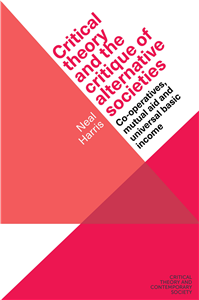
Critical theory and the critique of alternative societies
Co-operatives, mutual aid and universal basic income
by Neal Harris
Description
Anti-capitalist activism has taken a wrong direction and social and political theoretical theorists have failed to realise this. The trend for building, what has become called, 'Alternative Societies', spaces such as mutual aid groups and workers' co-operatives, failed to grasp the true power of the capitalist totality. Drawing on the work of the early Frankfurt School, this book argues that such anti-capitalist strategies are deeply mistaken and must be urgently reconsidered.
More Information
Rights Information
Albania, Algeria, Angola, Argentina, Armenia, Australia, Austria, Bahrain, Belgium, Belize, Benin, Bolivia, Bosnia and Herzegovina, Botswana, Brazil, Bulgaria, Burkina Faso, Burundi, Cameroon, Canada, Cape Verde, Central African Republic, Chad, Chile, China, Colombia, Comoros, Congo [DRC], Congo, Republic of the, Costa Rica, Ivory Coast, Croatia, Czech Republic, Denmark, Djibouti, Ecuador, Egypt, El Salvador, Equatorial Guinea, Eritrea, Estonia, Ethiopia, Faroe Islands, Finland, France, French Guiana, Gabon, Gambia, Georgia, Germany, Ghana, Greece, Guatemala, Guinea, Guinea-Bissau, Guyana, Honduras, Hongkong, Hungary, Iceland, India, Indonesia, Iran, Iraq, Ireland, Israel, Italy, Japan, Jordan, Kazakhstan, Kenya, Kuwait, Latvia, Lebanon, Lesotho, Liberia, Libya, Lithuania, Luxembourg, Macau, China, Macedonia [FYROM], Madagascar, Malawi, Malaysia, Mali, Malta, Mauritania, Mauritius, Mayotte, Mexico, Mongolia, Montenegro, Morocco, Mozambique, Namibia, Netherlands, New Zealand, Nicaragua, Niger, Nigeria, Norway, Oman, Pakistan, Panama, Paraguay, Peru, Philippines, Poland, Portugal, Puerto Rico, Qatar, Reunion, Romania, Russia, Rwanda, Saint Helena, Sao Tome and Principe, Saudi Arabia, Senegal, Serbia, Seychelles, Sierra Leone, Singapore, Slovakia, Slovenia, Somalia, South Africa, South Korea, Spain, Sri Lanka, Sudan, Suriname, Swaziland, Sweden, Switzerland, Syria, Taiwan, Tanzania, Thailand, Timor-Leste, Togo, Tokelau, Tunisia, Turkey, Uganda, Ukraine, United Arab Emirates, United Kingdom, United States, Uruguay, Venezuela, Vietnam, Western Sahara, Yemen, Zambia, Zimbabwe, South Sudan, Cyprus, Palestine, Bangladesh, Cambodia, Liechtenstein, Azerbaijan, Jamaica, Kyrgyzstan, Dominican Republic, Myanmar, Monaco
Endorsements
Since the 1980s, anti-capitalist activism has taken a new form. Instead of planning the revolutionary overthrow of the capitalist state, or mobilising in mass political parties, there has been an embrace of 'Alternative Societies', nominally non-capitalist spaces which exist within the here and now. Famous examples of these purportedly non-capitalist projects are co-operative firms, mutual aid groups, and calls for a Universal Basic Income. Such projects gained prominence during COVID-19 and have shot to the forefront of social and political theorising. These Alternative Societies are increasingly supported by anti-capitalist thinkers and activists as they are held to possess radical transformative potential. Yet, to date, the viability of an anti-capitalism based on investing in a plurality of models of Alternative Societies remains unclear and under-examined. Developing insights from the early Frankfurt School, in Critical Theory & Alternative Societies, Harris poses an alarming and hitherto under-explored question: what if these purportedly radical 'non-capitalist' spaces are actually stabilising component parts of the capitalist totality? Drawing on Marcuse's concept of 'repressive desublimation' and Adorno's analysis of 'reified consciousness', Harris suggests that even the most promising Alternative Societies may actually contain system-affirming tendencies. When he delves further into this question, he shows there to be an actionist-inflection to much of the Alternative Societies literature, and a reluctance to engage in critique and strategic thinking. As such, Harris makes the case for an urgent rebalancing of the relationship between critique and activism, pointing towards a renewed centrality for critique in the anti-capitalist project.
Reviews
Since the 1980s, anti-capitalist activism has taken a new form. Instead of planning the revolutionary overthrow of the capitalist state, or mobilising in mass political parties, there has been an embrace of 'Alternative Societies', nominally non-capitalist spaces which exist within the here and now. Famous examples of these purportedly non-capitalist projects are co-operative firms, mutual aid groups, and calls for a Universal Basic Income. Such projects gained prominence during COVID-19 and have shot to the forefront of social and political theorising. These Alternative Societies are increasingly supported by anti-capitalist thinkers and activists as they are held to possess radical transformative potential. Yet, to date, the viability of an anti-capitalism based on investing in a plurality of models of Alternative Societies remains unclear and under-examined. Developing insights from the early Frankfurt School, in Critical Theory & Alternative Societies, Harris poses an alarming and hitherto under-explored question: what if these purportedly radical 'non-capitalist' spaces are actually stabilising component parts of the capitalist totality? Drawing on Marcuse's concept of 'repressive desublimation' and Adorno's analysis of 'reified consciousness', Harris suggests that even the most promising Alternative Societies may actually contain system-affirming tendencies. When he delves further into this question, he shows there to be an actionist-inflection to much of the Alternative Societies literature, and a reluctance to engage in critique and strategic thinking. As such, Harris makes the case for an urgent rebalancing of the relationship between critique and activism, pointing towards a renewed centrality for critique in the anti-capitalist project.
Author Biography
Neal Harris is Associate Professor in Sociology and Politics at Oxford Brookes University, Oxford.
 Trusted Partner

Manchester University Press
Manchester University Press is a leading UK publisher known for excellent research in the humanities and social sciences.
View all titlesBibliographic Information
- Publisher Manchester University Press
- Publication Date April 2026
- Orginal LanguageEnglish
- ISBN/Identifier 9781526172228 / 1526172224
- Publication Country or regionUnited Kingdom
- FormatPrint PDF
- Pages208
- ReadershipGeneral/trade; College/higher education; Professional and scholarly
- Publish StatusPublished
- Dimensions234 X 156 mm
- Biblio NotesDerived from Proprietary 5892
- SeriesCritical Theory and Contemporary Society
- Reference Code15639
Thank you for proceeding with this offer.
Manchester University Press has chosen to review this offer before it proceeds.
You will receive an email update that will bring you back to complete the process.
You can also check the status in the My Offers area
Manchester University Press has chosen to review this offer before it proceeds.
You will receive an email update that will bring you back to complete the process.
You can also check the status in the My Offers area

Please wait while the payment is being prepared.
Do not close this window.

(c) Copyright 2026 - Frankfurter Buchmesse GmbH. All Right Reserved