
Humanities & Social Sciences
Elites in civil society
A comparative perspective
by Niklas Altermark, Malin Arvidson, Jayeon Lee, Roberto Scaramuzzino
Description
Where civil society is often seen as a driving force for equality, this book addresses a challenging topic: civil society elites.
Drawing on a comprehensive study of Italy, Poland, Sweden, and the UK, this ground-breaking research investigates the often-overlooked power structures within civil society. By combining elite studies with civil society research, the book uncovers how a distinct civil society elite emerges and how it interacts with leaders in politics and business.
The findings reveal a fascinating paradox. While this elite may be a powerful engine for social change, its integration into wider power circles risks reproducing the very inequalities it seeks to dismantle. By exploring how this elite can become disconnected from its grassroots, the book provides essential insights into the future of civil society and its democratic promise.
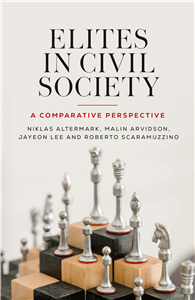
More Information
Rights Information
Albania, Algeria, Angola, Argentina, Armenia, Australia, Austria, Bahrain, Belgium, Belize, Benin, Bolivia, Bosnia and Herzegovina, Botswana, Brazil, Bulgaria, Burkina Faso, Burundi, Cameroon, Canada, Cape Verde, Central African Republic, Chad, Chile, China, Colombia, Comoros, Congo [DRC], Congo, Republic of the, Costa Rica, Ivory Coast, Croatia, Czech Republic, Denmark, Djibouti, Ecuador, Egypt, El Salvador, Equatorial Guinea, Eritrea, Estonia, Ethiopia, Faroe Islands, Finland, France, French Guiana, Gabon, Gambia, Georgia, Germany, Ghana, Greece, Guatemala, Guinea, Guinea-Bissau, Guyana, Honduras, Hongkong, Hungary, Iceland, India, Indonesia, Iran, Iraq, Ireland, Israel, Italy, Japan, Jordan, Kazakhstan, Kenya, Kuwait, Latvia, Lebanon, Lesotho, Liberia, Libya, Lithuania, Luxembourg, Macau, China, Macedonia [FYROM], Madagascar, Malawi, Malaysia, Mali, Malta, Mauritania, Mauritius, Mayotte, Mexico, Mongolia, Montenegro, Morocco, Mozambique, Namibia, Netherlands, New Zealand, Nicaragua, Niger, Nigeria, Norway, Oman, Pakistan, Panama, Paraguay, Peru, Philippines, Poland, Portugal, Puerto Rico, Qatar, Reunion, Romania, Russia, Rwanda, Saint Helena, Sao Tome and Principe, Saudi Arabia, Senegal, Serbia, Seychelles, Sierra Leone, Singapore, Slovakia, Slovenia, Somalia, South Africa, South Korea, Spain, Sri Lanka, Sudan, Suriname, Swaziland, Sweden, Switzerland, Syria, Taiwan, Tanzania, Thailand, Timor-Leste, Togo, Tokelau, Tunisia, Turkey, Uganda, Ukraine, United Arab Emirates, United Kingdom, United States, Uruguay, Venezuela, Vietnam, Western Sahara, Yemen, Zambia, Zimbabwe, South Sudan, Cyprus, Palestine, Bangladesh, Cambodia, Liechtenstein, Azerbaijan, Jamaica, Kyrgyzstan, Dominican Republic, Myanmar, Monaco
Endorsements
What characterises a civil society elite? How does this elite emerge and interact with elites from politics and business? With these questions, this book challenges the assumption that civil society is inherently egalitarian and shielded from elite formation. Drawing on unique empirical data and combining elite studies with civil society research, the book investigates civil society elite structures in four countries - Italy, Poland, Sweden and the UK. The patterns of elitisation that emerge reveal that a civil society elite is distinctly different from the general civil society constituency. Patterns also show how the civil society elite is integrated with other elite groups of society. The book explores how these patterns can be linked to the institutional and historical backgrounds of civil society in the four countries. It also looks into how integration in wider elite circles may shape the attitudes of the civil society elite towards representation and inclusion, both central civil society values. While we expect that civil society offers a counterbalance to asymmetries of power in society at large, this book shows that investigating the internal power structures of civil society is essential. It is also important to reflect on the paradox of a civil society elite: while such an elite may contribute to advancing social change, it also risks reproducing inequality by distancing civil society organisations from its grassroots, thereby undermining civil society's democratic promise.
Reviews
What characterises a civil society elite? How does this elite emerge and interact with elites from politics and business? With these questions, this book challenges the assumption that civil society is inherently egalitarian and shielded from elite formation. Drawing on unique empirical data and combining elite studies with civil society research, the book investigates civil society elite structures in four countries - Italy, Poland, Sweden and the UK. The patterns of elitisation that emerge reveal that a civil society elite is distinctly different from the general civil society constituency. Patterns also show how the civil society elite is integrated with other elite groups of society. The book explores how these patterns can be linked to the institutional and historical backgrounds of civil society in the four countries. It also looks into how integration in wider elite circles may shape the attitudes of the civil society elite towards representation and inclusion, both central civil society values. While we expect that civil society offers a counterbalance to asymmetries of power in society at large, this book shows that investigating the internal power structures of civil society is essential. It is also important to reflect on the paradox of a civil society elite: while such an elite may contribute to advancing social change, it also risks reproducing inequality by distancing civil society organisations from its grassroots, thereby undermining civil society's democratic promise.
Author Biography
Niklas Altermark is Associate Professor of Political Science at Lund University, Sweden Malin Arvidson is Associate Professor of Social Work at Lund University, Sweden Jayeon Lee is Senior Lecturer in Social Work, Gothenburg University, Sweden Roberto Scaramuzzino is Associate Professor of Social Work at Lund University, Sweden All authors are well published in reputable journals such as Journal of civil society, Voluntary Sector Review, Comparative Migration Studies, Disability & Society, Sociology of Health and Illness and have published books for Routledge, Palgrave, amongst others.
 Trusted Partner

Manchester University Press
Manchester University Press is a leading UK publisher known for excellent research in the humanities and social sciences.
View all titlesBibliographic Information
- Publisher Manchester University Press
- Publication Date April 2026
- Orginal LanguageEnglish
- ISBN/Identifier 9781526191656 / 1526191652
- Publication Country or regionUnited Kingdom
- FormatPrint PDF
- Pages224
- ReadershipCollege/higher education; Professional and scholarly
- Publish StatusPublished
- Dimensions198 X 129 mm
- Biblio NotesDerived from Proprietary 6423
- Reference Code17243
Thank you for proceeding with this offer.
Manchester University Press has chosen to review this offer before it proceeds.
You will receive an email update that will bring you back to complete the process.
You can also check the status in the My Offers area
Manchester University Press has chosen to review this offer before it proceeds.
You will receive an email update that will bring you back to complete the process.
You can also check the status in the My Offers area

Please wait while the payment is being prepared.
Do not close this window.

(c) Copyright 2026 - Frankfurter Buchmesse GmbH. All Right Reserved