
Humanities & Social Sciences
Description
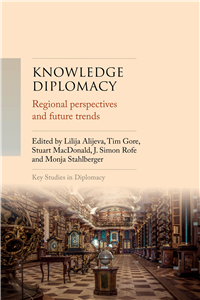
Knowledge Diplomacy examines particular and cultural antecedents to the development of the field; and its predominance in western thinking and critiques. Crucially, it does so not just from the perspective of scholars but also by consciously drawing on the perspectives of practitioners.
The development of Knowledge Diplomacy allows for increased understanding of the role of research, innovation and higher education institutions as actors in international relations; shaping knowledge as they do.
As such Knowledge Diplomacy presents a meaningful means of understanding how understanding knowledge impacts scholars, students and decisions makers as those who use knowledge in their practice.
More Information
Rights Information
Albania, Algeria, Angola, Argentina, Armenia, Australia, Austria, Bahrain, Belgium, Belize, Benin, Bolivia, Bosnia and Herzegovina, Botswana, Brazil, Bulgaria, Burkina Faso, Burundi, Cameroon, Canada, Cape Verde, Central African Republic, Chad, Chile, China, Colombia, Comoros, Congo [DRC], Congo, Republic of the, Costa Rica, Ivory Coast, Croatia, Czech Republic, Denmark, Djibouti, Ecuador, Egypt, El Salvador, Equatorial Guinea, Eritrea, Estonia, Ethiopia, Faroe Islands, Finland, France, French Guiana, Gabon, Gambia, Georgia, Germany, Ghana, Greece, Guatemala, Guinea, Guinea-Bissau, Guyana, Honduras, Hongkong, Hungary, Iceland, India, Indonesia, Iran, Iraq, Ireland, Israel, Italy, Japan, Jordan, Kazakhstan, Kenya, Kuwait, Latvia, Lebanon, Lesotho, Liberia, Libya, Lithuania, Luxembourg, Macau, China, Macedonia [FYROM], Madagascar, Malawi, Malaysia, Mali, Malta, Mauritania, Mauritius, Mayotte, Mexico, Mongolia, Montenegro, Morocco, Mozambique, Namibia, Netherlands, New Zealand, Nicaragua, Niger, Nigeria, Norway, Oman, Pakistan, Panama, Paraguay, Peru, Philippines, Poland, Portugal, Puerto Rico, Qatar, Reunion, Romania, Russia, Rwanda, Saint Helena, Sao Tome and Principe, Saudi Arabia, Senegal, Serbia, Seychelles, Sierra Leone, Singapore, Slovakia, Slovenia, Somalia, South Africa, South Korea, Spain, Sri Lanka, Sudan, Suriname, Swaziland, Sweden, Switzerland, Syria, Taiwan, Tanzania, Thailand, Timor-Leste, Togo, Tokelau, Tunisia, Turkey, Uganda, Ukraine, United Arab Emirates, United Kingdom, United States, Uruguay, Venezuela, Vietnam, Western Sahara, Yemen, Zambia, Zimbabwe, South Sudan, Cyprus, Palestine, Bangladesh, Cambodia, Liechtenstein, Azerbaijan, Jamaica, Kyrgyzstan, Dominican Republic, Myanmar, Monaco
Endorsements
Through knowledge diplomacy we can achieve so much, and the authors infect the readers with their confidence and commitment. This book has truly inspired me! Mary Stiasny, Pro Vice Chancellor Emerita, University of London This book reminds us that universities and research communities are key actors in addressing global challenges. A must-read for those committed to education's role in international cooperation. Martha Flor Puebla Mora, University of Guadalajara In our current times of geopolitical turmoil, knowledge diplomacy is increasingly important. This volume provides an essential resource for those engaging with the theory of knowledge diplomacy and those putting it into action in the world. The rich debate in these pages over the concept of knowledge diplomacy and the keen insights into application will support the work of researchers working to further the academic field. Practitioners attempting to hone knowledge diplomacy into a global force for mutual understanding, productive negotiation, and collaborative change-making will also find this book invaluable. Professor Jane Norman, President and Vice Chancellor, University of Nottingham Knowledge Diplomacy addresses the development of the field of study and practice of knowledge diplomacy. It captures the emerging field of Knowledge Diplomacy at a key juncture due to its resonance in addressing contemporary a range geopolitical crises. It provides a foundational study exploring theory and practice; and regional perspectives, before offering thoughts for the future of knowledge diplomacy discourse. The volume establishes its theoretical foundations including a blend of practitioner and scholar perspectives with chapters addressing the experiences of the University of London by Alijeva & Rofe; the relationship with International Relations theory from Alex Lake; then knowledge diplomacy and power in Cogan and Scott's work. Jane Knight's contributes an exploration of the relationship with other forms of diplomacy and soft power, while El Masry explores knowledge diplomacy's role in foreign policy. The second principle section of the book explores contending perspectives of knowledge diplomacy reflecting not only different geographic locations but also differing practitioner and scholarly outlooks. Lüdert offers the view from the German Center for Research and Innovation, before Varpahovskis looks at the South Korean case, and Corcoran how Western perspectives run through knowledge diplomacy in Asia; Pradhan examines the application in Singalila; and Loera-Gonzalez in Mexican diplomacy. The book draws to a close with reflections on the value of knowledge diplomacy at this juncture in global affairs and outlines for a future research agenda to add to, and potentially contest, the concepts and perspectives this book presents.
Reviews
Through knowledge diplomacy we can achieve so much, and the authors infect the readers with their confidence and commitment. This book has truly inspired me! Mary Stiasny, Pro Vice Chancellor Emerita, University of London This book reminds us that universities and research communities are key actors in addressing global challenges. A must-read for those committed to education's role in international cooperation. Martha Flor Puebla Mora, University of Guadalajara In our current times of geopolitical turmoil, knowledge diplomacy is increasingly important. This volume provides an essential resource for those engaging with the theory of knowledge diplomacy and those putting it into action in the world. The rich debate in these pages over the concept of knowledge diplomacy and the keen insights into application will support the work of researchers working to further the academic field. Practitioners attempting to hone knowledge diplomacy into a global force for mutual understanding, productive negotiation, and collaborative change-making will also find this book invaluable. Professor Jane Norman, President and Vice Chancellor, University of Nottingham Knowledge Diplomacy addresses the development of the field of study and practice of knowledge diplomacy. It captures the emerging field of Knowledge Diplomacy at a key juncture due to its resonance in addressing contemporary a range geopolitical crises. It provides a foundational study exploring theory and practice; and regional perspectives, before offering thoughts for the future of knowledge diplomacy discourse. The volume establishes its theoretical foundations including a blend of practitioner and scholar perspectives with chapters addressing the experiences of the University of London by Alijeva & Rofe; the relationship with International Relations theory from Alex Lake; then knowledge diplomacy and power in Cogan and Scott's work. Jane Knight's contributes an exploration of the relationship with other forms of diplomacy and soft power, while El Masry explores knowledge diplomacy's role in foreign policy. The second principle section of the book explores contending perspectives of knowledge diplomacy reflecting not only different geographic locations but also differing practitioner and scholarly outlooks. Lüdert offers the view from the German Center for Research and Innovation, before Varpahovskis looks at the South Korean case, and Corcoran how Western perspectives run through knowledge diplomacy in Asia; Pradhan examines the application in Singalila; and Loera-Gonzalez in Mexican diplomacy. The book draws to a close with reflections on the value of knowledge diplomacy at this juncture in global affairs and outlines for a future research agenda to add to, and potentially contest, the concepts and perspectives this book presents.
Author Biography
Lilija Alijeva, University of London Institute in Paris Linda Amrane-Cooper, Centre for Online and Distance Education, University of London Tim Gore, University of London Institute in Paris Alexander Lake, University of London Institute in Paris Stuart MacDonald, ICR Research J Simon Rofe, University of Leeds & Centre for Online and Distance Education, University of London
 Trusted Partner

Manchester University Press
Manchester University Press is a leading UK publisher known for excellent research in the humanities and social sciences.
View all titlesBibliographic Information
- Publisher Manchester University Press
- Publication Date June 2026
- Orginal LanguageEnglish
- ISBN/Identifier 9781526189967 / 1526189968
- Publication Country or regionUnited Kingdom
- FormatPrint PDF
- Pages208
- ReadershipCollege/higher education; Professional and scholarly
- Publish StatusPublished
- Dimensions234 X 156 mm
- Biblio NotesDerived from Proprietary 6456
- SeriesKey Studies in Diplomacy
- Reference Code17383
Thank you for proceeding with this offer.
Manchester University Press has chosen to review this offer before it proceeds.
You will receive an email update that will bring you back to complete the process.
You can also check the status in the My Offers area
Manchester University Press has chosen to review this offer before it proceeds.
You will receive an email update that will bring you back to complete the process.
You can also check the status in the My Offers area

Please wait while the payment is being prepared.
Do not close this window.

(c) Copyright 2026 - Frankfurter Buchmesse GmbH. All Right Reserved