
Humanities & Social Sciences
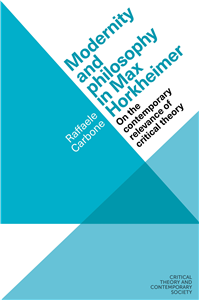
Modernity and philosophy in Max Horkheimer
On the contemporary relevance of critical theory
by Raffaele Carbone
Description
This book shows that Max Horkheimer's program of critical theory and his research throughout his career as a university professor and thinker are rooted in the cogency of philosophical questions and an in-depth knowledge of the historical development of philosophical problems in their close correlation with the socio-economic framework which shaped the 'bourgeois society' and the Modern Era. Indeed, his analyses of modern philosophers allows us to understand how the bourgeoisie seeks legitimisation and consolidation of its position, partly through the voices of its thinkers. In this way, in his investigation of early modern philosophy problems, and through constant dialogue with his colleagues Adorno, Marcuse, Pollock and Fromm, Horkheimer expresses a profound awareness of the critical force inherent in thought which, admittedly, is ever vulnerable to crisis and weakening, but which can always be reactivated.
More Information
Rights Information
Albania, Algeria, Angola, Argentina, Armenia, Australia, Austria, Bahrain, Belgium, Belize, Benin, Bolivia, Bosnia and Herzegovina, Botswana, Brazil, Bulgaria, Burkina Faso, Burundi, Cameroon, Canada, Cape Verde, Central African Republic, Chad, Chile, China, Colombia, Comoros, Congo [DRC], Congo, Republic of the, Costa Rica, Ivory Coast, Croatia, Czech Republic, Denmark, Djibouti, Ecuador, Egypt, El Salvador, Equatorial Guinea, Eritrea, Estonia, Ethiopia, Faroe Islands, Finland, France, French Guiana, Gabon, Gambia, Georgia, Germany, Ghana, Greece, Guatemala, Guinea, Guinea-Bissau, Guyana, Honduras, Hongkong, Hungary, Iceland, India, Indonesia, Iran, Iraq, Ireland, Israel, Italy, Japan, Jordan, Kazakhstan, Kenya, Kuwait, Latvia, Lebanon, Lesotho, Liberia, Libya, Lithuania, Luxembourg, Macau, China, Macedonia [FYROM], Madagascar, Malawi, Malaysia, Mali, Malta, Mauritania, Mauritius, Mayotte, Mexico, Mongolia, Montenegro, Morocco, Mozambique, Namibia, Netherlands, New Zealand, Nicaragua, Niger, Nigeria, Norway, Oman, Pakistan, Panama, Paraguay, Peru, Philippines, Poland, Portugal, Puerto Rico, Qatar, Reunion, Romania, Russia, Rwanda, Saint Helena, Sao Tome and Principe, Saudi Arabia, Senegal, Serbia, Seychelles, Sierra Leone, Singapore, Slovakia, Slovenia, Somalia, South Africa, South Korea, Spain, Sri Lanka, Sudan, Suriname, Swaziland, Sweden, Switzerland, Syria, Taiwan, Tanzania, Thailand, Timor-Leste, Togo, Tokelau, Tunisia, Turkey, Uganda, Ukraine, United Arab Emirates, United Kingdom, United States, Uruguay, Venezuela, Vietnam, Western Sahara, Yemen, Zambia, Zimbabwe, South Sudan, Cyprus, Palestine, Bangladesh, Cambodia, Liechtenstein, Azerbaijan, Jamaica, Kyrgyzstan, Dominican Republic, Myanmar, Monaco
Endorsements
The importance of the Frankfurt School in shaping the philosophical foundations of the social sciences-particularly its critique of positivism and its engagement with authority, emancipation and recognition-is well established. More recently, scholars have begun to recognise its key role in forming the image contemporary philosophers have of the European past, and how this image informs their analysis of the contemporary world. This book shows that Max Horkheimer's programme of critical theory, and his lifelong work as a university professor and thinker, are grounded in the force of philosophical questioning and a deep understanding of the historical development of philosophical problems. These problems are closely related to the socio-economic framework that shaped the 'bourgeois society' and the Modern Era. His readings of modern philosophers reveal how the bourgeoisie sought to legitimise and consolidate its position, partly through the voices of its thinkers. Through his investigation of early modern philosophy and ongoing dialogue with colleagues such as Adorno, Marcuse, Pollock and Fromm, Horkheimer demonstrates a profound awareness of the critical force inherent in thought. Though this force is always vulnerable to crisis and decline, it can be reactivated. The book delineates how Horkheimer's work continues to offer valuable insights into the philosophical and social challenges of the contemporary world.
Reviews
The importance of the Frankfurt School in shaping the philosophical foundations of the social sciences-particularly its critique of positivism and its engagement with authority, emancipation and recognition-is well established. More recently, scholars have begun to recognise its key role in forming the image contemporary philosophers have of the European past, and how this image informs their analysis of the contemporary world. This book shows that Max Horkheimer's programme of critical theory, and his lifelong work as a university professor and thinker, are grounded in the force of philosophical questioning and a deep understanding of the historical development of philosophical problems. These problems are closely related to the socio-economic framework that shaped the 'bourgeois society' and the Modern Era. His readings of modern philosophers reveal how the bourgeoisie sought to legitimise and consolidate its position, partly through the voices of its thinkers. Through his investigation of early modern philosophy and ongoing dialogue with colleagues such as Adorno, Marcuse, Pollock and Fromm, Horkheimer demonstrates a profound awareness of the critical force inherent in thought. Though this force is always vulnerable to crisis and decline, it can be reactivated. The book delineates how Horkheimer's work continues to offer valuable insights into the philosophical and social challenges of the contemporary world.
Author Biography
Raffaele Carbone is Professor of History of Philosophy at the Federico University of Naples
 Trusted Partner

Manchester University Press
Manchester University Press is a leading UK publisher known for excellent research in the humanities and social sciences.
View all titlesBibliographic Information
- Publisher Manchester University Press
- Publication Date July 2026
- Orginal LanguageEnglish
- ISBN/Identifier 9781807070311 / 180707031X
- Publication Country or regionUnited Kingdom
- FormatPrint PDF
- Pages320
- ReadershipGeneral/trade; College/higher education; Professional and scholarly
- Publish StatusPublished
- Dimensions234 X 156 mm
- Biblio NotesDerived from Proprietary 6760
- SeriesCritical Theory and Contemporary Society
- Reference Code18550
Thank you for proceeding with this offer.
Manchester University Press has chosen to review this offer before it proceeds.
You will receive an email update that will bring you back to complete the process.
You can also check the status in the My Offers area
Manchester University Press has chosen to review this offer before it proceeds.
You will receive an email update that will bring you back to complete the process.
You can also check the status in the My Offers area

Please wait while the payment is being prepared.
Do not close this window.

(c) Copyright 2026 - Frankfurter Buchmesse GmbH. All Right Reserved