
Humanities & Social Sciences
Revolutionary anxieties
Defending privilege in the wake of the 2011 Egyptian Revolution
by Liina Mustonen
Description
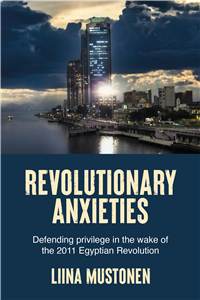
Revolutionary anxieties sheds light on an unexplored dimension of the 2011 Egyptian revolution: the anxieties experienced by Cairo-based liberal elite, socialites, and cultural actors who opposed the rise of the new political actors, the Muslim Brotherhood. This book provides fresh insights into the failure of the Egyptian revolution by examining the perspectives of those who had a vested interest in maintaining the status-quo. It engages with post-colonial theory and examines the elite milieu in Cairo through the lenses of gender and race. Based on over two years of ethnographic research in various elite locations such as the Cairo Opera House, an Egyptian-European film festival, and an elite sporting club in Cairo, the book illustrates how members of Egyptian liberal upper class insisted on their privilege in a moment when the country's class hierarchies were challenged. By revealing the prevalence of counter-revolutionary sentiment among Cairo's liberal and affluent elite, the book tells an untold story of the Arab Spring.
More Information
Rights Information
Albania, Algeria, Angola, Argentina, Armenia, Australia, Austria, Bahrain, Belgium, Belize, Benin, Bolivia, Bosnia and Herzegovina, Botswana, Brazil, Bulgaria, Burkina Faso, Burundi, Cameroon, Canada, Cape Verde, Central African Republic, Chad, Chile, China, Colombia, Comoros, Congo [DRC], Congo, Republic of the, Costa Rica, Ivory Coast, Croatia, Czech Republic, Denmark, Djibouti, Ecuador, Egypt, El Salvador, Equatorial Guinea, Eritrea, Estonia, Ethiopia, Faroe Islands, Finland, France, French Guiana, Gabon, Gambia, Georgia, Germany, Ghana, Greece, Guatemala, Guinea, Guinea-Bissau, Guyana, Honduras, Hongkong, Hungary, Iceland, India, Indonesia, Iran, Iraq, Ireland, Israel, Italy, Japan, Jordan, Kazakhstan, Kenya, Kuwait, Latvia, Lebanon, Lesotho, Liberia, Libya, Lithuania, Luxembourg, Macau, China, Macedonia [FYROM], Madagascar, Malawi, Malaysia, Mali, Malta, Mauritania, Mauritius, Mayotte, Mexico, Mongolia, Montenegro, Morocco, Mozambique, Namibia, Netherlands, New Zealand, Nicaragua, Niger, Nigeria, Norway, Oman, Pakistan, Panama, Paraguay, Peru, Philippines, Poland, Portugal, Puerto Rico, Qatar, Reunion, Romania, Russia, Rwanda, Saint Helena, Sao Tome and Principe, Saudi Arabia, Senegal, Serbia, Seychelles, Sierra Leone, Singapore, Slovakia, Slovenia, Somalia, South Africa, South Korea, Spain, Sri Lanka, Sudan, Suriname, Swaziland, Sweden, Switzerland, Syria, Taiwan, Tanzania, Thailand, Timor-Leste, Togo, Tokelau, Tunisia, Turkey, Uganda, Ukraine, United Arab Emirates, United Kingdom, United States, Uruguay, Venezuela, Vietnam, Western Sahara, Yemen, Zambia, Zimbabwe, South Sudan, Cyprus, Palestine, Bangladesh, Cambodia, Liechtenstein, Azerbaijan, Jamaica, Kyrgyzstan, Dominican Republic, Myanmar, Monaco
Endorsements
Revolutionary Anxieties studies the role of the liberal elite during the Egyptian transitional period (2011-2014). It shows how the election of the Islamists caused anxiety among the liberal and cultural elites that constituted Cairo's exclusive society. The book examines their relationship with other Egyptians-those who were not part of Cairo's exclusive society, including their servants, the city's poor, and members of Islamist parties. It further illustrates how the narratives of "others" relied on dichotomies such as "ugly versus beautiful" and "civilized versus uncivilized," familiar to scholars from the colonial era. The book also shows how, during the transitional period, Cairo's liberal elite attempted to assert their superiority in various fields. Performative practices related to gender, culture, and art; etiquette and manners; the use of foreign languages; and knowledge of Egyptian history all manifested the cultural capital of the liberal elite. One purpose of this book is to explore the uses of the past in legitimizing and reinventing current cultural and socio-political asymmetries. Throughout, I demonstrate how access to narratives of Egypt's past-understood as "liberal" and "civilized"-functioned as a critical resource for the elite who opposed the new Islamist rulers. The insistence on Egypt's true "civilized" character, which was seen as endangered by the Islamists, was closely tied to political calculations.
Reviews
Revolutionary Anxieties studies the role of the liberal elite during the Egyptian transitional period (2011-2014). It shows how the election of the Islamists caused anxiety among the liberal and cultural elites that constituted Cairo's exclusive society. The book examines their relationship with other Egyptians-those who were not part of Cairo's exclusive society, including their servants, the city's poor, and members of Islamist parties. It further illustrates how the narratives of "others" relied on dichotomies such as "ugly versus beautiful" and "civilized versus uncivilized," familiar to scholars from the colonial era. The book also shows how, during the transitional period, Cairo's liberal elite attempted to assert their superiority in various fields. Performative practices related to gender, culture, and art; etiquette and manners; the use of foreign languages; and knowledge of Egyptian history all manifested the cultural capital of the liberal elite. One purpose of this book is to explore the uses of the past in legitimizing and reinventing current cultural and socio-political asymmetries. Throughout, I demonstrate how access to narratives of Egypt's past-understood as "liberal" and "civilized"-functioned as a critical resource for the elite who opposed the new Islamist rulers. The insistence on Egypt's true "civilized" character, which was seen as endangered by the Islamists, was closely tied to political calculations.
Author Biography
Liina Mustonen is a researcher at the Centre for Research on Ethnic Relations and Nationalism (CEREN), University of Helsinki
 Trusted Partner

Manchester University Press
Manchester University Press is a leading UK publisher known for excellent research in the humanities and social sciences.
View all titlesBibliographic Information
- Publisher Manchester University Press
- Publication Date March 2026
- Orginal LanguageEnglish
- ISBN/Identifier 9781526187673 / 1526187671
- Publication Country or regionUnited Kingdom
- FormatPrint PDF
- Pages216
- ReadershipGeneral/trade; College/higher education; Professional and scholarly
- Publish StatusPublished
- Dimensions234 X 156 mm
- Biblio NotesDerived from Proprietary 6455
- Reference Code17380
Thank you for proceeding with this offer.
Manchester University Press has chosen to review this offer before it proceeds.
You will receive an email update that will bring you back to complete the process.
You can also check the status in the My Offers area
Manchester University Press has chosen to review this offer before it proceeds.
You will receive an email update that will bring you back to complete the process.
You can also check the status in the My Offers area

Please wait while the payment is being prepared.
Do not close this window.

(c) Copyright 2026 - Frankfurter Buchmesse GmbH. All Right Reserved