
Description
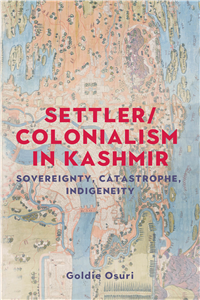
Sovereignty, catastrophe, Indigeneity examines Indian rule in occupied Jammu and Kashmir through settler/colonial geopolitics. Engaging with settler colonial, decolonial and Indigenous studies, the book explores how European sovereignty was shaped by settler/colonialism. Settler/colonialism was catastrophic for Indigenous worlds and generated the climate crisis. The book explores how India draws on settler/colonialism's catastrophic mechanisms to rule Kashmir, thus fuelling the climate crisis and participating in the geopolitical settler/colonial world order. Sites of analysis include the India China rivalry, Kashmir's political economy, and India's indigenisation of its Hindu sacred geography in Kashmir. Through this exploration, the author argues for asserting Kashmiri resistance as an Indigenous anti-colonial struggle. The intersections between sovereignty, catastrophe, Indigeneity, and ecology, illuminate Kashmir's place in the geopolitical settler/colonial world order. The book contributes to timely debates regarding settler/colonialism and planetary crises.
More Information
Rights Information
Albania, Algeria, Angola, Argentina, Armenia, Australia, Austria, Bahrain, Belgium, Belize, Benin, Bolivia, Bosnia and Herzegovina, Botswana, Brazil, Bulgaria, Burkina Faso, Burundi, Cameroon, Canada, Cape Verde, Central African Republic, Chad, Chile, China, Colombia, Comoros, Congo [DRC], Congo, Republic of the, Costa Rica, Ivory Coast, Croatia, Czech Republic, Denmark, Djibouti, Ecuador, Egypt, El Salvador, Equatorial Guinea, Eritrea, Estonia, Ethiopia, Faroe Islands, Finland, France, French Guiana, Gabon, Gambia, Georgia, Germany, Ghana, Greece, Guatemala, Guinea, Guinea-Bissau, Guyana, Honduras, Hongkong, Hungary, Iceland, India, Indonesia, Iran, Iraq, Ireland, Israel, Italy, Japan, Jordan, Kazakhstan, Kenya, Kuwait, Latvia, Lebanon, Lesotho, Liberia, Libya, Lithuania, Luxembourg, Macau, China, Macedonia [FYROM], Madagascar, Malawi, Malaysia, Mali, Malta, Mauritania, Mauritius, Mayotte, Mexico, Mongolia, Montenegro, Morocco, Mozambique, Namibia, Netherlands, New Zealand, Nicaragua, Niger, Nigeria, Norway, Oman, Pakistan, Panama, Paraguay, Peru, Philippines, Poland, Portugal, Puerto Rico, Qatar, Reunion, Romania, Russia, Rwanda, Saint Helena, Sao Tome and Principe, Saudi Arabia, Senegal, Serbia, Seychelles, Sierra Leone, Singapore, Slovakia, Slovenia, Somalia, South Africa, South Korea, Spain, Sri Lanka, Sudan, Suriname, Swaziland, Sweden, Switzerland, Syria, Taiwan, Tanzania, Thailand, Timor-Leste, Togo, Tokelau, Tunisia, Turkey, Uganda, Ukraine, United Arab Emirates, United Kingdom, United States, Uruguay, Venezuela, Vietnam, Western Sahara, Yemen, Zambia, Zimbabwe, South Sudan, Cyprus, Palestine, Bangladesh, Cambodia, Liechtenstein, Azerbaijan, Jamaica, Kyrgyzstan, Dominican Republic, Myanmar, Monaco
Endorsements
In 2019, the Indian government annexed Indian-occupied Kashmir and revoked its semi-autonomous status. India's subsequent changes to Kashmir's land and domicile laws enabling its settler/colonialism in Kashmir has prompted a settler/colonial turn in recent scholarly analyses within Critical Kashmir Studies. Widening this canvas in conversation with settler/colonial, decolonial and Indigenous Studies, this book examines Indian settler/colonial rule in Kashmir in the context of the global settler/colonial world order. It theorises the historical shaping of European settler/colonial sovereignty as catastrophic for Indigenous worlds, and how this form of sovereignty informs Indian rule in Kashmir. By exploring historical British and present Indian indirect and direct rule, the book traces the ways in which Kashmir was reshaped through settler/colonial sovereignty as a catastrophe in geopolitical, economic, religio-cultural and ecological terms. Examining Indian rule in Kashmir in the context of a destructive geopolitical settler/colonial world order, Settler/colonialism in Kashmir offers a cogent anti-colonial analysis as a contribution to current scholarship on Kashmir in the context of Critical Kashmir, settler/colonial, Indigenous, decolonial and South Asian Studies. Its focus on the intersections of sovereignty, catastrophe, Indigeneity and ecology offers a timely and pressing contribution to ongoing debates about the role of settler/colonialism in shaping planetary crises.
Reviews
In 2019, the Indian government annexed Indian-occupied Kashmir and revoked its semi-autonomous status. India's subsequent changes to Kashmir's land and domicile laws enabling its settler/colonialism in Kashmir has prompted a settler/colonial turn in recent scholarly analyses within Critical Kashmir Studies. Widening this canvas in conversation with settler/colonial, decolonial and Indigenous Studies, this book examines Indian settler/colonial rule in Kashmir in the context of the global settler/colonial world order. It theorises the historical shaping of European settler/colonial sovereignty as catastrophic for Indigenous worlds, and how this form of sovereignty informs Indian rule in Kashmir. By exploring historical British and present Indian indirect and direct rule, the book traces the ways in which Kashmir was reshaped through settler/colonial sovereignty as a catastrophe in geopolitical, economic, religio-cultural and ecological terms. Examining Indian rule in Kashmir in the context of a destructive geopolitical settler/colonial world order, Settler/colonialism in Kashmir offers a cogent anti-colonial analysis as a contribution to current scholarship on Kashmir in the context of Critical Kashmir, settler/colonial, Indigenous, decolonial and South Asian Studies. Its focus on the intersections of sovereignty, catastrophe, Indigeneity and ecology offers a timely and pressing contribution to ongoing debates about the role of settler/colonialism in shaping planetary crises.
Author Biography
Goldie Osuri is Professor of Sociology at the University of Warwick
 Trusted Partner

Manchester University Press
Manchester University Press is a leading UK publisher known for excellent research in the humanities and social sciences.
View all titlesBibliographic Information
- Publisher Manchester University Press
- Publication Date April 2026
- Orginal LanguageEnglish
- ISBN/Identifier 9781526196064 / 1526196069
- Publication Country or regionUnited Kingdom
- FormatPrint PDF
- Pages232
- ReadershipGeneral/trade; College/higher education; Professional and scholarly
- Publish StatusPublished
- Dimensions234 X 156 mm
- Biblio NotesDerived from Proprietary 6709
- Reference Code18350
Thank you for proceeding with this offer.
Manchester University Press has chosen to review this offer before it proceeds.
You will receive an email update that will bring you back to complete the process.
You can also check the status in the My Offers area
Manchester University Press has chosen to review this offer before it proceeds.
You will receive an email update that will bring you back to complete the process.
You can also check the status in the My Offers area

Please wait while the payment is being prepared.
Do not close this window.

(c) Copyright 2026 - Frankfurter Buchmesse GmbH. All Right Reserved