
Humanities & Social Sciences
Description
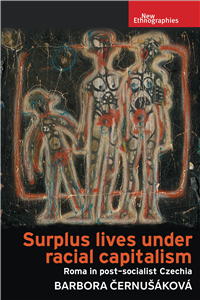
Surplus lives under racial capitalism is a critical contribution to the study of racial capitalism. It theorises the link between political economy, anti-Roma racism and modern forms of white supremacy in East Central Europe. The book shows how the introduction of capitalism in the 1990s overlapped with the rise of racialised disposability of Roma workers. Since then, their surplusing recurrently comes into sharp relief during the time of crisis. Surplus lives under racial capitalism is built on an investigation of how race and class structure the Czech labour regime and how they form a single site of struggle. One which binds workers across racialised divisions as surplusing continuously expands.
More Information
Rights Information
Albania, Algeria, Angola, Argentina, Armenia, Australia, Austria, Bahrain, Belgium, Belize, Benin, Bolivia, Bosnia and Herzegovina, Botswana, Brazil, Bulgaria, Burkina Faso, Burundi, Cameroon, Canada, Cape Verde, Central African Republic, Chad, Chile, China, Colombia, Comoros, Congo [DRC], Congo, Republic of the, Costa Rica, Ivory Coast, Croatia, Czech Republic, Denmark, Djibouti, Ecuador, Egypt, El Salvador, Equatorial Guinea, Eritrea, Estonia, Ethiopia, Faroe Islands, Finland, France, French Guiana, Gabon, Gambia, Georgia, Germany, Ghana, Greece, Guatemala, Guinea, Guinea-Bissau, Guyana, Honduras, Hongkong, Hungary, Iceland, India, Indonesia, Iran, Iraq, Ireland, Israel, Italy, Japan, Jordan, Kazakhstan, Kenya, Kuwait, Latvia, Lebanon, Lesotho, Liberia, Libya, Lithuania, Luxembourg, Macau, China, Macedonia [FYROM], Madagascar, Malawi, Malaysia, Mali, Malta, Mauritania, Mauritius, Mayotte, Mexico, Mongolia, Montenegro, Morocco, Mozambique, Namibia, Netherlands, New Zealand, Nicaragua, Niger, Nigeria, Norway, Oman, Pakistan, Panama, Paraguay, Peru, Philippines, Poland, Portugal, Puerto Rico, Qatar, Reunion, Romania, Russia, Rwanda, Saint Helena, Sao Tome and Principe, Saudi Arabia, Senegal, Serbia, Seychelles, Sierra Leone, Singapore, Slovakia, Slovenia, Somalia, South Africa, South Korea, Spain, Sri Lanka, Sudan, Suriname, Swaziland, Sweden, Switzerland, Syria, Taiwan, Tanzania, Thailand, Timor-Leste, Togo, Tokelau, Tunisia, Turkey, Uganda, Ukraine, United Arab Emirates, United Kingdom, United States, Uruguay, Venezuela, Vietnam, Western Sahara, Yemen, Zambia, Zimbabwe, South Sudan, Cyprus, Palestine, Bangladesh, Cambodia, Liechtenstein, Azerbaijan, Jamaica, Kyrgyzstan, Dominican Republic, Myanmar, Monaco
Endorsements
'Quite simply, this book is extraordinary. The text is coherent, theoretically and analytically rich, and above all, readable. The theoretical grounding for the book is complex, but the author unpacks her main arguments about racial capitalism and surplus populations lucidly and in an understandable manner.' - Bernadette Nadya Jaworsky, Masaryk University, Czech Republic 'This book forcefully re-centres race and class in East-Central European and post-socialist scholarship. By bridging Marxian accounts of reserve armies of labour with theories of racial capitalism, Cernusáková provides a crucial lens on contemporary capitalist racialisation and the Roma question.' - Sara Farris, Goldsmiths University of London Surplus lives under racial capitalism explores race and class in East Central Europe. It reveals how the introduction of capitalism in the 1990s coincided with the rise of racialised disposability among Roma workers. For Roma, the end of 'communism' in Czechia signified more than privatisation, market reforms and workforce reorganisation. These shifts in political economy intertwined with a complex restructuring of everyday life, confining Roma to restricted spaces for living and working. Focusing on housing, labour and household finance, the book exposes the mechanisms through which state and capital discipline Roma workers - and labour as a whole. While anti-Roma stigmatisation and violence have long existed in East Central Europe, their functions have shifted across social formations: feudal, state socialist and capitalist. This book examines the latest phase, showing how Roma workers, as a racialised surplus population, remain invisible, precarious and the first to be cast aside in times of crisis. A contribution to the study of racial capitalism, the book investigates how political economy, anti-Roma racism and white supremacy intersect in East Central Europe. It demonstrates how race and class continue to structure the Czech labour regime - forming a single, contested site of struggle.
Reviews
'Quite simply, this book is extraordinary. The text is coherent, theoretically and analytically rich, and above all, readable. The theoretical grounding for the book is complex, but the author unpacks her main arguments about racial capitalism and surplus populations lucidly and in an understandable manner.' - Bernadette Nadya Jaworsky, Masaryk University, Czech Republic 'This book forcefully re-centres race and class in East-Central European and post-socialist scholarship. By bridging Marxian accounts of reserve armies of labour with theories of racial capitalism, Cernusáková provides a crucial lens on contemporary capitalist racialisation and the Roma question.' - Sara Farris, Goldsmiths University of London Surplus lives under racial capitalism explores race and class in East Central Europe. It reveals how the introduction of capitalism in the 1990s coincided with the rise of racialised disposability among Roma workers. For Roma, the end of 'communism' in Czechia signified more than privatisation, market reforms and workforce reorganisation. These shifts in political economy intertwined with a complex restructuring of everyday life, confining Roma to restricted spaces for living and working. Focusing on housing, labour and household finance, the book exposes the mechanisms through which state and capital discipline Roma workers - and labour as a whole. While anti-Roma stigmatisation and violence have long existed in East Central Europe, their functions have shifted across social formations: feudal, state socialist and capitalist. This book examines the latest phase, showing how Roma workers, as a racialised surplus population, remain invisible, precarious and the first to be cast aside in times of crisis. A contribution to the study of racial capitalism, the book investigates how political economy, anti-Roma racism and white supremacy intersect in East Central Europe. It demonstrates how race and class continue to structure the Czech labour regime - forming a single, contested site of struggle.
Author Biography
Barbora Cernusáková is Hallsworth Fellow at the University of Manchester and a researcher at the University of Ostrava
 Trusted Partner

Manchester University Press
Manchester University Press is a leading UK publisher known for excellent research in the humanities and social sciences.
View all titlesBibliographic Information
- Publisher Manchester University Press
- Publication Date April 2026
- Orginal LanguageEnglish
- ISBN/Identifier 9781526181879 / 1526181878
- Publication Country or regionUnited Kingdom
- FormatPrint PDF
- Pages216
- ReadershipCollege/higher education; Professional and scholarly
- Publish StatusPublished
- Dimensions234 X 156 mm
- Biblio NotesDerived from Proprietary 6312
- SeriesNew Ethnographies
- Reference Code16804
Thank you for proceeding with this offer.
Manchester University Press has chosen to review this offer before it proceeds.
You will receive an email update that will bring you back to complete the process.
You can also check the status in the My Offers area
Manchester University Press has chosen to review this offer before it proceeds.
You will receive an email update that will bring you back to complete the process.
You can also check the status in the My Offers area

Please wait while the payment is being prepared.
Do not close this window.

(c) Copyright 2026 - Frankfurter Buchmesse GmbH. All Right Reserved