
Humanities & Social Sciences
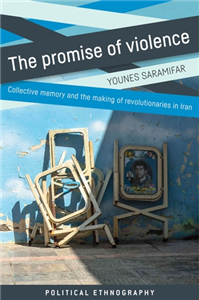
The promise of violence
Collective memory and the making of revolutionaries in Iran
by Younes Saramifar
Description
Revolutionaries in Iran choose to identify memories of the Iran-Iraq War as their 'collective' memory to mark the war era as the temporal reference in history - the time of times, or sometimes even a time beyond time. Can a sole event and its violence truly become - for some - the all-encompassing, constituting element of history and memory? This book pursues this question and follows revolutionaries in the maze of 'collective' memory to offer a temporal account of the breakdown of happenings - as well as the mending of happenings through the force of remembrance.
More Information
Rights Information
Albania, Algeria, Angola, Argentina, Armenia, Australia, Austria, Bahrain, Belgium, Belize, Benin, Bolivia, Bosnia and Herzegovina, Botswana, Brazil, Bulgaria, Burkina Faso, Burundi, Cameroon, Canada, Cape Verde, Central African Republic, Chad, Chile, China, Colombia, Comoros, Congo [DRC], Congo, Republic of the, Costa Rica, Ivory Coast, Croatia, Czech Republic, Denmark, Djibouti, Ecuador, Egypt, El Salvador, Equatorial Guinea, Eritrea, Estonia, Ethiopia, Faroe Islands, Finland, France, French Guiana, Gabon, Gambia, Georgia, Germany, Ghana, Greece, Guatemala, Guinea, Guinea-Bissau, Guyana, Honduras, Hongkong, Hungary, Iceland, India, Indonesia, Iran, Iraq, Ireland, Israel, Italy, Japan, Jordan, Kazakhstan, Kenya, Kuwait, Latvia, Lebanon, Lesotho, Liberia, Libya, Lithuania, Luxembourg, Macau, China, Macedonia [FYROM], Madagascar, Malawi, Malaysia, Mali, Malta, Mauritania, Mauritius, Mayotte, Mexico, Mongolia, Montenegro, Morocco, Mozambique, Namibia, Netherlands, New Zealand, Nicaragua, Niger, Nigeria, Norway, Oman, Pakistan, Panama, Paraguay, Peru, Philippines, Poland, Portugal, Puerto Rico, Qatar, Reunion, Romania, Russia, Rwanda, Saint Helena, Sao Tome and Principe, Saudi Arabia, Senegal, Serbia, Seychelles, Sierra Leone, Singapore, Slovakia, Slovenia, Somalia, South Africa, South Korea, Spain, Sri Lanka, Sudan, Suriname, Swaziland, Sweden, Switzerland, Syria, Taiwan, Tanzania, Thailand, Timor-Leste, Togo, Tokelau, Tunisia, Turkey, Uganda, Ukraine, United Arab Emirates, United Kingdom, United States, Uruguay, Venezuela, Vietnam, Western Sahara, Yemen, Zambia, Zimbabwe, South Sudan, Cyprus, Palestine, Bangladesh, Cambodia, Liechtenstein, Azerbaijan, Jamaica, Kyrgyzstan, Dominican Republic, Myanmar, Monaco
Endorsements
Revolutionary youth in Iran are promised the violence that opens the pathway to martyrdom, salvation, futures, the 'true' fulfilment of Iranian citizenship, and the return of Messiah/Mahdi. The promise turns violence into the conduit of a set of felt relationships, where past, present, and future find meanings and continuity. The promise of violence is the Islamic Republic's yardstick with which to measure the citizenship and commitment of revolutionaries, inducing in them an improved way of being and instilling in them the substance to stand apart from the rest of Iranians, who oppose Islamism and militancy. This book is an ethnography of revolutionaries and Shia militancy, and depicts violence becoming the promissory something that is passed around among revolutionaries to bolster their commitments to Shi'ism, armed 'resistance', and the notion of citizenship per the Islamic Republic. Revolutionaries' political sensibilities, regardless of their age, social class, and generation, are configured in different scales by doing violence in the name of the state that claims to be the place-holder for the Messiah and his last war. The promise of violence is a political anthropology of the Islamic Republic of Iran utilising the 'collective' memory of Iran-Iraq War framed by Shi'ism, Shia Islamism, and its culture of martyrdom to articulate the promise and reticulate revolutionaries in doing violence.
Reviews
Revolutionary youth in Iran are promised the violence that opens the pathway to martyrdom, salvation, futures, the 'true' fulfilment of Iranian citizenship, and the return of Messiah/Mahdi. The promise turns violence into the conduit of a set of felt relationships, where past, present, and future find meanings and continuity. The promise of violence is the Islamic Republic's yardstick with which to measure the citizenship and commitment of revolutionaries, inducing in them an improved way of being and instilling in them the substance to stand apart from the rest of Iranians, who oppose Islamism and militancy. This book is an ethnography of revolutionaries and Shia militancy, and depicts violence becoming the promissory something that is passed around among revolutionaries to bolster their commitments to Shi'ism, armed 'resistance', and the notion of citizenship per the Islamic Republic. Revolutionaries' political sensibilities, regardless of their age, social class, and generation, are configured in different scales by doing violence in the name of the state that claims to be the place-holder for the Messiah and his last war. The promise of violence is a political anthropology of the Islamic Republic of Iran utilising the 'collective' memory of Iran-Iraq War framed by Shi'ism, Shia Islamism, and its culture of martyrdom to articulate the promise and reticulate revolutionaries in doing violence.
Author Biography
Younes Saramifar is an Assistant Professor at Vrije Universiteit Amsterdam
 Trusted Partner

Manchester University Press
Manchester University Press is a leading UK publisher known for excellent research in the humanities and social sciences.
View all titlesBibliographic Information
- Publisher Manchester University Press
- Publication Date July 2026
- Orginal LanguageEnglish
- ISBN/Identifier 9781526179982 / 1526179989
- Publication Country or regionUnited Kingdom
- FormatPrint PDF
- Pages328
- ReadershipGeneral/trade; College/higher education; Professional and scholarly
- Publish StatusPublished
- Dimensions234 X 156 mm
- Biblio NotesDerived from Proprietary 6238
- SeriesPolitical Ethnography
- Reference Code16530
Thank you for proceeding with this offer.
Manchester University Press has chosen to review this offer before it proceeds.
You will receive an email update that will bring you back to complete the process.
You can also check the status in the My Offers area
Manchester University Press has chosen to review this offer before it proceeds.
You will receive an email update that will bring you back to complete the process.
You can also check the status in the My Offers area

Please wait while the payment is being prepared.
Do not close this window.

(c) Copyright 2026 - Frankfurter Buchmesse GmbH. All Right Reserved