
Humanities & Social Sciences
Description
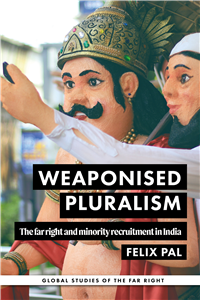
Weaponised pluralism takes a fine-grained lens to understand why far-right organisations recruit from the very minorities they oppose. Why do these organisations seek to appear like pluralists? Building on his time with the Muslim wing of the Hindu far-right in India, Felix Pal proposes that bigots can strategically use what he calls weaponised pluralism. This political strategy counterintuitively uses progressive political performances to bolster bigoted political agendas. Basing his analysis in an Indian context, Weaponised pluralism nonetheless reveals much about contexts as varied as Palestinian soldiers in the Israeli army, Indigenous Australians on far-right television, and Black congressional candidates in the American Republican Party. Drawing on rare access to the Hindu far-right and its Muslim wing, Pal paints an evocative picture of the complexities of how far-right organising extends far beyond the pointy end of traditional bigotry.
More Information
Rights Information
Albania, Algeria, Angola, Argentina, Armenia, Australia, Austria, Bahrain, Belgium, Belize, Benin, Bolivia, Bosnia and Herzegovina, Botswana, Brazil, Bulgaria, Burkina Faso, Burundi, Cameroon, Canada, Cape Verde, Central African Republic, Chad, Chile, China, Colombia, Comoros, Congo [DRC], Congo, Republic of the, Costa Rica, Ivory Coast, Croatia, Czech Republic, Denmark, Djibouti, Ecuador, Egypt, El Salvador, Equatorial Guinea, Eritrea, Estonia, Ethiopia, Faroe Islands, Finland, France, French Guiana, Gabon, Gambia, Georgia, Germany, Ghana, Greece, Guatemala, Guinea, Guinea-Bissau, Guyana, Honduras, Hongkong, Hungary, Iceland, India, Indonesia, Iran, Iraq, Ireland, Israel, Italy, Japan, Jordan, Kazakhstan, Kenya, Kuwait, Latvia, Lebanon, Lesotho, Liberia, Libya, Lithuania, Luxembourg, Macau, China, Macedonia [FYROM], Madagascar, Malawi, Malaysia, Mali, Malta, Mauritania, Mauritius, Mayotte, Mexico, Mongolia, Montenegro, Morocco, Mozambique, Namibia, Netherlands, New Zealand, Nicaragua, Niger, Nigeria, Norway, Oman, Pakistan, Panama, Paraguay, Peru, Philippines, Poland, Portugal, Puerto Rico, Qatar, Reunion, Romania, Russia, Rwanda, Saint Helena, Sao Tome and Principe, Saudi Arabia, Senegal, Serbia, Seychelles, Sierra Leone, Singapore, Slovakia, Slovenia, Somalia, South Africa, South Korea, Spain, Sri Lanka, Sudan, Suriname, Swaziland, Sweden, Switzerland, Syria, Taiwan, Tanzania, Thailand, Timor-Leste, Togo, Tokelau, Tunisia, Turkey, Uganda, Ukraine, United Arab Emirates, United Kingdom, United States, Uruguay, Venezuela, Vietnam, Western Sahara, Yemen, Zambia, Zimbabwe, South Sudan, Cyprus, Palestine, Bangladesh, Cambodia, Liechtenstein, Azerbaijan, Jamaica, Kyrgyzstan, Dominican Republic, Myanmar, Monaco
Endorsements
Why does the Hindu far-right have a Muslim wing? Why did the Nazis have Jewish supporters? Why do White supremacist parties run Black candidates? Sometimes far-right actors recruit from the very minorities they challenge. Drawing on his time in India with the Muslim Rashtriya Manch - the Muslim wing of the Hindu far-right Rashtriya Swayamsevak Sangh (RSS) - Pal argues in this book that these bigots act like pluralists because pluralism can sometimes be bigotry. Weaponised pluralism proposes that far-right groups like the RSS can adopt a strategy of weaponised pluralism, in which traditional performances of inter-community forbearance counterintuitively produce communities stratified by race, ethnicity and religion. Examining how the RSS performs pluralism through its Muslim wing, the book takes the reader into the rallies where Muslims pray to the Hindu god Ram; to the Manch's cow-milk iftar parties; and the Muslim-run cow refuges in Hindu temples. The volume provides a deep dive into the creative organisational strategies that bigots use to navigate diverse societies. Whether by holding interfaith dinners that reify Muslim subordination; creating a small category of Good Muslims so that the rest are bad; or by co-opting Muslim institutions to undermine them, far-right actors are increasingly adept at navigating a world where looking pluralist still hold great weight. Weaponised pluralism offers a rare internal account of how bigots actually pull this off.
Reviews
Why does the Hindu far-right have a Muslim wing? Why did the Nazis have Jewish supporters? Why do White supremacist parties run Black candidates? Sometimes far-right actors recruit from the very minorities they challenge. Drawing on his time in India with the Muslim Rashtriya Manch - the Muslim wing of the Hindu far-right Rashtriya Swayamsevak Sangh (RSS) - Pal argues in this book that these bigots act like pluralists because pluralism can sometimes be bigotry. Weaponised pluralism proposes that far-right groups like the RSS can adopt a strategy of weaponised pluralism, in which traditional performances of inter-community forbearance counterintuitively produce communities stratified by race, ethnicity and religion. Examining how the RSS performs pluralism through its Muslim wing, the book takes the reader into the rallies where Muslims pray to the Hindu god Ram; to the Manch's cow-milk iftar parties; and the Muslim-run cow refuges in Hindu temples. The volume provides a deep dive into the creative organisational strategies that bigots use to navigate diverse societies. Whether by holding interfaith dinners that reify Muslim subordination; creating a small category of Good Muslims so that the rest are bad; or by co-opting Muslim institutions to undermine them, far-right actors are increasingly adept at navigating a world where looking pluralist still hold great weight. Weaponised pluralism offers a rare internal account of how bigots actually pull this off.
Author Biography
Felix Pal is a Lecturer in Political Science at the University of Western Australia
 Trusted Partner

Manchester University Press
Manchester University Press is a leading UK publisher known for excellent research in the humanities and social sciences.
View all titlesBibliographic Information
- Publisher Manchester University Press
- Publication Date May 2026
- Orginal LanguageEnglish
- ISBN/Identifier 9781526189110 / 1526189119
- Publication Country or regionUnited Kingdom
- FormatPrint PDF
- Pages232
- ReadershipCollege/higher education; Professional and scholarly
- Publish StatusPublished
- Dimensions234 X 156 mm
- Biblio NotesDerived from Proprietary 6501
- SeriesGlobal Studies of the Far Right
- Reference Code17585
Thank you for proceeding with this offer.
Manchester University Press has chosen to review this offer before it proceeds.
You will receive an email update that will bring you back to complete the process.
You can also check the status in the My Offers area
Manchester University Press has chosen to review this offer before it proceeds.
You will receive an email update that will bring you back to complete the process.
You can also check the status in the My Offers area

Please wait while the payment is being prepared.
Do not close this window.

(c) Copyright 2026 - Frankfurter Buchmesse GmbH. All Right Reserved