
The Arts
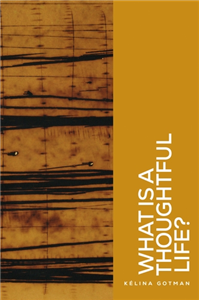
What is a thoughtful life?
by Kélina Gotman
Description
In fresh readings of Theodor W. Adorno, Giorgio Agamben, Hannah Arendt, Judith Butler, Barbara Cassin, Michel Foucault, Werner Hamacher, Martin Heidegger, and many more, Gotman rearticulates the foundations of broadly western philosophical thinking to carve out a shadowy space of recalcitrant thought 'in dark times'. At once indebted to the legacy of critique and enmeshed in affective and performative approaches to language, anti-theatricality, critical race theory and gender studies, she weaves a poetic mesh of intimate fragments, reflections on what it means to think and to write, as she puts it, after spectacle. Almost but not quite a straight work of philosophy, distinctly literary and performative in its anti-genre, this book twists and turns, swerves and cuts, to show the work of thinking as an intimate act - a theatre of angles and openings, adjacencies and reverberations.
More Information
Rights Information
Albania, Algeria, Angola, Argentina, Armenia, Australia, Austria, Bahrain, Belgium, Belize, Benin, Bolivia, Bosnia and Herzegovina, Botswana, Brazil, Bulgaria, Burkina Faso, Burundi, Cameroon, Canada, Cape Verde, Central African Republic, Chad, Chile, China, Colombia, Comoros, Congo [DRC], Congo, Republic of the, Costa Rica, Ivory Coast, Croatia, Czech Republic, Denmark, Djibouti, Ecuador, Egypt, El Salvador, Equatorial Guinea, Eritrea, Estonia, Ethiopia, Faroe Islands, Finland, France, French Guiana, Gabon, Gambia, Georgia, Germany, Ghana, Greece, Guatemala, Guinea, Guinea-Bissau, Guyana, Honduras, Hongkong, Hungary, Iceland, India, Indonesia, Iran, Iraq, Ireland, Israel, Italy, Japan, Jordan, Kazakhstan, Kenya, Kuwait, Latvia, Lebanon, Lesotho, Liberia, Libya, Lithuania, Luxembourg, Macau, China, Macedonia [FYROM], Madagascar, Malawi, Malaysia, Mali, Malta, Mauritania, Mauritius, Mayotte, Mexico, Mongolia, Montenegro, Morocco, Mozambique, Namibia, Netherlands, New Zealand, Nicaragua, Niger, Nigeria, Norway, Oman, Pakistan, Panama, Paraguay, Peru, Philippines, Poland, Portugal, Puerto Rico, Qatar, Reunion, Romania, Russia, Rwanda, Saint Helena, Sao Tome and Principe, Saudi Arabia, Senegal, Serbia, Seychelles, Sierra Leone, Singapore, Slovakia, Slovenia, Somalia, South Africa, South Korea, Spain, Sri Lanka, Sudan, Suriname, Swaziland, Sweden, Switzerland, Syria, Taiwan, Tanzania, Thailand, Timor-Leste, Togo, Tokelau, Tunisia, Turkey, Uganda, Ukraine, United Arab Emirates, United Kingdom, United States, Uruguay, Venezuela, Vietnam, Western Sahara, Yemen, Zambia, Zimbabwe, South Sudan, Cyprus, Palestine, Bangladesh, Cambodia, Liechtenstein, Azerbaijan, Jamaica, Kyrgyzstan, Dominican Republic, Myanmar, Monaco
Endorsements
In this book, we are 'present' to thought, 'together with no one but ourselves', in Hannah Arendt's terms - but in this self-presence, conjuring so many friends, teachers, interlocutors, we are also conjuring a world to come. What is a thoughtful life? asks - in this era of crisis - how we might for a moment pause to think; stop to wonder; carve out something of the doubt, uncertainty, awe that have shaped so much of philosophy for centuries and which constituted, for the Greeks at least, a way of shaping everyday living, practising self-reflection as a route to civic life, to political theory. Embroiled in querying the shape of 'free thinking', and the circumlocutions that accompany any train of thought as it moves, this book performs an act of recalcitrance relative to the forms that thought takes when it is fit for misuse. The chapters thus meander, morph - long and short, thick and thin, they act like an imprint of vulnerable and tender reading ensconced in the bodied work of time passing. From Michel Foucault and Judith Butler, Audre Lorde and Werner Hamacher, to Fred Moten, Sara Ahmed and Giorgio Agamben, and from Martin Heidegger's complex relationship with Arendt to Catherine Malabou's reflections on the plasticity of narrative and prose, this book moves with writers engaged in the radical poetics of 'passionate thinking' - attending, in a granular way, to the 'nearness of life'. Terms like truth, spectacle, performance, quiver, here; a retort to hypervisibility; a promise for another order of grounding.
Reviews
In this book, we are 'present' to thought, 'together with no one but ourselves', in Hannah Arendt's terms - but in this self-presence, conjuring so many friends, teachers, interlocutors, we are also conjuring a world to come. What is a thoughtful life? asks - in this era of crisis - how we might for a moment pause to think; stop to wonder; carve out something of the doubt, uncertainty, awe that have shaped so much of philosophy for centuries and which constituted, for the Greeks at least, a way of shaping everyday living, practising self-reflection as a route to civic life, to political theory. Embroiled in querying the shape of 'free thinking', and the circumlocutions that accompany any train of thought as it moves, this book performs an act of recalcitrance relative to the forms that thought takes when it is fit for misuse. The chapters thus meander, morph - long and short, thick and thin, they act like an imprint of vulnerable and tender reading ensconced in the bodied work of time passing. From Michel Foucault and Judith Butler, Audre Lorde and Werner Hamacher, to Fred Moten, Sara Ahmed and Giorgio Agamben, and from Martin Heidegger's complex relationship with Arendt to Catherine Malabou's reflections on the plasticity of narrative and prose, this book moves with writers engaged in the radical poetics of 'passionate thinking' - attending, in a granular way, to the 'nearness of life'. Terms like truth, spectacle, performance, quiver, here; a retort to hypervisibility; a promise for another order of grounding.
Author Biography
Kélina Gotman is Professor of Performance and the Humanities at King's College London
 Trusted Partner

Manchester University Press
Manchester University Press is a leading UK publisher known for excellent research in the humanities and social sciences.
View all titlesBibliographic Information
- Publisher Manchester University Press
- Publication Date June 2026
- Orginal LanguageEnglish
- ISBN/Identifier 9781526187567 / 1526187566
- Publication Country or regionUnited Kingdom
- FormatPrint PDF
- Pages352
- ReadershipGeneral/trade
- Publish StatusPublished
- Dimensions216 X 138 mm
- Biblio NotesDerived from Proprietary 6445
- Reference Code17345
Thank you for proceeding with this offer.
Manchester University Press has chosen to review this offer before it proceeds.
You will receive an email update that will bring you back to complete the process.
You can also check the status in the My Offers area
Manchester University Press has chosen to review this offer before it proceeds.
You will receive an email update that will bring you back to complete the process.
You can also check the status in the My Offers area

Please wait while the payment is being prepared.
Do not close this window.

(c) Copyright 2026 - Frankfurter Buchmesse GmbH. All Right Reserved