Your Search Results

      • Trusted Partner
        Humanities & Social Sciences
        May 2016

        The Scots in early Stuart Ireland

        Union and separation in two kingdoms

        by David Edwards, Micheál Ó Siochrú, David Edwards

        By exploring Irish-Scottish connections during the period 1603-60 this book brings important new perspectives to the study of the Early Stuart state. Acknowledging the pivotal role of the Hiberno-Scottish world, it identifies some of the limits of England's Anglicising influence in the northern and western 'British Isles' and the often slight basis on which the Stuart pursuit of a new 'British' consciousness operated. Regarding the Anglo-Scottish relationship, it was chiefly in Ireland that the English and Scots intermingled after 1603, with a variety of consequences, often destabilising for English, Scots and Irish. The importance of the Gaelic sphere in Irish-Scottish connections also receives much greater attention here than in previous accounts. This Gaedhealtacht played a central role in the transmission of religious radicalism, both Catholic and Protestant, in Ireland and Scotland, ultimately leading to political crisis and revolution within the British Isles. ;

      • Trusted Partner
        Humanities & Social Sciences
        March 2016

        The end of the Irish Poor Law?

        Welfare and healthcare reform in revolutionary and independent Ireland

        by Donnacha Lucey

      • Trusted Partner
      • Trusted Partner
        Literature & Literary Studies
        October 2015

        Staging the revolution

        Drama, reinvention and history, 1647–72

        by Rachel Willie

      • Trusted Partner
      • Trusted Partner
        Humanities & Social Sciences
        June 2016

        The Anglo-Irish agreement

        Rethinking its legacy

        by Arthur Aughey

        The 25th anniversary of the Anglo-Irish Agreement provides an appropriate opportunity to re-examine its legacy because after its signing nothing was ever quite the same again. How and why that is so is the subject of this book. The book provides new perspectives on how the Anglo-Irish Agreement influenced the nature and direction of the subsequent peace process by examining it through the key concepts of the Northern Ireland conflict.The objective is not only to understand the Anglo-Irish Agreement's momentary impact but also its status as an enduring moment of political modification. By bringing together some of the most distinguished scholars in the field and by addressing the key challenges and possibilities which the Anglo-Irish Agreement bequeathed, this book will appeal to scholars and students of British and Irish politics, contemporary history, and peace and conflict studies. ;

      • Trusted Partner
        Literature & Literary Studies
        October 2015

        Staging the revolution

        Drama, reinvention and history, 1647–72

        by Rachel Willie

      • Trusted Partner
        Humanities & Social Sciences
        March 2016

        William Parsons, 3rd Earl of Rosse

        Astronomy and the castle in nineteenth-century Ireland

        by R. Charles Mollan

        This is a revealing account of the family life and achievements of the Third Earl of Rosse, a hereditary peer and resident landlord at Birr Castle, County Offaly, in nineteenth-century Ireland, before, during and after the devastating famine of the 1840s. He was a remarkable engineer, who built enormous telescopes in the cloudy middle of Ireland. The book gives details, in an attractive non-technical style which requires no previous scientific knowledge, of his engineering initiatives and the astronomical results, but also reveals much more about the man and his contributions - locally in the town and county around Birr, in political and other functions in an Ireland administered by the Protestant Ascendancy, in the development and activities of the Royal Society, of which he was President from 1848-54, and the British Association for the Advancement of Science. The Countess of Rosse, who receives full acknowledgement in the book, was a woman of many talents, among which was her pioneering work in photography, and the book includes reproductions of her artistic exposures, and many other attractive illustrations. ;

      • Trusted Partner
        Literature & Literary Studies
        May 2016

        Staging the revolution

        Drama, reinvention and history, 1647–72

        by Rachel Willie

        Staging the revolution offers a reappraisal of the weight and volume of theatrical output during the commonwealth and early Restoration, both in terms of live performances and performances on the paper stage. It argues that the often-cited notion that 1642 marked an end to theatrical production in England until the playhouses were reopened in 1660 is a product of post-Restoration re-writing of the English civil wars and the representations of royalists and parliamentarians that emerged in the 1640s and 1650s. These retellings of recent events in dramatic form mean that drama is central to civil-war discourse. Staging the revolution examines the ways in which drama was used to rewrite the civil war and commonwealth period and demonstrates that, far from marking a clear cultural demarcation from the theatrical output of the early seventeenth century, the Restoration is constantly reflecting back on the previous thirty years. ;

      • Trusted Partner
        Humanities & Social Sciences
        March 2016

        The end of the Irish Poor Law?

        Welfare and healthcare reform in revolutionary and independent Ireland

        by Donnacha Lucey

      • Trusted Partner
        Humanities & Social Sciences
        December 2015

        The Irish in Manchester c.1750–1921

        Resistance, adaptation and identity

        by Mervyn Busteed

      • Trusted Partner
        Humanities & Social Sciences
        May 2016

        The end of the Irish Poor Law?

        Welfare and healthcare reform in revolutionary and independent Ireland

        by Donnacha Lucey

        This book examines Irish Poor Law reform during the years of the Irish revolution and Irish Free State. This work is a significant addition to the growing historiography of the twentieth century which moves beyond political history, and demonstrates that concepts of respectability, social class and gender are central dynamics in Irish society. This book provides the first major study of local welfare practices and exploration of policies, attitudes and the poor. This monograph examines local public assistance regimes, institutional and child welfare, and hospital care. It charts the transformation of workhouses into a network of local authority welfare and healthcare institutions including county homes, county hospitals, and mother and baby homes. The book's exploration of welfare and healthcare during revolutionary and independent Ireland provides fresh and original insights into this critical juncture in Irish history. The book will appeal to Irish historians and those with interests in welfare, the Poor Law and the social history of medicine and institutions. ;

      • Trusted Partner
      • Trusted Partner
      • Trusted Partner
        Humanities & Social Sciences
        December 2015

        The Irish in Manchester c.1750–1921

        Resistance, adaptation and identity

        by Mervyn Busteed

      • Trusted Partner
        Humanities & Social Sciences
        January 2016

        Unfolding Irish landscapes

        Tim Robinson, culture and environment

        by Derek Gladwin, Christine Cusick

        An unprecedented compilation of critical and creative essays and visual texts from leading international scholars, Unfolding Irish landscapes presents cross-disciplinary studies of the prose, cartography, visual art and cultural legacy of the award-winning work of cartographer and writer Tim Robinson. This book explores the process in which Robinson has addressed the historical and geographical tensions that suffuse the landscapes of Ireland. Robinson's distinctive methods of map-making and topographical writing capture the geographical and cultural consciousness of not only Ireland, but also of the entire North Atlantic archipelago. Through both topographic prose and cartography Robinson undertakes one of the greatest explorations of the Irish landscape by a single person in recent history, paralleling, if not surpassing, Robert Lloyd Praeger's extensive catalogue of writings and natural histories of western Ireland. ;

      • Trusted Partner
        Travel writing
        January 2016

        Unfolding Irish landscapes

        Tim Robinson, culture and environment

        by Edited by Derek Gladwin and Christine Cusick

        An unprecedented compilation of critical and creative essays and visual texts from leading international scholars, Unfolding Irish landscapes presents cross-disciplinary studies of the prose, cartography, visual art and cultural legacy of the award-winning work of cartographer and writer Tim Robinson. This book explores the process in which Robinson has addressed the historical and geographical tensions that suffuse the landscapes of Ireland. Robinson's distinctive methods of map-making and topographical writing capture the geographical and cultural consciousness of not only Ireland, but also of the entire North Atlantic archipelago. Through both topographic prose and cartography Robinson undertakes one of the greatest explorations of the Irish landscape by a single person in recent history, paralleling, if not surpassing, Robert Lloyd Praeger's extensive catalogue of writings and natural histories of western Ireland.

      • Trusted Partner
        British & Irish history
        July 2013

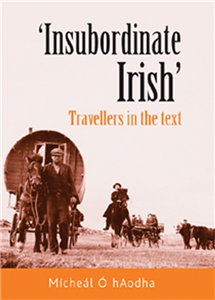
        ‘Insubordinate Irish‘

        Travellers in the text

        by Mícheál Ó hAodha

        This book traces a number of common themes relating to the representation of Irish Travellers in Irish popular tradition and how these themes have impacted on Ireland's collective imagination. A particular focus of the book is on the exploration of the Traveller as "Other", an "Other" who is perceived as both inside and outside Ireland's collective ideation. Frequently constructed as a group whose cultural tenets are in a dichotomous opposition to that of the "settled" community, this book demonstrates the ambivalence and complexity of the Irish Traveller "Other" in the context of a European postcolonial country. Not only has the construction and representation of Travellers always been less stable and "fixed" than previously supposed, these images have been acted upon and changed by both the Traveller and non-Traveller communities as the situation has demanded. Drawing primarily on little-explored Irish language sources, this volume demonstrates the fluidity of what is often assumed as reified or "fixed". As evidenced in Irish-language cultural sources the image of the Traveller is inextricably linked with the very concept of Irish identity itself. They are simultaneously the same and "Other" and frequently function as exemplars of the hegemony of native Irish culture as set against colonial traditions. This book is an important addition to the Irish Studies canon, in particular as relating to those exciting and unexplored terrains hitherto deemed "marginal" - Traveller Studies, Romani Studies and Diaspora/Migration Studies to name but a few.

      Subscribe to our

      newsletter