
Your Search Results
-

-

International Writers and Translators' House / Latvian Literature
The Latvian Literature platform was established in order to promote Latvian literature and its distribution abroad, thus ensuring international cooperation among publishers, literary agents, writers, translators, and organizations working in the fields of literature and publishing. The Latvian Literature platform provides wide-ranging information about Latvian authors, books, translators and translations, the publishing industry and innovations within the industry.
View Rights Portal
-
Promoted Content

 Literature & Literary StudiesFebruary 1994
Italian women writing
by Sharon Wood
How has it happened that from being politely ignored or marginalized just half a century ago, women writers in Italy are now at the centre of literary activity? To what extent does writing by women reflect the successes and failures of Italy in the post-war period? What form did the feminist movement in Italy take, and how did this affect what - and how - women wrote? And how are women who write responding to a more fragmented post-modern age? These are just some of the questions asked of the relationship between women and fiction in post-war Italy in this anthology. It includes stories by Cialente, Ginzburg, Ortese, Morante, Romano, Maraini and Duranti as well as Bompiani, Sanvitale, Mizzau, Scaramuzzino, Capriolo and Petrignani. The thirteen stories presented offer a range of style and content indicative of the wealth and diversity of writing by women, and their reading is supported by critical notes and an extensive vocabulary. This is a clear and challenging introduction to the rich field of women and fiction in Italy. ;
-
Promoted Content
 Literature & Literary StudiesOctober 2017
Botany, sexuality and women's writing, 1760–1830
From modest shoot to forward plant
by Sam George
In this fascinating study, Samantha George explores the cultivation of the female mind and the feminised discourse of botanical literature in eighteenth-century Britain. In particular, she discusses British women's engagement with the Swedish botanist, Carl Linnaeus, and his unsettling discovery of plant sexuality. Previously ignored primary texts of an extraordinary nature are rescued from obscurity and assigned a proper place in the histories of science, eighteenth-century literature, and women's writing. The result is groundbreaking: the author explores nationality and sexuality debates in relation to botany and charts the appearance of a new literary stereotype, the sexually precocious female botanist. She uncovers an anonymous poem on Linnaean botany, handwritten in the eighteenth century, and subsequently traces the development of a new genre of women's writing - the botanical poem with scientific notes. The book is indispensable reading for all scholars of the eighteenth century, especially those interested in Romantic women's writing, or the relationship between literature and science.
-
 Trusted Partner
 Literature & Literary StudiesMarch 2000
Women's writing of the First World War
an anthology
by Angela Smith
A fully-rounded anthology of women's writing from World War One containing the known and unknown biographers and fiction writers of the period.. Explores the impact of the war on ideology, gender, genre and society and is a perfect complimentary text to Trudi Tate's Women Men and the Great War.. Aims to re-read the First World War as a female experience by drawing on the public and private sources of a wide range of different women.. Uses diaries, letters, articles and essays many of which have not been published.. Invaluable source document for scholars in many disciplines. ;
-
Trusted Partner
 Literary studies: fiction, novelists & prose writersJanuary 2015
Writing disenchantment
by Andrew Frayn
-
Trusted Partner
-
Trusted Partner
-
Trusted Partner
 Literature & Literary StudiesNovember 2013
Writing otherwise
Experiments in cultural criticism
by Jackie Stacey, Janet Wolff
Writing otherwise is a collection of essays by established feminist and cultural critics interested in experimenting with new styles of expression. Leading figures in their field, such as Marianne Hirsch, Lynne Pearce, Griselda Pollock, Carol Smart, Jackie Stacey and Janet Wolff, all risk new ways of writing about themselves and their subjects. Aimed at both general and academic readers interested in how scholarly writing might be more innovative and creative, this collection introduces the personal, the poetic and the experimental into the frame of cultural criticism. This collection of essays is highly interdisciplinary and contributes to debates in sociology, history, anthropology, art history, cultural and media studies and gender studies. ;
-
Trusted Partner
 Literary studies: from c 1900 -August 2016
Writing otherwise
Experiments in cultural criticism
by Edited by Jackie Stacey, Janet Wolff
Writing otherwise is a collection of essays by established feminist and cultural critics interested in experimenting with new styles of expression. Leading figures in their field, such as Marianne Hirsch, Lynne Pearce, Griselda Pollock, Carol Smart, Jackie Stacey and Janet Wolff, all risk new ways of writing about themselves and their subjects. Aimed at both general and academic readers interested in how scholarly writing might be more innovative and creative, this collection introduces the personal, the poetic and the experimental into the frame of cultural criticism. This collection of essays is highly interdisciplinary and contributes to debates in sociology, history, anthropology, art history, cultural and media studies and gender studies.
-
Trusted Partner
-
Trusted Partner
-
Trusted Partner
 Humanities & Social SciencesOctober 2014
Writing imperial histories
by Andrew Thompson, John Mackenzie
-
Trusted Partner
-
Trusted Partner
-
Trusted Partner
 Humanities & Social SciencesMay 2016
Writing imperial histories
by Andrew Thompson, Andrew Thompson, John M. MacKenzie
-
Trusted Partner
-
Trusted Partner
 Humanities & Social SciencesSeptember 2025
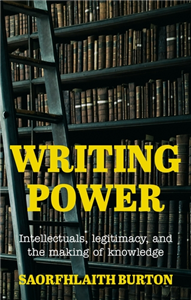
Writing power
Intellectuals, legitimacy, and the making of knowledge
by Sarah Victoria Alexandra Burton
Writing power radically rethinks the place of the canon and canonicity as objects and concepts in contemporary academia and the everyday intellectual practices of academics. It is distinctive in its demonstration of how academics' engagements with canons shape their writing practices but also how scholars' writing practices, spaces, proclivities, and desires shape the canon and changing ideas of value in canonicity. The book thinks through frequently discussed problems of legitimacy and knowledge production from fresh perspectives of lived experience and the everyday to offer new insights into the politics of knowledge in contemporary social sciences.
-
Trusted Partner
 Literature & Literary StudiesMarch 2007
On the uses of history in recent Irish writing
by Bernhard Klein
This book offers a critical reassessment of the uses of history in contemporary Irish literature and culture. It argues that in much recent Irish writing, history is approached not as the proverbial 'nightmare' from which Joyce's Stephen Dedalus tried to awake, but as a rich, imaginative resource. Drawing on recent debates in Irish literary and cultural criticism, On the uses of history in recent Irish writing explores the varied, creative, and often critically challenging forms of rewriting Ireland's troubled past in contemporary prose, drama and poetry. Individual chapters focus on literary treatments of the Tudor reconquest, the Famine, the Northern Irish Troubles and other key events in Irish history, highlighting in a series of close readings the unique forms of historical thought enabled by different literary forms and genres. Canonical works by authors such as Seamus Heaney, Derek Mahon, Tom Paulin, Brian Friel, Stewart Parker and Frank McGuinness are considered alongside lesser known writers and texts, placing each in their wider social, cultural and historical contexts. ;
-
Trusted Partner
-
Trusted Partner
 Literature & Literary StudiesOctober 2010
Writing for Art
The aesthetics of ekphrasis
by Stephen Cheeke
Writing for art is a concise introduction to the subject of ekphrasis, and the first study to offer a useful general survey of the larger philosophical and theoretical questions arising from the encounter of literary texts and artworks. Stephen Cheeke offers close readings of poems and prose from the nineteenth and twentieth centuries alongside a generous amount of illustrations, covering a broad range of writing and theory about the relation of literary texts to the visual arts, and extending the subject of ekphrasis to include literary works on photography, as well as celebrated prose descriptions of artworks. ;
-
Trusted Partner



