
Playwrights Canada Press
Livres Canada Books
View Rights Portal

Livres Canada Books supports Canadian-owned book publishers in their export sales activities, in developing international partnerships, and assists publishers in improving their overall results through a range of services, including financial support, collective marketing, promotion, research, training, and a collective presence at major international book fairs. We are delighted to showcase great Canadian fiction, non-fiction, scholarly books, children’s books and young adult fiction in English and French. We encourage you to consult the listings here to find the stories and relationships that speak to you most. Livres Canada Books appuie les éditeurs appartenant à des intérêts canadiens dans leurs activités de ventes à l’exportation, en établissant des partenariats internationaux et en améliorant leur rendement global au moyen d’une gamme de services, dont l’aide financière, le marketing collectif, la promotion, la recherche, la formation et une présence collective aux principales foires internationales du livre. Nous nous réjouissons de mettre en vedette des titres canadiens exceptionnels, qu’il s’agisse de romans, de livres de non fiction, de livres pour enfants, de romans jeunes adultes ainsi que des publications savantes, et ce, en français et anglais. Nous vous invitons à consulter ces titres pour y découvrir les récits et les histoires qui vous interpellent le plus.
View Rights Portal

Local government in the UK is in crisis. It is now neither local in terms of the geography and populations of its principle units, nor does it truly govern in these areas. As this book reveals, over the previous 200 years local government has moved from a system in which local interests held governance over localities to one in which central government and national and multi-national agencies such as corporate businesses hold governance over local and community decision-making. These changes seriously undermine the important role that local government can play in liberal democracy in the UK. The book explains the nature of local government today and asks if there is any possibility of change.

Local government today provides a comprehensive analysis of the structure, finance, management and democratic framework for local government in Britain. This new edition has been substantially rewritten to encompass the many changes to the structure and function of the system since 2000, including developments flowing from the 2007 Local Government Act. The study discusses how, during the Blair years, local governments came to be seen once again as centrally important institutions within Britain's political system. However, they are not seen as organisations that can function as separate agencies, undertaking all their duties 'in-house'. They are now required to work in partnership with the private, public and voluntary sectors to deliver local services and represent local interests. It is further argued that, for the first time in over a century, the barriers between civil servants and senior local government officers are being eroded as central government begins to incorporate leading local government officials into its decision-making processes. This established textbook also offers a comparative focus by showing how the British system differs from the structures for local governance in Western Europe and the United States. ;
 Trusted Partner
Trusted Partner
Trusted Partner

Emigration from Scotland has always been very high. However, emigration from Scotland between the wars surpassed all records; more people emigrated than were born, leading to an overall population decline. Why was it so many people left? Marjory Harper, whose knowledge is grounded in a deep understanding of the local records, maps out the many factors which worked together to cause this massive diaspora. After an opening section where the author sets the Scottish experience within the context of the rest of the British Isles, the book then divides the country geographically, starting with the Highlands, then coastal Scotland, and the urban Lowland highlighting in turn the factors that particularly influenced each of these areas. Harper then discusses the organised religious and political movements that encouraged emigration. By interweaving personal stories with statistical evidence Harper brings to life the reality behind the dramatic historical migration.
Trusted Partner

This book is a study of the ambitions, activities and achievements of Methodist missionaries in northern Burma from 1887-1966 and the expulsion of the last missionaries by Ne Win. The story is told through painstaking original research in archives which contain thousands of hitherto unpublished documents and eyewitness accounts meticulously recorded by the Methodist missionaries. This accessible study constitutes a significant contribution to a very little-known area of missionary history. Leigh pulls together the themes of conflict, politics and proselytisation in to a fascinating study of great breadth. The historical nuances of the relationship between religion and governance in Burma are traced in an accessible style. This book will appeal to those teaching or studying colonial and postcolonial history, Burmese politics, and the history of missionary work.
Trusted Partner
Trusted Partner

During the 1990s, the structure of local government in Scotland and Wales was completely reorganised by Acts of Parliament. Under other legislation, and in response to recommendations from the Local Government Commission, there was a partial reorganisation in shire England. This is the only study which examines these reforms in one volume. Running through this study is the contrast between the rhetoric used to justify replacing counties and districts by new unitary authorities and the realities of local government. The book reviews the reasons for the reforms, the processes and outcomes in the three countries, and the nature of the evidence which was available for the advantages and disadvantages of reorganisation. Two chapters compare the prior assessments with the actuality, and the final chapter discusses some important lessons for national governance. This is the only study written by someone who was directly involved in the structural review, as a member of the Local Government Commission, and it combines this special experience with a wealth of information from many sources. The book will be a key text for teachers and students of local government and also important for those studying public administration, government and politics at the second or third year undergraduate level. There should also be a wide readership in local government circles and among MPs and those concerned with public life. ;
Trusted Partner

In 2007 Labour lost an election in Scotland for the first time in half a century and the SNP went on to form the Scottish Government. This book explains why. Based on a unique three-wave survey of the Scottish electorate, it can truly be described as the first full-scale Scottish national election study. As such, it is notable not only for its innovative methodology but also because theories and concepts are taken from the recent electoral studies literature and applied to Scotland. Other questions investigated include the impact of campaigning and of the party leaders (at both Scottish and British level) on the election outcome. In addition, for the first time in the UK context, a special study is made of the causes and consequences of rejected ballots - the large number of which at this election caused a media outcry. This book will be required reading for anyone interested in, involved in, teaching or studying Scottish politics. It will also be an important text for those concerned with UK politics in general and attract particular interest among students of elections, both in the UK and internationally. ;
Trusted Partner

This book challenges the idealised narrative of Canada as an antislavery haven for self-liberated people to explore Canada's complicated relationship with slavery. Examining advertisements, abolitionist texts and narratives about slavery in Canadian newspapers and the texts that were printed alongside them, it shows how Canadian readers and enslavers developed an image of themselves as belonging to an antislavery community even while recognising their own complicity in slavery. The book explores narratives that depict the lives of Black settlers in Canada and how slave narratives circulated in Canada. Canada's relationship with slavery is far more complicated than seeing it as either an antislavery haven or a slaveholding space. Canada was connected to Britain, France, the Caribbean and the United States and this was central to how Canadians and Canadian readers fashioned their self-image in relation to slavery.
Trusted Partner

This is the first comprehensive textbook on the market to cover the A/S level politics syllabuses offered by the main examination boards.. Written in clear, accessible, easy to understand language, with checklists, bullet points, chapter summaries, boxes and charts, revision notes and sample examination questions, as well as further sources of information, in both written form and on the web, this is the perfect information source for students preparing for the A/S level politics examination.. The book starts by giving a basic introduction to politics including a definition of what politics is, the nature of government and the basic concepts of politics and political action.. It goes on to deal with popular participation, including democracy, elections, the electoral system and referendums, political parties including their role and functions, ideologies, theories and traditions of UK parties, the current state of the parties with regard to policy, and the work of parties at local, national and European level. ;
Trusted Partner
Trusted Partner
On 25 January 1474, Charles the Bold, duke of Burgundy, appeared before his subjects in Dijon. Robed in silk, gold and precious jewels and wearing a headpiece that gave the illusion of a crown, he made a speech in which he cryptically expressed his desire to become a king. Three years later, Charles was killed at the battle of Nancy, an event that plunged the Great Principality of Burgundy into chaos. This book, innovative and essential, not only explores Burgundian history and historiography but offers a complete synthesis about the nature of politics in this region, considered both from the north and the south. Focusing on political ideologies, a number of important issues are raised relating to the medieval state, the signification of the nation under the 'Ancien Regime', the role of warfare in the creation of political power and the impact of political loyalties in the exercise of government. In doing so, the book challenges a number of existing ideas about the Burgundian state.
Trusted Partner
 Trusted Partner
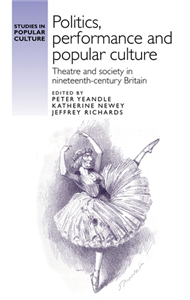
This collection brings together studies of popular performance and politics across the nineteenth century, offering a fresh perspective from an archivally grounded research base. It works with the concept that politics is performative and performance is political. The book is organised into three parts in dialogue regarding specific approaches to popular performance and politics. Part I offers a series of conceptual studies using popular culture as an analytical category for social and political history. Part II explores the ways that performance represents and constructs contemporary ideologies of race, nation and empire. Part III investigates the performance techniques of specific politicians - including Robert Peel, Keir Hardie and Henry Hyndman - and analyses the performative elements of collective movements.
Trusted Partner
Trusted Partner
The politics of Middle English parables examines the dynamic intersection of fiction, theology and social practice in late-medieval England. Parables occupy a prominent place in Middle English literature, appearing in dream visions and story collections as well as in lives of Christ and devotional treatises. While most scholarship approaches the translated stories as stable vehicles of Christian teaching, this book highlights the many variations and points of conflict across Middle English renditions of the same story. In parables related to labour, social inequality, charity and penance, the book locates a creative theological discourse through which writers attempted to re-construct Christian belief and practice. Analysis of these diverse retellings reveals not what a given parable meant in a definitive sense but rather how Middle English parables inscribe the ideologies, power structures and cultural debates of late-medieval Christianity.
Trusted Partner
 Trusted Partner

This book is a powerful addition to a developing literature informed by arts and humanities research carried out during the COVID-19 pandemic. Investigating the impacts of crisis governance and decision-making on people and populations, the book brings together microbial organisms and humans, children and data, decision-making and infection prevention, publics and process, global vaccine distribution and citizens' juries. Through its eight chapters, the book stimulates broadly-drawn discussions about exceptional executive powers in an emergency, the role of trust, and the importance of the principles of good governance - such as selflessness, ethics, integrity, accountability and honesty in leadership. The lessons drawn out in this book will support future decision-makers in both ordinary times and extra-ordinary emergencies.
Trusted Partner

This important book provides new understandings of how the politics of memory impacts peace in societies transitioning from a violent past. It does so by developing a theoretical approach focusing on the intersection of sites, agency, narratives, and events in memory-making. Drawing on rich empirical studies of mnemonic formations in Cyprus, Bosnia and Herzegovina, Rwanda, South Africa and Cambodia, the book speaks to a broad audience. The in-depth, cross-case analysis shows that inclusivity, pluralism, and dignity in memory politics are key to the construction of a just peace. The book contributes crucial and timely knowledge about societies that grapple with the painful legacies of the past and advances the study of memory and peace.
Trusted Partner



