
Your Search Results
-

-

Afram Publications
Afram Publication is specialized in publishing materials for pre-school and basic education with special focus on development of local authorship especially in children’s books.
View Rights Portal
-
Promoted Content

 Humanities & Social SciencesNovember 2025
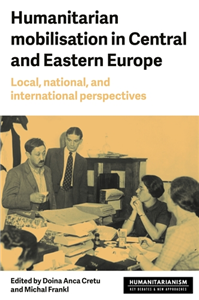
Humanitarian mobilisation in Central and Eastern Europe
Local, national, and international perspectives
by Doina Anca Cretu, Michal Frankl
By focusing on aid Central and Eastern Europe, the volume adds to the existent scholarly explorations of modern humanitarianism, its actors and practices. In the twentieth century, aid workers assisted victims of war and earthquakes, delivered food, supported health care, provided childcare, or sheltered refugees. The contributors not only reconstruct these diverse histories and their protagonists, but also bring international, national, and local actors together: from grassroots activists to private associations to state-driven "socialist humanitarians" to large Western aid organizations. In doing so, they challenge the often unidirectional, from West-to-East, and asymmetrical perspective on donor-recipient relationships in humanitarian processes.
-
Promoted Content
 Humanities & Social SciencesJuly 2025
The adventure
Violent borders, illegal migration and the uncertain quest for life in Morocco
by Sébastien Bachelet
This ethnographic exploration of irregular migration from Western and Central Africa in Morocco deconstructs dehumanising narratives of a "migration crisis" and a "sub-Saharan problem" in politics of migration. The book provides an original focus on how migrants understood and experienced their entrapped mobility. The emic notion of "the adventure" at the heart of this study sheds light on a transformative, epic quest to carve out a better life and future. The book traces how young men from Western and Central Africa sought to assert themselves as agents of their own destinies, despite uncertain, illegalising processes. In steering away from aesthetics of despair and fearmongering narratives, the book brings new insights into inter-disciplinary debates (e.g. illegality, uncertainty, immobility, violence, suffering, transit, etc.). Such focus is essential to draw out the complexity and existential depth of (irregular) migrants' lives, journeys, and stories.
-
 Trusted Partner
 Humanities & Social SciencesMarch 2017
Ordering Africa
Anthropology, European imperialism and the politics of knowledge
by Helen Tilley, Robert Gordon
African research played a major role in transforming the discipline of anthropology in the twentieth century. Ethnographic studies, in turn, had significant effects on the way imperial powers in Africa approached subject peoples. Ordering Africa provides the first comparative history of these processes. With essays exploring metropolitan research institutes, Africans as ethnographers, the transnational features of knowledge production, and the relationship between anthropology and colonial administration, this volume both consolidates and extends a range of new research questions focusing on the politics of imperial knowledge. Specific chapters examine French West Africa, the Belgian and French Congo, the Anglo-Egyptian Sudan, Italian Northeast Africa, Kenya, and Equatorial Africa (Gabon) as well as developments in Britain, France, Germany, Italy, and Switzerland. A major collection of essays that will be welcomed by scholars interested in imperial history and the history of Africa.
-
Trusted Partner

 May 2014
Europe Central
Roman
by William T. Vollmann, Robin Detje
William T. Vollmann, der in einer Reihe mit Thomas Pynchon und David Foster Wallace steht, hat mit Europe Central ein Krieg und Frieden für das 21. Jahrhundert geschrieben – ein Epos in Übergröße, in 37 Kapiteln von fiktiven und realen Personen, Künstlern wie Käthe Kollwitz und Dimitri Schostakowitsch oder Militärs wie General Wlassow und Friedrich Paulus, dem Verlierer von Stalingrad. Ihre Lebensgeschichten beschwören aufs Neue die Geschichte des Zweiten Weltkriegs auf sowjetischer und deutscher Seite herauf. Aber im Zentrum des Romans steht eine Liebe: die bedingungslose Liebe von Schostakowitsch zu Elena Konstantinowskaja. Schieben wir zur Seite, was wir über Geschichte wissen, und lassen wir uns ein auf dieses wagemutige, gewaltige, faszinierende, tiefgreifende und umfassende Werk: Europe Central. »Ein ›Krieg und Frieden‹ des 20. Jahrhunderts, mit dem sich Vollmann endgültig seinen Rang in der Weltliteratur gesichert hat.« Welt am Sonntag
-
Trusted Partner
 Humanities & Social SciencesMarch 2026
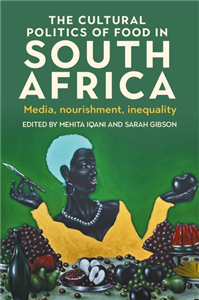
The cultural politics of food in South Africa
Media, nourishment, inequality
by Mehita Iqani, Sarah Gibson
Food is both a material system of nourishment, necessary for human survival, and a communicative system that signifies multiple meanings across human cultures. This book explores the cultural politics of food in the South African context, bringing together a range of disciplinary perspectives on the links between media, nourishment, and inequality. The chapters all highlight the multiplicity of meanings that food has in South African society. These include historical perspectives on the impact of colonialism, migration and apartheid had on food and foodways in South Africa; sociological interventions on food and society; aesthetic practices in relation to food; and mediated food cultures in South Africa. Taken together, the book critically explores the multiple ways in which food is never just food, and always linked to complex and shifting modalities of meaning and knowledge in the South African context.
-
Trusted Partner
 Humanities & Social SciencesMarch 2017
Travellers in Africa
British travelogues, 1850-1900
by Timothy Youngs
Works of travel have been the subject of increasingly sophisticated studies in recent years. This book undermines the conviction with which nineteenth-century British writers talked about darkest Africa. It places the works of travel within the rapidly developing dynamic of Victorian imperialism. Images of Abyssinia and the means of communicating those images changed in response to social developments in Britain. As bourgeois values became increasingly important in the nineteenth century and technology advanced, the distance between the consumer and the product were justified by the scorn of African ways of eating. The book argues that the ambiguities and ambivalence of the travellers are revealed in their relation to a range of objects and commodities mentioned in narratives. For instance, beads occupy the dual role of currency and commodity. The book deals with Henry Morton Stanley's expedition to relieve Emin Pasha, and attempts to prove that racial representations are in large part determined by the cultural conditions of the traveller's society. By looking at Joseph Conrad's Heart of Darkness, it argues that the text is best read as what it purports to be: a kind of travel narrative. Only when it is seen as such and is regarded in the context of the fin de siecle can one begin to appreciate both the extent and the limitations of Conrad's innovativeness.
-
Trusted Partner
-
Trusted Partner
 Humanities & Social SciencesJuly 2025
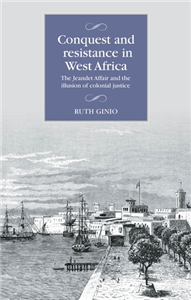
Conquest and resistance in West Africa
The Jeandet Affair and the illusion of colonial justice
by Ruth Ginio
This book is an enthralling account of a legal scandal, which erupted in colonial Senegal in 1890 and reached the French metropolitan press and the parliament. The murder of a colonial administrator, Abel Jeandet, by one of his soldiers led to the brutal and illegal executions without trial of the killer and two local dignitaries. The volume follows the fascinating story of Ndiereby Ba, the widow of one of the dignitaries, who with the help of powerful métis men in the capital Saint Louis sued the French administrators who had supervised the executions for the murder of her husband. Through this captivating tale the book articulates the French expansion into West Africa, the resistance to colonial rule both violent and non-violent, and the lack of interest on the part of French politicians in the brutal conquest of a territory they know nothing about.
-
Trusted Partner
 Literature & Literary StudiesJune 2025
Contemporary Slavic horror across media
Cursed zones
by Agnieszka Jezyk
In the Western cultural production that puts individual or collective fear at its center, East/Central Europe has been portrayed as an othered space of horror - lawless, frightening zones where anything can happen. Incorporating articles on literature, film, visual arts, video games, music videos, and music festivals, Contemporary Slavic horror across media: Cursed zones is a pioneering anthology of academic essays devoted to Slavic horror fiction. The book focuses on works from the mid-20th century through the present, particularly the post-Soviet period. Assessing current trends in Czech, Polish, Russian, Slovak, Ukrainian, and East/Central European horror media, the book looks at similarities and idiosyncrasies of the genre in its Slavic variant. With this anthology we hope to tame 'the Easterner Other' and start exorcising 'monstrous' East/Central Europe.
-
Trusted Partner
 Humanities & Social SciencesMay 2010
Representing Africa
Landscape, exploration and empire in Southern Africa, 1780–1870
by John McAleer, Andrew Thompson, John Mackenzie
Southern Africa played a varied but vital role in Britain's maritime and imperial stories: it was one of the most intricate pieces in the British imperial strategic jigsaw, and representations of southern African landscape and maritime spaces reflect its multifaceted position. Representing Africa examines the ways in which British travellers, explorers and artists viewed southern Africa in a period of evolving and expanding British interest in the region. Drawing on a wide range of archival sources, contemporary travelogues and visual images, many of which have not previously been published in this context, this book posits landscape as a useful prism through which to view changing British attitudes towards Africa. Richly illustrated, this book will be essential reading for scholars and students interested in British, African, imperial and exploration history, art history, and landscape and environment studies. ;
-
Trusted Partner
 Humanities & Social SciencesMarch 2017
Representing Africa
Landscape, exploration and empire in Southern Africa, 1780–1870
by John McAleer, Andrew Thompson, John M. MacKenzie
Southern Africa played a varied but vital role in Britain's maritime and imperial stories: it was one of the most intricate pieces in the British imperial strategic jigsaw, and representations of southern African landscape and maritime spaces reflect its multifaceted position. Representing Africa examines the ways in which British travellers, explorers and artists viewed southern Africa in a period of evolving and expanding British interest in the region. Drawing on a wide range of archival sources, contemporary travelogues and visual images, many of which have not previously been published in this context, this book posits landscape as a useful prism through which to view changing British attitudes towards Africa. Richly illustrated, this book will be essential reading for scholars and students interested in British, African, imperial and exploration history, art history, and landscape and environment studies.
-
Trusted Partner
-
Trusted Partner
 Humanities & Social SciencesNovember 2013
Britain and Africa Under Blair
In pursuit of the good state
by Julia Gallagher
Africa was a key focus of Britain's foreign policy under Tony Blair. Military intervention in Sierra Leone, increases in aid and debt relief, and grand initiatives such as the Commission for Africa established the continent as a place in which Britain could 'do good'. Britain and Africa under Blair: in pursuit of the good state critically explores Britain's fascination with Africa. It argues that, under New Labour, Africa represented an area of policy that appeared to transcend politics. Gradually, it came to embody an ideal state activity around which politicians, officials and the wider public could coalesce, leaving behind more contentious domestic and international issues. Building on the story of Britain and Africa under Blair, the book, now available in paperback, draws wider conclusions about the role of 'good' and idealism in foreign policy. In particular, it discusses how international relationships provide opportunities to create and pursue ideals, and why they are essential for the well-being of political communities. It argues that state actors project the idea of 'good' onto idealised, distant objects, in order to restore a sense of the 'good state'. The book makes a distinctive and original contribution to debates about the role of ethics in international relations, and will be of particular interest to academics, policy-makers and students of international relations, Africa and British foreign policy, as well as anyone interested in ethics in international affairs. ;
-
Trusted Partner
Humanities & Social SciencesJune 2023
Worrier state
Risk, anxiety and moral panic in South Africa
by Nicky Falkof
Risk, anxiety and moral panic are endemic to contemporary societies and media forms. How do these phenomena manifest in a place like South Africa, which features heightened insecurity, deep inequality and accelerated social change? What happens when cultures of fear intersect with pervasive systems of gender, race and class? Worrier state investigates four case studies in which fear and anxiety appear in radically different ways: the far right myth of 'white genocide'; so-called 'Satanist' murders of young women; an urban legend about township crime; and social theories about safety and goodness in the suburbs. Falkof foregrounds the significance of emotion as a socio-political force, emphasising South Africa's imbrication within globalised conditions of anxiety and thus its fundamental and often-ignored hypermodernity. The book offers a bold and creative perspective on the social roles of fear and emotion in South Africa and thus on everyday life in this complex place.
-
Trusted Partner
 Humanities & Social SciencesMay 2024
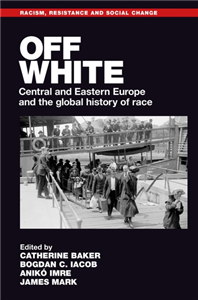
Off white
Central and Eastern Europe and the global history of race
by Catherine Baker, Bogdan C. Iacob, Anikó Imre, James Mark
This volume foregrounds racial difference as a key to an alternative history of the Central and Eastern European region, which revolves around the role of whiteness as the unacknowledged foundation of semi-peripheral nation-states and national identities, and of the region's current status as a global stronghold of unapologetic white, Christian nationalisms. Contributions address the pivotal role of whiteness in international diplomacy, geographical exploration, media cultures, music, intellectual discourses, academic theories, everyday language and banal nationalism's many avenues of expressions. The book offers new paradigms for understanding the relationships among racial capitalism, populism, economic peripherality and race.
-
Trusted Partner
 Humanities & Social SciencesJuly 2013
The 1989 Revolutions in Central and Eastern Europe
From Communism to Pluralism
by Kevin McDermott, Matthew Stibbe
This important book reassesses a defining historical, political and ideological moment in contemporary history: the 1989 revolutions in central and eastern Europe. Adopting a multi-disciplinary approach, the authors reconsider such crucial themes as the broader historical significance of the 1989 events, the complex interaction between external and internal factors in the origins and outcomes of the revolutions, the impact of the 'Gorbachev phenomenon', the West and the end of the Cold War, the political and socio-economic determinants of the revolutionary processes in Poland, Hungary, the German Democratic Republic, Czechoslovakia, Romania and Bulgaria, and the competing academic, cultural and ideological perceptions of the year 1989 as communism gave way to post-communist pluralism in the 1990s and beyond. Concluding that the contentious term 'revolution' is indeed apt for the momentous developments in eastern Europe in 1989, this book will be essential reading for undergraduates, postgraduates and specialists alike. ;
-
Trusted Partner
 Humanities & Social SciencesJuly 2018
The Victorian soldier in Africa
by Edward Spiers, Andrew Thompson, John M. MacKenzie
The Victorian soldier in Africa re-examines the campaign experience of British soldiers in Africa during the period, 1874-1902 - the zenith of the Victorian imperial expansion - and does so from the perspective of the regimental soldier. The book utilises an unprecedented number of letters and diaries, written by regimental officers and other ranks, to allow soldiers to speak for themselves about their experience of colonial warfare. The sources demonstrate the adaptability of the British army in fighting in different climates, over demanding terrain and against a diverse array of enemies. They also uncover soldiers' responses to army reforms of the era as well as the response to the introduction of new technologies of war. Moreover, the book provides commentary on soldiers' views of commanding officers and politicians alongside assessment of war correspondents, colonial auxiliaries and African natives in their roles as bearers, allies and enemies. This book reveals new insights on imperial and racial attitudes within the army, on relations between soldiers and the media and the production of information and knowledge from frontline to homefront. It will make fascinating reading for students, academics and enthusiasts in imperial history, Victorian studies, military history and colonial warfare.
-
Trusted Partner
-
Trusted Partner
 Humanities & Social SciencesJune 2009
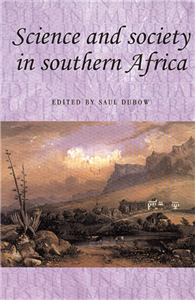
Science and society in southern Africa
by Andrew Thompson, Saul Dubow, John Mackenzie
This collection, dealing with case studies drawn from South Africa, Zimbabwe, Mozambique and Mauritius, examines the relationship between scientific claims and practices, and the exercise of colonial power. It challenges conventional views that portray science as a detached mode of reasoning with the capacity to confer benefits in a more or less even-handed manner. That science has the potential to further the collective good is not fundamentally at issue, but science can also be seen as complicit in processes of colonial domination. Not only did science assist in bolstering aspects of colonial power and exploitation, it also possessed a significant ideological component: it offered a means of legitimating colonial authority by counter-poising Western rationality to native superstition and it served to enhance the self-image of colonial or settler elites in important respects. This innovative volume ranges broadly through topics such as statistics, medicine, eugenics, agriculture, entomology and botany. ;
-
Trusted Partner
 Humanities & Social SciencesMarch 2017
Science and society in southern Africa
by Saul Dubow
This collection, dealing with case studies drawn from South Africa, Zimbabwe, Mozambique and Mauritius, examines the relationship between scientific claims and practices, and the exercise of colonial power. It challenges conventional views that portray science as a detached mode of reasoning with the capacity to confer benefits in a more or less even-handed manner. That science has the potential to further the collective good is not fundamentally at issue, but science can also be seen as complicit in processes of colonial domination. Not only did science assist in bolstering aspects of colonial power and exploitation, it also possessed a significant ideological component: it offered a means of legitimating colonial authority by counter-poising Western rationality to native superstition and it served to enhance the self-image of colonial or settler elites in important respects. This innovative volume ranges broadly through topics such as statistics, medicine, eugenics, agriculture, entomology and botany.



