
Your Search Results


-
Promoted Content

 March 2005
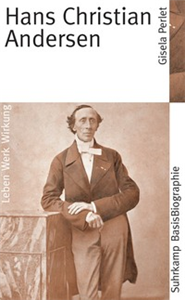
Hans Christian Andersen
by Gisela Perlet
Der Werdegang Hans Christian Andersens vom armen Schustersohn zum erfolgreichen Schriftsteller mutet wie ein Märchen an. Allerdings bemühte er sich auch nach Kräften, diesen Mythos zu pflegen. Andersens Figuren traten schon zu seinen Lebzeiten ihren Siegeszug durch die Welt an und sind bis heute unvergessen.
-
Promoted Content

 2025
2025Why Be a Christian Today?
by Elisabeth Zoll / Thomas Seiterich (eds.)
The exciting texts and reports by professing Christians offer a fresh perspective for all those who have cultivated a Christian spirituality for many years. However, the book also provides easy access for those who are newly interested in the Christian faith. There are probably as many professions of Christian faith as there are believers in the world. But what do Christians think and how have they been moulded? Elisabeth Zoll and Thomas Seiterich have compiled very personal ideas about the Christian faith in this book. When selecting the contributors, the editors deliberately chose not to include people with church offices or specialised theologians. Irrespective of church policy issues and church scandals, the contributors have provided insights into their path to faith.
-
 Trusted Partner

 November 2010
Lebenslust mit Christian Morgenstern
by Christian Morgenstern, Thomas Kluge
Christian Morgenstern wurde am 6. Mai 1871 in München geboren. 1892/93 begann er ein Studium der Rechtswissenschaften an der Universität Breslau, das er bald abbrach. Er zog nach Berlin und war dort als Journalist, Kultur- und Literaturkritiker und Redakteur tätig und veröffentlichte zahlreiche Beiträge und Glossen in Zeitschriften. Sein erster von seinen insgesamt vierzehn Lyrik-Bänden In Phantas Schloß erschien 1895. In der Folgezeit beschäftigte er sich mit der Übersetzung und Herausgabe der Werke von August Strindberg und Henrik Ibsen und schrieb für Max Reinhardts Berliner Kabarett »Schall und Rauch«. Von 1903 bis 1905 war er Redakteur der Zeitschrift »Das Theater« im Verlag von Bruno Cassirer, für den er auch als freier Lektor arbeitete. 1909 schloß sich Morgenstern dem Kreis der antroposophischen Gesellschaft um Rudolf Steiner an. Am 31. März 1914 starb er in Meran / Italien an den Folgen einer Tuberkulose-Erkrankung.
-
Trusted Partner
-
Trusted Partner

 Humanities & Social SciencesMarch 2025
Straight nation
Heteronormativity and other exigencies of postcolonial nationalism
by Pavan Mano
In Straight Nation, Pavan Mano reveals the logic of straightness that sits at the heart of postcolonial nationalism in Singapore. Mano rejects the romantic notion of the nation as a haven of belonging, showing it to be a relentless force that is allied with heteronormativity to create a host of minoritized and xenologized figures. Through meticulous exploration and close reading of a swathe of texts, Mano unveils the instrumental role of sexuality in structuring the national imaginary. The book adroitly demonstrates how queerness is rendered foreign in postcolonial Singapore and functions alongside technologies of "race", gender, and class. A provocative critique of narrow contemporary identity politics and its concomitant stymying of a more ambitious political critique, Straight Nation sets out an argument that moves beyond the negativity of traditional critique into a space of (re)thinking, (re)building and (re)imagining.
-
Trusted Partner
 Humanities & Social SciencesJuly 2025
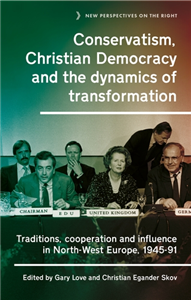
Conservatism, Christian Democracy and the dynamics of transformation
Traditions, cooperation and influence in North-West Europe, 1945-91
by Gary Love, Christian Egander Skov
Conservatism, Christian Democracy, and the Dynamics of Transformation compares the centre-right political traditions of Britain, the Nordic countries, France, West Germany, and Austria and looks for evidence of political cooperation and influence across borders during the period 1945-90. The book explores howa variety of intellectuals, politicians, and political parties transformed their politics in response to major economic, social, and political challenges and seeks to explain why conservatives and Christian democrats came to feel that they belonged to a wider centre-right political family by the end of this period. It also examines why these political traditions found it difficult to cooperate with each other after the Second World War and why they decided to invest more political capital in inter-party relations and wider transnational projects from the 1960s. As the book shows, these developments resulted in two new centre-right internationals: the European Democrat Union and the International Democrat Union.
-
Trusted Partner
 Humanities & Social SciencesMay 2020
English nationalism, Brexit and the Anglosphere
Wider still and wider
by Ben Wellings
This is the first book to examine the relationship between English nationalism, Brexit and 'the Anglosphere' - a politically-contested term used to denote English-speaking countries sharing cultural and historical roots with the UK. In the aftermath of the UK's EU referendum some pointed to a 'revolt' of those 'left behind' by globalisation. Ben Wellings argues instead that Brexit was and is an elite project, firmly situated within the tradition of an expansive English nationalism. Far from being parochial 'Little Englanders', elite Brexiteers sought to replace the European Union with trade and security alliances between 'true friends' and 'traditional allies' in the Anglosphere. Brexit was thus reassuringly presented as a giant leap into the known. As the UK's future relationship with the rest of the world is negotiated, the need to understand this 'English moment' has never been more pressing.
-
Trusted Partner
 Humanities & Social SciencesFebruary 2025
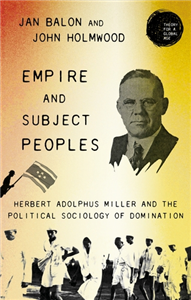
Empire and subject peoples
Herbert Adolphus Miller and the political sociology of domination
by Jan Balon, John Holmwood
The book outlines the sociological arguments and political activities of the US pragmatist sociologist, Herbert Adolphus Miller (1875-1951). Miller was part of the milieu of Chicago sociology and involved in its studies of race and immigration. He took a distinctly more radical approach and developed a novel political sociology of domination in which he set out a critique of empires, the plight of subject minorities and the risks associated with the inevitable nationalist responses. Where others have identified with the 'internationalisation' of nationalism, Miller sought to make the nation 'international'. He was actively involved in movements for racial justice, Czechoslovakian independence, the formation of the Mid-European Union of subject peoples, as well as support for Korean and Indian independence. He was dismissed by Ohio State University for his activism in 1932.
-
Trusted Partner
 Humanities & Social SciencesSeptember 2020
A global history of white nationalism
by Daniel Geary, Camilla Schofield, Jennifer Sutton, John Solomos, Satnam Virdee, Aaron Winter
-
Trusted Partner
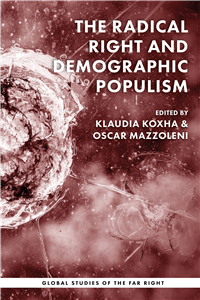 Humanities & Social SciencesJuly 2026
Weaponizing demography
The transformation of radical right-wing populism
by Oscar Mazzoleni, Klaudia Koxha
This book introduces a new framework for understanding how the radical right reimagines demographic change as an existential threat. Across Europe and the Americas, low birth rates, immigration, and gender equality are reframed as signs of civilisational decline. This volume explores how radical right actors mobilise fears around fertility, migration, race, family, and sexuality through narratives of crisis, ethnic purity, and control over borders, reproduction, and social norms. It examines conspiracy thinking fuelled by demographic anxiety to justify attacks on gender and sexual rights and reinforce exclusionary ideas of national belonging. Grounded in empirical case studies and interdisciplinary approaches, this book reveals how these narratives converge to reinforce dominance of a native, heteronormative, Christian population. In linking domains often treated separately, it provides a timely and critical perspective on the evolving logic of radical right politics worldwide.
-
Trusted Partner
 Humanities & Social SciencesJanuary 2013
Christian Dualist Heresies in the Byzantine World, c. 650-c. 1450
by Janet Hamilton, Bernard Hamilton
Christian dualism originated in the reign of Constans II (641-68). It was a popular religion, which shared with orthodoxy an acceptance of scriptual authority and apostolic tradition and held a sacramental doctrine of salvation, but understood all these in a radically different way to the Orthodox Church. One of the differences was the strong part demonology played in the belief system. This text traces, through original sources, the origins of dualist Christianity throughout the Byzantine Empire, focusing on the Paulician movement in Armenia and Bogomilism in Bulgaria. It presents not only the theological texts, but puts the movements into their social and political context.
-
Trusted Partner
-
Trusted Partner
 Humanities & Social SciencesMarch 2014
The politics of constitutional nationalism in Northern Ireland, 1932–70
Between grievance and reconciliation
by Christopher Norton
In the changed political landscape of Northern Ireland, where all major political parties with a nationalist agenda are now reconciled to the use of peaceful and constitutional means to achieve their objectives, this book presents a timely analysis of the constitutional nationalist tradition in Northern Ireland in the period leading up to the outbreak of the Troubles. The first book on constitutional nationalism to appear in over a decade, this new and incisive work based on extensive primary sources and existing secondary literature, maps the history of the campaigns of nationalist parties and organisations to redress the grievances of Northern Ireland's Catholics and bring partition to an end. It offers a critical reappraisal of these campaigns and it assesses the outcomes and consequences of the political strategies pursued by an array of nationalist parties and groups. ;
-
Trusted Partner
-
Trusted Partner

 September 2003
Hans Jonas – »Zusammen Philosoph und Jude«
Essay
by Christian Wiese
Hans Jonas verstand sich nie als »jüdischer Philosoph«, sondern fühlte sich einem universalen philosophischen Denken verpflichtet. »Daß man zusammen Philosoph und Jude ist, darin liegt eine gewisse Spannung, das ist keine Frage.« Die gerade erschienenen Erinnerungen des großen Denkers bezeugen eindringlich sein bewußtes Jude-Sein: Das Engagement für den Zionismus, die Emigration nach Palästina, der Kampf gegen Nazi-Deutschland als Soldat der Jüdischen Brigade, die Ermordung seiner Mutter in Auschwitz sind entscheidende biographische Wegmarken. Vor diesem Hintergrund ist das Verhältnis von Leben und Werk neu in den Blick zu nehmen. Auf der Grundlage von bislang größtenteils unbekannten Zeugnissen dokumentiert Christian Wiese aufschlußreiche Facetten der Jonasschen Biographie – etwa die Freundschaft sowie den Konflikt mit Gershom Scholem und Hannah Arendt. Zudem zeigt er die Einflüsse jüdischer Traditionselemente in dessen religionsgeschichtlichen und philosophischen Schriften auf. Die von Hans Jonas zeitlebens bewahrte Bindung an das Judentum ist, wie Christian Wiese hier erstmals umfassend vor Augen führt, zentral für das Verständnis seines Lebenswerks.
-
Trusted Partner
-
Trusted Partner
-
Trusted Partner

 February 2009
Federführung für die Nation ohne Vorbehalt?
Deutsche Medien in China während der Zeit des Nationalsozialismus
by Taaks, Christian
-
Trusted Partner
 October 2024
Hans Christian Andersen
Little People, Big Dreams. Deutsche Ausgabe | Der Erfinder der kleinen Meerjungfrau | Kinderbuch ab 4 Jahre
by María Isabel Sánchez Vegara, Maxine Lee-Mackie, Svenja Becker
Seine Eltern waren arm, aber einen Schatz gab es im Haus, der sorgsam behandelt wurde: ein Märchenbuch, aus dem der Vater dem kleinen Hans Christian abends vorlas. Und wenn schon mein Leben kein Märchen sein kann, wird er sich gedacht haben, als er mit elf Jahren bei einem Weber in die Lehre ging, dann möchte ich wenigstens Märchen schreiben. Heute ist die kleine Meerjungfrau – die wunderschön-traurige Heldin eines seiner 160 Märchen – Kopenhagens Wahrzeichen, und jedes Jahr feiern Kinder auf der ganzen Welt am 2. April, Andersens Geburtstag, den Internationalen Tag des Kinderbuchs. Little People, Big Dreams erzählt von den beeindruckenden Lebensgeschichten großer Menschen: Jede dieser Persönlichkeiten, ob Philosophin, Forscherin oder Sportler, hat Unvorstellbares erreicht. Dabei begann alles, als sie noch klein waren: mit großen Träumen.
-
Trusted Partner
 Humanities & Social SciencesMarch 2017
The French empire between the wars
Imperialism, politics and society
by Martin Thomas
By considering the distinctiveness of the inter-war years as a discrete period of colonial change, this book addresses several larger issues, such as tracing the origins of decolonization in the rise of colonial nationalism, and a re-assessment of the impact of inter-war colonial rebellions in Africa, Syria and Indochina. The book also connects French theories of colonial governance to the lived experience of colonial rule in a period scarred by war and economic dislocation.



