
Your Search Results
-

-

Ice Cold Publishing
Ice Cold Publishing is a dynamic Australian publisher creating beautiful mind-body-spirit, cooking, gardening and non-book products for the world.
View Rights Portal
-
Promoted Content

 Humanities & Social SciencesAugust 2018
Flight MH17, Ukraine and the new Cold War
by Kees van der Pijl, Radhika Desai, Alan Freeman
-
Promoted Content
 Humanities & Social SciencesNovember 2021
De-centering queer theory
Communist sexuality in the flow during and after the Cold War
by Bogdan Popa, Gurminder Bhambra
De-centering queer theory seeks to reorient queer theory to a different conception of bodies and sexuality derived from Eastern European Marxism. The book articulates a contrast between the concept of the productive body, which draws its epistemology from Soviet and avant-garde theorists, and Cold War gender, which is defined as the social construction of the body. The first part of the book concentrates on the theoretical and visual production of Eastern European Marxism, which proposed an alternative version of sexuality to that of western liberalism. In doing so it offers a historical angle to understand the emergence not only of an alternative epistemology, but also of queer theory's vocabulary. The second part of the book provides a Marxist, anti-capitalist archive for queer studies, which often neglects to engage critically with its liberal and Cold War underpinnings.
-
 Trusted Partner
 Humanities & Social SciencesApril 2025
Britain’s 'Mr X’
Sir Frank Roberts and the making of British foreign policy, 1930-68
by Jonathan Colman
Over four decades as a diplomat, Sir Frank Roberts dealt with headline issues, including policy towards Germany during the years of appeasement, the Second World War alliance with the Soviet Union, the origins of the Cold War, NATO affairs, the Berlin and Cuban Missile Crises, European integration, and relations with the Federal Republic of Germany. Collaborating with the renowned American diplomat, George F. Kennan (the cryptonymous author 'X' of an influential 1947 article), his despatches from Moscow in 1946 shaped Britain's Cold War strategy. In 1954 he played an integral part in the diplomacy behind the rearmament of the Federal Republic and her incorporation into NATO, helping to build an enduring structure of transatlantic security. Roberts' career sheds new light on British foreign policy across an era in which Britain slipped from global pre-eminence to regional power status.
-
Trusted Partner
 Humanities & Social SciencesMarch 2026
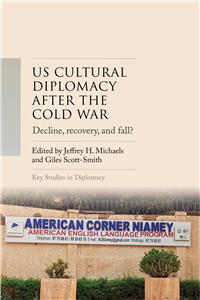
US cultural diplomacy after the Cold War
Decline, recovery, and fall
by Jeffrey H. Michaels, Giles Scott-Smith
In the decades following the USSR's collapse, the US has gone from unrivalled hegemon to a position of relative decline. With America 'triumphant' after 1991, its culture, like its diplomatic, military and economic power, remained unmatched. Such favourable circumstances seemed to undercut the need for cultural diplomacy. Why should the US government sell a product that was already selling so well? After 9/11, however, it was apparent the US image was less popular than previously assumed. To reverse this negative image, cultural diplomacy was revived. Despite being beset by internal and external challenges, US officials supported various cultural initiatives and partnerships to promote the American brand globally. Along the way, cultural diplomacy has made use of new forms of expression to promote American culture and build positive foreign relations. The arrival of the second Trump administration in 2025 has clearly signalled an end to using cultural diplomacy to further causes of empowerment and diversity, making the future uncertain for this field of activity.
-
Trusted Partner
 Humanities & Social SciencesNovember 2024
US public diplomacy in socialist Yugoslavia, 1950–70
Soft culture, cold partners
by Carla Konta
The first comprehensive account of the public and cultural diplomacy campaigns carried out by the US in Yugoslavia during the height of the Cold War, this book examines the political role of culture in US-Yugoslav bilateral relations and the fluid links between information and propaganda. Tito allowed the US Information Agency and the State Department's cultural programmes to enter Yugoslavia, liberated from Soviet control. The exchange of intellectual and political personnel helped foster the US-Yugoslav relationship, yet it posed severe ideological challenges for both sides. By providing new insights into porous borders between freedom and coercion in Tito's regime, this book shows how public diplomacy acted as an external input for Yugoslav liberalisation and dissident movements. Using extensive archival research and interviews, Konta analyses the links between information and propaganda, and the unintended effects of propaganda beyond the control of producers and receivers.
-
Trusted Partner

 October 2022
My Father's Secret
The BND, my family and I
by Corinna von Bassewitz
For a long time, Corinna von Bassewitz believed her father was a soldier, later on that he was a diplomat. Then, at the age of 16, she learnt something unbelievable: he had been a secret agent for the Bundesnachrichtendienst (BND, Germany's Federal Intelligence Service). Once the secret had been at least partly uncovered, she became something of a spy herself and eventually found some confidential documents in her parents' attic. Later, she realised that her father had been living as a double agent for the FRG and the GDR. So what effect does it have on a girl if her father conceals his true identity and eventually disappears without trace? Along with her family history, the author provides multi-layered and exciting insights into the historical context of the Cold War. A very personal book, intriguingly told and emotionally touching.
-
Trusted Partner
Humanities & Social SciencesNovember 2024
Unofficial peace diplomacy
Private peace entrepreneurs in conflict resolution processes
by Lior Lehrs
This book analyses the international phenomenon of private peace entrepreneurs. These are private citizens with no official authority who initiate channels of communication with official representatives from the other side of a conflict in order to promote a conflict resolution process. It combines theoretical discussion with historical analysis, examining four cases from different conflicts: Norman Cousins and Suzanne Massie in the Cold War, Brendan Duddy in the Northern Ireland conflict and Uri Avnery in the Israeli-Palestinian conflict. The book defines the phenomenon, examines the resources and activities of private peace entrepreneurs and their impact on the official diplomacy, and examines the conditions under which they can play an effective role in peace-making processes. This book is relevant to United Nations Sustainable Development Goal 16, Peace, justice and strong institutions.
-
Trusted Partner
-
Trusted Partner
 The ArtsSeptember 2024
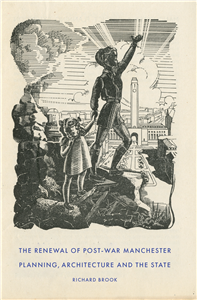
The renewal of post-war Manchester
Planning, architecture and the state
by Richard Brook
A compelling account of the project to transform post-war Manchester, revealing the clash between utopian vision and compromised reality. Urban renewal in Britain was thrilling in its vision, yet partial and incomplete in its implementation. For the first time, this deep study of a renewal city reveals the complex networks of actors behind physical change and stagnation in post-war Britain. Using the nested scales of region, city and case-study sites, the book explores the relationships between Whitehall legislation, its interpretation by local government planning officers and the on-the-ground impact through urban architectural projects. Each chapter highlights the connections between policy goals, global narratives and the design and construction of cities. The Cold War, decolonialisation, rising consumerism and the oil crisis all feature in a richly illustrated account of architecture and planning in post-war Manchester.
-
Trusted Partner
 Business, Economics & LawJuly 2025
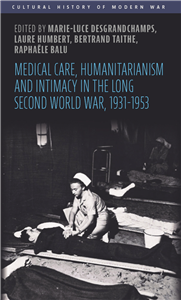
Medical care, humanitarianism and intimacy in the long Second World War, 1931-1953
by Marie-Luce Desgrandchamps, Laure Humbert, Bertrand Taithe, Raphaële Balu
This book offers a micro-global history of humanitarianism and medical care during the 'long' Second World War, which challenges the traditional and Eurocentric chronological boundaries of 1939/1945. It takes as its starting point the Japanese invasion of Manchuria in 1931, which led to the progressive dislocation of the League of Nations, with the Japanese, German and Soviet departures in the 1930s. It ends with the termination of the Korean War in 1953, and the subsequent dismantlement of the first United Coalition and UN Peace enforcement operation. It considers the slow, messy and ambivalent transformation of humanitarian actors' relations to the suffering of distant others through a study of humanitarian encounters, practices, spaces and affects. Paying close attention to a variety of actors, such as French colonial doctors, Swiss ICRC delegates, Egyptian relief workers, Chinese-style physicians, Peruvian and Ecuadorian nurses or American member of the Unitarian Service Committee, the book provides a more holistic story of humanitarianism.
-
Trusted Partner
 Humanities & Social SciencesJuly 2025
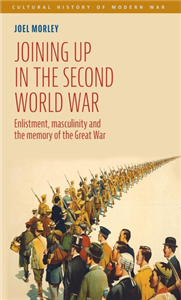
Joining up in the Second World War
Enlistment, masculinity and the memory of the Great War
by Joel Morley
This book connects the First and Second World Wars. It uses oral histories and Mass Observation material to explore men's attitudes to Second World War enlistment and the relationship they perceived between military service and masculinity, and how these were influenced by understandings of the First World War. Locating the cultural legacy of First World War in the subjectivities of men who participated in the Second World War demonstrates the breadth of sources that informed men's understandings of the First World War in interwar Britain. Its cultural legacy was omnipresent and diverse, and informed young men's attitudes and service preferences, but it reinforced Edwardian conceptions of wartime masculinity as often as it undermined them. Two decades after the First World War ended, they remained resilient in the subjective understandings of men who grew up in the Great War's shadow.
-
Trusted Partner
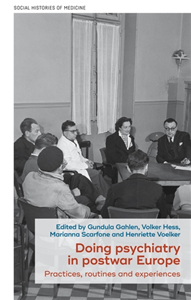 MedicineMarch 2024
Doing psychiatry in postwar Europe
Practices, routines and experiences
by Gundula Gahlen, Henriette Voelker, Volker Hess, Marianna Scarfone
Doing psychiatry engages with the history of European psychiatry in the second half of the twentieth century through a close and fresh look at the practices that contributed to reshape the mental health field. Case studies from across Europe allow readers to appreciate how new 'ways of doing' contributed to transform the field, beyond the watchwords of deinstitutionalisation, the prescription of neuroleptics, centrality of patients and overcoming of asylum-era habits. Through a variety of sources and often adopting a small-scale perspective, the chapters take a close look at the way new practices emerged and at how they installed themselves, eventually facing resistance, injecting new purposes and contributing to enlarging psychiatry's fields of expertise, therefore blurring its once-more-defined boundaries.
-
Trusted Partner

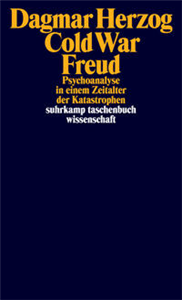 November 2023
Cold War Freud
Psychoanalyse in einem Zeitalter der Katastrophen
by Dagmar Herzog, Aaron Lahl
Hitzige Kämpfe tobten in der Folge des Zweiten Weltkrieges um das Erbe Sigmund Freuds. Die verspätete Aufarbeitung des Nationalsozialismus, die sexuelle Revolution und die Dekolonisation stießen fundamentale Transformationsprozesse in der psychoanalytischen Theorie an, die ihrerseits auf die Kultur zurückwirkten. Von den USA über Europa bis nach Lateinamerika schildert Dagmar Herzog die Deutungskämpfe einer Zunft, deren konkurrierende Theorien über Begehren, Angst, Aggression, Lust und Trauma mal konservativen, mal subversiven Zielen dienten – und hält damit ein innovatives Plädoyer für die Psychoanalyse als Erkenntnisinstrument im Dickicht der Verflechtung von Psyche und Gesellschaft.
-
Trusted Partner
-
Trusted Partner
-
Trusted Partner
-
Trusted Partner
-
Trusted Partner
 Humanities & Social SciencesApril 2020
Early modern war narratives and the Revolt in the Low Countries
by Raymond Fagel, Leonor Álvarez Francés, William G. Naphy, Beatriz Santiago Belmonte
-
Trusted Partner
 Humanities & Social SciencesSeptember 2020
Defense of the West
by Stanley R. Sloan, Lawrence Freedman
-
Trusted Partner
 Humanities & Social SciencesNovember 2013
Britain’s Korean War
Cold War diplomacy, strategy and security 1950–53
by Thomas Hennessey
The book assesses the strains within the 'Special Relationship' between London and Washington and offers a new perspective on the limits and successes of British influence. The interaction between the main personalities on the British side - Attlee, Bevan, Morrison, Churchill and Eden - and their American counterparts - Truman, Acheson, Eisenhower and Dulles - are chronicled. By the end of the war the British were concerned that it was the Americans, rather than the Soviets, who were the greater threat to world peace. British fears concerning the Korean War were not limited to the diplomatic and military fronts - these extended to the 'Manchurian Candidate' threat posed by returning prisoners of war who had been exposed to communist indoctrination. The book is essential reading for those interested in British and US foreign policy and military strategy during the Cold War. ;



