Your Search Results

      • Chemical Industry Press Co. Ltd.

        Chemical Industry Press( hereinafter called “CIP”) was established in 1953, and is one of the most distinguished state-owned publishers in China. As one of “top 100 publishers in China”, CIP has been seen as a well-known and trusted brand in China. For years, CIP is one of the most impressive Chinese publisher with powerful overseas libraries’ collection influence. Key subjects: Chemistry, Materials, Environment, Energy, Engineering, Machine, Automotive, Electric & Electrical, Architecture, Biology, Pharmacy, Medicine, Healthcare, Business & Management, Humanities, Lifestyle, Photography, Self-help, Baby & Parenting, Language learning, Literature&Arts,etc.

        View Rights Portal
      • Trusted Partner
        Lifestyle, Sport & Leisure
        August 2016

        Culture in Manchester

        Institutions and urban change since 1850

        by Janet Wolff, Mike Savage

        This book brings together studies of cultural institutions in Manchester from 1850 to the present day, giving an unprecedented account of the city's cultural evolution. These bring to light the remarkable range of Manchester's contribution to modern cultural life, including the role of art education, popular theatre, religion, pleasure gardens, clubs and societies. The chapters show the resilience and creativity of Manchester's cultural institutions since 1850, challenging any simple narrative of urban decline following the erosion of Lancashire's industrial base, at the same time illustrating the range of activities across the social classes. This book will appeal to everyone interested in the cultural life of the city of Manchester, including cultural historians, sociologists and urban geographers, as well as general readers with interests in the city. It is written by leading international authorities, including Viv Gardner, Stephen Milner, Mike Savage, Bill Williams and Janet Wolff.

      • Trusted Partner
        Humanities & Social Sciences
        September 2025

        Industrial memory in North East England

        Negotiating northernness

        by Victoria Allen

        Industrial memory in North East England examines how the region's industrial myth and memory have been articulated in the renegotiation of northernness. The book offers a critical contextualisation of the concept of northernness and the English North, and an introduction to the concept of the PopCultural Portfolio, a mixed-methods approach to conjunctural analysis in cultural and memory studies. The book provides six richly illustrated case studies to demonstrate the practical application of cultural studies' expansive and inclusive understanding of texts, bringing together materials from North East football, folk, indie and exhibition culture to establish how the North East's industrial past continues to be remembered and functionalised as industrial memory. In turn, the conjunctural analysis demonstrates how industrial memory is articulated and mythologised as north(east)ernes in contemporary popular culture.

      • Trusted Partner
        Humanities & Social Sciences
        April 2018

        Disability in the Industrial Revolution

        Physical impairment in British coalmining, 1780–1880

        by David M. Turner, Daniel Blackie, Julie Anderson

        An electronic version of this book is also available under a Creative Commons (CC-BY-NC-ND) license, thanks to the support of the Wellcome Trust. The Industrial Revolution produced injury, illness and disablement on a large scale and nowhere was this more visible than in coalmining. Disability in the Industrial Revolution sheds new light on the human cost of industrialisation by examining the lives and experiences of those disabled in an industry that was vital to Britain's economic growth. Although it is commonly assumed that industrialisation led to increasing marginalisation of people with impairments from the workforce, disabled mineworkers were expected to return to work wherever possible, and new medical services developed to assist in this endeavour. This book explores the working lives of disabled miners and analyses the medical, welfare and community responses to disablement in the coalfields. It shows how disability affected industrial relations and shaped the class identity of mineworkers. The book will appeal to students and academics interested in disability, occupational health and social history.

      • Trusted Partner
        Humanities & Social Sciences
        November 2024

        Culture is bad for you

        by Orian Brook, Dave O'Brien, Mark Taylor

      • Trusted Partner
        Humanities & Social Sciences
        April 2022

        Critical theory and demagogic populism

        by Paul K. Jones, Darrow Schecter

        Populism is a powerful force today, but its full scope has eluded the analytical tools of both orthodox and heterodox 'populism studies'. This book provides a valuable alternative perspective. It reconstructs in detail for the first time the sociological analyses of US demagogues by members of the Frankfurt School and compares these with contemporary approaches. Modern demagogy emerges as a key under-researched feature of populism, since populist movements, whether 'left' or 'right', are highly susceptible to 'demagogic capture'. The book also details the culture industry's populist contradictions - including its role as an incubator of modern demagogues - from the 1930s through to today's social media and 'Trumpian psychotechnics'. Featuring a previously unpublished text by Adorno on modern demagogy as an appendix, it will be of interest to everyone concerned about the rise of demagogic populism today.

      • Trusted Partner
        Humanities & Social Sciences
        September 2021

        Critical theory and demagogic populism

        by Paul K. Jones

        Populism is a powerful force today, but its full scope has eluded the analytical tools of both orthodox and heterodox 'populism studies'. This book provides a valuable alternative perspective. It reconstructs in detail for the first time the sociological analyses of US demagogues by members of the Frankfurt School and compares these with contemporary approaches. Modern demagogy emerges as a key under-researched feature of populism, since populist movements, whether 'left' or 'right', are highly susceptible to 'demagogic capture'. The book also details the culture industry's populist contradictions - including its role as an incubator of modern demagogues - from the 1930s through to today's social media and 'Trumpian psychotechnics'. Featuring a previously unpublished text by Adorno on modern demagogy as an appendix, it will be of interest to researchers and students in critical theory, sociology, politics, German studies, philosophy and history of ideas, as well as all those concerned about the rise of demagogic populism today.

      • Trusted Partner
        November 2022

        Cancel Culture Transfer

        Wie eine moralische Panik die Welt erfasst | Das Phänomen »Cancel Culture« verstehen

        by Adrian Daub

        Ein Gespenst geht um in Europa, ja in der ganzen Welt – das Gespenst der Cancel Culture. Glaubt man diversen Zeitungen, dürfen insbesondere weiße Männer jenseits der vierzig praktisch nichts mehr sagen, wenn sie nicht ihren guten Ruf oder gar ihren Job riskieren wollen. Ist da etwas dran? Oder handelt es sich häufig um Panikmache, bei der Aktivist:innen zu einer Gefahr für die moralische Ordnung stilisiert werden, um ihre berechtigten Anliegen zu diskreditieren? Der Ursprung der Cancel Culture wird üblicherweise an US-Universitäten verortet. Adrian Daub lehrt im kalifornischen Stanford Literaturwissenschaft. Er zeigt, wie während der Reagan-Jahre entwickelte Deutungsmuster über Campus-Romane verbreitet und auf die Gesellschaft insgesamt übertragen wurden. Man pickt einige wenige Anekdoten heraus und reicht sie herum, was auch hierzulande zu einer verzerrten Wahrnehmung führt. Anhand quantitativer Analysen zeichnet Daub nach, wie diese Diagnosen immer weitere Kreise zogen, bis sie auch die Twitter-Kanäle deutscher Politiker erfassten.

      • Trusted Partner
        August 2006

        Culture Club II

        Klassiker der Kulturtheorie

        by Martin Ludwig Hofmann, Tobias F. Korta, Sibylle Niekisch

        Was heißt »Kultur«? Kaum ein anderer Begriff durchzieht die theoretische Debatte der letzten Jahrzehnte mit solch einer Wucht.Kulturtheorie ist nicht nur zu einem interdisziplinären, sondern auch zu einem internationalen intellektuellen Abenteuer geworden.Auch der zweite Band des Culture Club bietet eine Orientierung in diesem schwer überschaubaren Feld, indem er einen überblick über das jeweilige Werk und Denken zentraler Kulturtheoretiker gibt.Vorgestellt werden Max Weber, Siegfried Kracauer, Martin Heidegger, Helmuth Plessner, Margaret Mead, Hannah Arendt, Marshall McLuhan, Richard Hoggart, Vilém Flusser, Raymond Williams, Paul Feyerabend, Jean-François Lyotard, Ivan Illich, Clifford Geertz, Jacques Derrida und Stuart Hall.

      • Trusted Partner
        Humanities & Social Sciences
        October 2013

        Culture in Manchester

        Institutions and urban change since 1850

        by Janet Wolff

        This book brings together studies of cultural institutions in Manchester from 1850 to the present day, giving an unprecedented account of the city's cultural evolution. These bring to light the remarkable range of Manchester's contribution to modern cultural life, including the role of art education, popular theatre, religion, pleasure gardens, clubs and societies. The chapters show the resilience and creativity of Manchester's cultural institutions since 1850, challenging any simple narrative of urban decline following the erosion of Lancashire's industrial base, at the same time illustrating the range of activities across the social classes. This book will appeal to everyone interested in the cultural life of the city of Manchester, including cultural historians, sociologists and urban geographers, as well as general readers with interests in the city. It is written by leading international authorities, including Viv Gardner, Stephen Milner, Mike Savage, Bill Williams and Janet Wolff. ;

      • Trusted Partner
        Humanities & Social Sciences
        November 2020

        Critical theory and demagogic populism

        by Paul Jones

      • Trusted Partner
      • Trusted Partner
        Humanities & Social Sciences
        February 2023

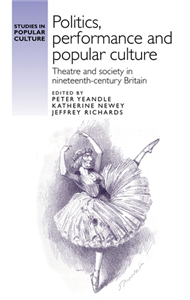
        Politics, performance and popular culture

        Theatre and society in nineteenth-century Britain

        by Peter Yeandle, Katherine Newey, Jeffrey Richards

        This collection brings together studies of popular performance and politics across the nineteenth century, offering a fresh perspective from an archivally grounded research base. It works with the concept that politics is performative and performance is political. The book is organised into three parts in dialogue regarding specific approaches to popular performance and politics. Part I offers a series of conceptual studies using popular culture as an analytical category for social and political history. Part II explores the ways that performance represents and constructs contemporary ideologies of race, nation and empire. Part III investigates the performance techniques of specific politicians - including Robert Peel, Keir Hardie and Henry Hyndman - and analyses the performative elements of collective movements.

      • Trusted Partner
        June 2024

        Wissenschaftsfreiheit und Moral

        by Tim Henning

        Die Wissenschaftsfreiheit gilt vielerorts als bedroht von Moralismus, Denkverboten und Cancel Culture. Aber ist moralische Empörung angesichts bestimmter wissenschaftlicher Positionen – etwa zu Genetik und IQ, zu Geschlecht und Biologie oder zu Behinderung und Infantizid – immer ein ideologischer, sachfremder Versuch der Bevormundung? Oder gibt es legitime moralische Kritik an wissenschaftlichen Thesen? Der Philosoph Tim Henning geht diesen Fragen in seinem hochaktuellen und originellen Buch auf den Grund. Einerseits verteidigt er eine strenge Auffassung von Wissenschaftsfreiheit: Die Wissenschaft ist ein autonomer Bereich und sollte als solcher auch respektiert werden. Sie sollte sich allein an den Kriterien orientieren, die sich aus der immanenten Natur einer systematischen Wahrheitssuche ergeben – an Daten und Belegen, an wahr oder falsch. Andererseits betont er die Möglichkeit einer nichtmoralistischen moralischen Kritik. Ansatzpunkte hierfür finden sich im Inneren des vermeintlich reinen Bereichs wissenschaftlicher Kriterien, wie neuere Analysen aus Erkenntnistheorie und Sprachphilosophie zeigen. Es sind die praktischen Kosten eines Irrtums, die sich als erkenntnistheoretisch und als moralisch relevant erweisen. Ob eine These wissenschaftlich haltbar ist, kann daher durchaus eine moralische Frage sein.

      • Trusted Partner
        Clinical psychology

        Cultural and Ethnic Diversity

        How European Psychologists Can Meet the Challenges

        by Alexander Thomas

        Culture and diversity are both challenge and opportunity. This volume looks at what psychologists are and can be doing to help society meet the challenges and grasp the opportunities in education, at work, and in clinical practice. The increasingly international and globalized nature of modern societies means that psychologists in particular face new challenges and have new opportunities in all areas of practice and research. The contributions from leading European experts cover relevant intercultural issues and topics in areas as diverse as personality, education and training, work and organizational psychology, clinical and counselling psychology, migration and international youth exchanges. As well as looking at the new challenges and opportunities that psychologists face in dealing with people from increasingly varied cultural backgrounds, perhaps more importantly they also explain and discuss how psychologists can deepen and acquire the intercultural competencies that are now needed in our professional lives.   Target Group: psychotherapists / clinical psychologists / mental health professionals

      • Trusted Partner
        Humanities & Social Sciences
        December 2024

        British culture after empire

        Race, decolonisation and migration since 1945

        by Josh Doble, Liam Liburd, Emma Parker

        British culture after Empire is the first collection of its kind to explore the intertwined social, cultural and political aftermath of empire in Britain from 1945 up to and beyond the Brexit referendum of 2016, combining approaches from the fields of history, English and cultural studies. Against those who would deny, downplay or attempt to forget Britain's imperial legacy, the various contributions expose and explore how the British Empire and the consequences of its end continue to shape Britain at the local, national and international level. As an important and urgent intervention in a field of increasing relevance within and beyond the academy, the book offers fresh perspectives on the colonial hangovers in post-colonial Britain from up-and-coming as well as established scholars.

      • Trusted Partner
        Humanities & Social Sciences
        June 2024

        Pandemic culture

        by Ben Walmsley, Abigail Gilmore, Dave O'Brien

      • Trusted Partner
        The Arts
        May 2024

        Adaptation and resilience in the performing arts

        The pandemic and beyond

        by Pascale Aebischer, Rachael Nicholas

        This book offers insights into some of the digital innovations, structural adaptations and analogue solutions that enabled live performance in the UK to survive through the COVID-19 pandemic. It provides evidence of values-led policies and practices that have improved the wellbeing of the creative workforce and have increased access to live performance. Through sections that address digital innovations, workforce resilience and programming live performances outdoors and in community settings, this book provides practical insights into the challenges live performance faced during the pandemic. It shows how, in order to survive, individuals and companies within the sector drew on the creativity and resourcefulness of its workforce, and on new and existing networks. In these accounts, the pandemic functioned as catalyst for technological innovations, stock-taking regarding exploitative industry structures, and a re-valuing of the role of live performance for community-building.

      • Trusted Partner
        Humanities & Social Sciences
        May 2021

        Culture matters

        by Robert Hendershot, Steve Marsh

      Subscribe to our

      newsletter