Your Search Results

      • Rights Expert

        Rights Expert Literary and Licensing Agency is representing in Romania, directly or through other agents, more than 45 publishing houses and imprints (mainly from UK and USA). Part of the publishers represented in Romania agreed to give us the international representation for other CEE territories: Poland, Czech Republic, Slovakia, Hungary, Croatia, Slovenia, Serbia, Bulgaria. Rights Expert Literary and Licensing Agency is having a portfolio of creative, independent and flexible publishers from domains like: Children and Young Adult books (non-fiction): activity books, color and stickers books. Children and Young Adult books (fiction): picture books (trendy in all the markets); story books; novels; comic magazines and books. Adult non-fiction: Self-help, Health, Body, Mind & Spirit etc. Adult fiction

        View Rights Portal
      • Daniel Goleman - Foreign Audio

        Please contact anaban@gmail.com for information

        View Rights Portal
      • Trusted Partner
      • Trusted Partner
        Humanities & Social Sciences
        January 2026

        Dancing through the dissonance

        by Lesley Pruitt, Erica Rose Jeffrey

      • Trusted Partner
        The Arts
        May 2024

        Adaptation and resilience in the performing arts

        The pandemic and beyond

        by Pascale Aebischer, Rachael Nicholas

        This book offers insights into some of the digital innovations, structural adaptations and analogue solutions that enabled live performance in the UK to survive through the COVID-19 pandemic. It provides evidence of values-led policies and practices that have improved the wellbeing of the creative workforce and have increased access to live performance. Through sections that address digital innovations, workforce resilience and programming live performances outdoors and in community settings, this book provides practical insights into the challenges live performance faced during the pandemic. It shows how, in order to survive, individuals and companies within the sector drew on the creativity and resourcefulness of its workforce, and on new and existing networks. In these accounts, the pandemic functioned as catalyst for technological innovations, stock-taking regarding exploitative industry structures, and a re-valuing of the role of live performance for community-building.

      • Trusted Partner
        Children's & YA

        Quiz Yourself Smart! Bees and Our Nature

        by Friederun Reichenstetter/ Helen Seeberg/ Hans-Günther Döring

        Where do bees get the wax for their honeycombs from? What does the bee dance mean? Why are bees important for us humans? General knowledge for primary school children! Who will be quiz king? The life of the little honeybee and its environment is full of surprises. Do you know your way around the native animal world? Discover their secrets, research how animals live and what distinguishes them. One quiz question – three possible answers. Plus all sorts of fascinating facts on the reverse page. For one or more players aged 6+.

      • Trusted Partner
        Humanities & Social Sciences
        June 2026

        Ageing and new intimacies

        by Sarah Milton

      • Trusted Partner
        History
        April 2017

        Dancing in the English style

        Consumption, Americanisation, and national identity in Britain, 1918–50

        by Allison Abra. Series edited by Jeffrey Richards

        Dancing in the English style explores the development, experience, and cultural representation of popular dance in Britain from the end of the First World War to the early 1950s. It describes the rise of modern ballroom dancing as Britain's predominant popular style, as well as the opening of hundreds of affordable dancing schools and purpose-built dance halls. It focuses in particular on the relationship between the dance profession and dance hall industry and the consumers who formed the dancing public. Together these groups negotiated the creation of a 'national' dancing style, which constructed, circulated, and commodified ideas about national identity. At the same time, the book emphasizes the global, exploring the impact of international cultural products on national identity construction, the complexities of Americanisation, and Britain's place in a transnational system of production and consumption that forged the dances of the Jazz Age.

      • Trusted Partner
        Humanities & Social Sciences
        March 2026

        US cultural diplomacy after the Cold War

        Decline, recovery, and fall

        by Jeffrey H. Michaels, Giles Scott-Smith

        In the decades following the USSR's collapse, the US has gone from unrivalled hegemon to a position of relative decline. With America 'triumphant' after 1991, its culture, like its diplomatic, military and economic power, remained unmatched. Such favourable circumstances seemed to undercut the need for cultural diplomacy. Why should the US government sell a product that was already selling so well? After 9/11, however, it was apparent the US image was less popular than previously assumed. To reverse this negative image, cultural diplomacy was revived. Despite being beset by internal and external challenges, US officials supported various cultural initiatives and partnerships to promote the American brand globally. Along the way, cultural diplomacy has made use of new forms of expression to promote American culture and build positive foreign relations. The arrival of the second Trump administration in 2025 has clearly signalled an end to using cultural diplomacy to further causes of empowerment and diversity, making the future uncertain for this field of activity.

      • Trusted Partner
        Humanities & Social Sciences
        June 2025

        Taking travel home

        The souvenir culture of British women tourists, 1750–1830

        by Emma Gleadhill

        In the late eighteenth-century, elite British women had an unprecedented opportunity to travel. Taking travel home uncovers the souvenir culture these women developed around the texts and objects they brought back with them to realise their ambitions in the arenas of connoisseurship, friendship and science. Key characters include forty-three-year-old Hester Piozzi (Thrale), who honeymooned in Italy; thirty-one-year-old Anna Miller, who accompanied her husband on a Grand Tour; Dorothy Richardson, who undertook various tours of England from the ages of twelve to fifty-two; and the sisters Katherine and Martha Wilmot, who travelled to Russia in their late twenties. The supreme tourist of the book, the political salon hostess Lady Elizabeth Holland, travelled to many countries with her husband, including Paris, where she met Napoleon, and Spain during the Peninsular War. Using a methodology informed by literary and design theory, art history, material culture studies and tourism studies, the book examines a wide range of objects, from painted fans "of the ruins of Rome for a sequin apiece" and the Pope's "bless'd beads", to lava from Vesuvius and pieces of Stonehenge. It argues that the rise of the souvenir is representative of female agency, as women used their souvenirs to form spaces in which they could create and control their own travel narratives.

      • Trusted Partner
        Humanities & Social Sciences
        November 2016

        Dance and politics

        by Dana Mills

      • Trusted Partner
        December 2025

        Dance of Stars and Ashes

        Das Nachtfeuer-Quartett 2

        by Tuli, Nisha J.

        Aus dem Englischen von Paula Telge

      • Trusted Partner
        January 2003

        Let's Dance

        Das Tanzbuch (mit einem Crashkurs von Birgitta Dehning und Martin Schleifstein)

        by Trautner, Tamara / Zusammen mit Dehning, Birgitta; Zusammen mit Schleifstein, Martin

      • Trusted Partner
      • Trusted Partner
      • Trusted Partner
        Teaching, Language & Reference
        June 2026

        Taking place

        by Erin Silver

      • Trusted Partner
        Popular culture
        July 2015

        Experimental British television

        by Martin Hargreaves

        Throughout its history, British television has found a place, if only in its margins, for programmes that consciously worked to expand the boundaries of television aesthetics. Even in the present climate of increased academic interest in television history, its experimental tradition has generally either been approached generically or been lost within the assumption that television is simply a mass medium. Avaible for the first time in paperback, Experimental British television uncovers the history of experimental television, bringing back forgotten programmes in addition to looking at relatively more privileged artists or programme strands from fresh perspectives. The book therefore goes against the grain of dominant television studies, which tends to place the medium within the flow of the 'everyday', in order to scrutinise those productions that attempted to make more serious interventions within the medium.

      • Trusted Partner
        Humanities & Social Sciences
        May 2015

        Experimental British television

        by Laura Mulvey, Martin Hargreaves, Jamie Sexton

        Throughout its history, British television has found a place, if only in its margins, for programmes that consciously worked to expand the boundaries of television aesthetics. Even in the present climate of increased academic interest in television history, its experimental tradition has generally either been approached generically or been lost within the assumption that television is simply a mass medium. Avaible for the first time in paperback, Experimental British television uncovers the history of experimental television, bringing back forgotten programmes in addition to looking at relatively more privileged artists or programme strands from fresh perspectives. The book therefore goes against the grain of dominant television studies, which tends to place the medium within the flow of the 'everyday', in order to scrutinise those productions that attempted to make more serious interventions within the medium. ;

      • Trusted Partner
        The Arts
        February 2006

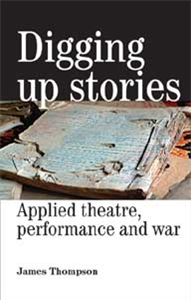
        Digging up stories

        Applied theatre, performance and war

        by James Thompson, Martin Hargreaves

        In 'Digging up stories', James Thompson explores the problems of theatre practice in communities affected by war and exclusion. Each chapter or 'story' is written in a lively and accessible style and draws on a range of contemporary performance theories. The chapters discuss: - participatory theatre in refugee camps - theatre workshop and stories of a massacre - traditional dance-dramas in an insurgent controlled village - 'Forum' theatre with the Mahabharata - ethical issues - the struggle to teach the author to dance 'Digging up stories' documents a range of theatre practice and includes project reports, ethnographic accounts, performance analysis and diary-style reflection. Taken from Thompson's research and practice in Sri Lanka, these diverse examples question the link between applied theatre, traditional performance and performances in everyday life. The book blurs lines between research and travel writing to create rich and provocative accounts of applying theatre in a troubled setting. ;

      • Trusted Partner
        Humanities & Social Sciences
        April 2025

        The Jacobites and the Grand Tour

        Educational travel and small-states' diplomacy

        by Jérémy Filet

        In the first monograph to fully examine the intersecting networks of Jacobites and travellers to the continent, Filet considers how small states used official diplomacy and deployed soft power - embodied by educational academies - to achieve foreign policy goals. This work uses little-known archival materials to explain how and why certain small states secretly supported the Jacobite cause during the crucial years surrounding the 1715 rising, while others stayed out of Jacobite affairs.At the same time, the book demonstrates how early modern small states sought to cultivate good relations with Britain by attracting travellers as part of a wider trend of ensuring connections with future diplomats or politicians in case a Stuart restoration never came.This publication therefore brings together a study of Britain, small states, Jacobitism, and educational travel, in its nexus at continental academies.

      Subscribe to our

      newsletter