
June 2001
Your Search Results
-
Promoted Content


-
Promoted Content

 Humanities & Social SciencesDecember 2007
Anglo–German relations during the Labour governments 1964–70
NATO strategy, détente and European integration
by Terry Macintyre
Speaking at West Point in 1962, Dean Acheson observed that Britain had lost an empire and had still to find a new role. This book explains why, in the following years, as Britain's Labour government contemplated withdrawal from east of Suez, ministers came to see that Britain's future role would be as a force within Europe. To this end, and in order to gain entry into the European Economic Community, a close relationship with the Federal Republic of Germany would be essential. This account of Anglo-German relations during the 1960s reveals fascinating insights into how both governments reacted to a series of complex issues and why, despite differences which might have led to strains, a good understanding was maintained. Terry Macintyre's innovative approach brings together material covering NATO strategy, détente and European integration, making the volume fascinating and essential reading for students and enthusiasts of contemporary British and German political history. This book makes an important contribution to what we know about Cold War history, and should help to redefine some of the views about the relationship between Britain and Germany during the 1960s. ;
-
 Trusted Partner
-
Trusted Partner

 October 1990
Karl Friedrich von Savigny 1814 - 1875.
Ein preußisches Diplomatenleben im Jahrhundert der Reichsgründung.
by Real, Willy
-
Trusted Partner
-
Trusted Partner
-
Trusted Partner
 August 1972
Die privaten Stipendienstiftungen der Universität Ingolstadt im ersten Jahrhundert ihres Bestehens.
Mit einem Beitrag "Das Georgianum 1494 - 1600. Frühe Geschichte und Gestalt eines staatlichen Stipendiatenkollegs" von Arno Seifert.
by Real, Heinz Jürgen
-
Trusted Partner
 Humanities & Social SciencesApril 2025
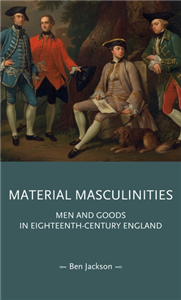
Material masculinities
Men and goods in eighteenth-century England
by Ben Jackson
Material Masculinities examines the material and consumer practices of over 1000 men from the middling and upper ranks of eighteenth-century society, c.1650-1850. It draws upon evidence from over 35 archives and museum collections to detail how material objects were integral for men in forming identities and shaping experiences. For men of all social ranks, ages, and geographic locations, material knowledge was imperative for masculine social identities to operate in a commercial society. Before the centralised factory and widespread mass-produced goods, men personalised and repaired their goods; products were shaped by men's attitudes and concerns. Objects were tools in men's identity formation and the exercise of social and gendered power. There was a reciprocal relationship between men and goods in this period; men were active agents of material and commercial change driving product and aesthetic innovation.
-
Trusted Partner

 August 2003
Unsere Gene
Eine Gebrauchsanleitung für ein besseres Leben
by Burnham, Terry; Phelan, Jay
-
Trusted Partner
-
Trusted Partner
-
Trusted Partner
 October 1995
Von Angesicht zu Angesicht
Was Gesichter verraten und was sie verbergen. (rororo science)
by Landau, Terry
-
Trusted Partner
-
Trusted Partner
 November 2022
Die prägende Kraft unserer Ahnen
Anleitungen, Übungen und Meditationen, um generationsübergreifende Familienwunden zu heilen
by O'Sullivan, Terry O'Sullivan, Natalia
Aus dem Englischen von Alexandra Baisch
-
Trusted Partner
-
Trusted Partner
 Humanities & Social SciencesAugust 2026
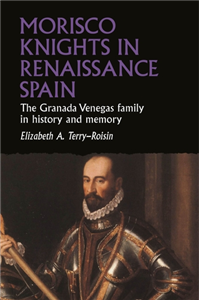
Morisco knights in Renaissance Spain
The Granada Venegas family in history and memory
by Elizabeth Terry-Roisin
How does a Morisco enter the Spanish nobility? This book reveals the cultural strategies through which a family of converts from Islam to Christianity overcame limpieza de sangre laws, rose in social status, avoided King Philip III's Morisco expulsions of 1609-14, and achieved a noble title. Drawing on archival sources from both Spain and Italy to re-create the original family archive, this book follows the Granada Venegas family from Granada, to Madrid, to the dusty Andalucían town of Campotéjar, of which they became Marquises, and finally to Italy. Their descendants would serve as Doges of Genoa in the eighteenth century.
-
Trusted Partner
 Literature & Literary StudiesFebruary 2020
Beckett and Nothing
Trying to understand Beckett
by Jonathan Bignell, Peter Boxall, Enoch Brater, Terry Eagleton, Daniela Caselli
Beckett and nothing invites its readership to understand the complex ways in which the Beckett canon both suggests and resists turning nothing into something by looking at specific, sometimes almost invisible ways in which 'little nothings' pervade the Beckett canon. The volume has two main functions: on the one hand, it looks at 'nothing' not only as a content but also a set of rhetorical strategies to reconsider afresh classic Beckett problems such as Irishness, silence, value, marginality, politics and the relationships between modernism and postmodernism and absence and presence. On the other, it focuses on 'nothing' in order to assess how the Beckett oeuvre can help us rethink contemporary preoccupations with materialism, neurology, sculpture, music and television. The volume is a scholarly intervention in the fields of Beckett studies which offers its chapters as case studies to use in the classroom. It will prove of interest to advanced students and scholars in English, French, Comparative Literature, Drama, Visual Studies, Philosophy, Music, Cinema and TV studies.
-
Trusted Partner
 January 1999
Mit geht's doch gut
Männliche Depressionen - warum sie so oft verborgen bleiben, woran man sie erkennt und wie man sie heilen kann
by Real, Terrence / Übersetzt von Strüh, Christine
-
Trusted Partner
 September 2002
Was kann ich tun, dass Du mich hörst?
Wie Männer und Frauen sich wieder nahe kommen
by Real, Terrence / Übersetzt von Strüh, Christine
-
Trusted Partner
 January 2001
Mir geht's doch gut
Männliche Depressionen - warum sie so oft verborgen bleiben, woran man sie erkennt und wie man sie heilen kann
by Real, Terrence / Übersetzt von Strüh, Christine



