Your Search Results

      • SPCK The Society for Promoting Christian Knowledge/InterVarsity Press (IVP) UK

        SPCK is the UK’s leading independent Christian publisher. We are known for our history and theological tradition of supporting the church with works of practical and pastoral benefit. Today we are a recognised market-leader publishing in the areas of theology and Christian spirituality and are developing into other areas. We publish leading authors such as Tom Wright, Rowan Williams, Paula Gooder, Alister McGrath, Janet Morley and Catherine Fox.   Inter-Varsity Press (IVP) publishes Christian books that are true to the Bible and that communicate the gospel, develop discipleship and strengthen the church for its mission throughout the world. We publish evangelical Christian books for the church and the world, including for academic audiences under the imprint Apollos. As a British publisher, we aim to be at the centre of the UK evangelical church's conversation with itself and with the wider world. We also seek to have a global reach and impact through worldwide distribution, licensing and partnerships.

        View Rights Portal
      • Reise Know-How Verlag Hans-R. Grundmann GmbH

        Reise Know-How Verlag Hans-R. Grundmann GmbH belongs to the publishing group of Reise Know-How and is specialized in Travel Guides for North America (Canada and the USA). Our portfolio consists of nine well selling books, mostly market leaders for the german market: USA Southwest, USA West complete, California, Florida, USA East/South, Canada Southwest/USA Northwest, Canada West, Canada East/USA Northeast, Canada East

        View Rights Portal
      • Trusted Partner
        Humanities & Social Sciences
        September 2025

        Writing power

        Intellectuals, legitimacy, and the making of knowledge

        by Sarah Victoria Alexandra Burton

        Writing power radically rethinks the place of the canon and canonicity as objects and concepts in contemporary academia and the everyday intellectual practices of academics. It is distinctive in its demonstration of how academics' engagements with canons shape their writing practices but also how scholars' writing practices, spaces, proclivities, and desires shape the canon and changing ideas of value in canonicity. The book thinks through frequently discussed problems of legitimacy and knowledge production from fresh perspectives of lived experience and the everyday to offer new insights into the politics of knowledge in contemporary social sciences.

      • Trusted Partner
        Teaching, Language & Reference
        April 2025

        Anti-colonial research praxis

        Methods for knowledge justice

        by Caroline Lenette

        How can anti-colonial research methodologies be transformative and achieve knowledge justice? This book brings together an eclectic group of leading scholars from around the world to share methodological knowledge grounded in First Nations and majority-world expertise and wisdom. The authors challenge western-centric and colonial approaches to knowledge production and redefine the possibilities of what we can achieve through social research. First Nations and majority-world perspectives are contextual and unique. They share a common aim of disrupting established beliefs on research methodologies and the unquestioned norms that dictate whose knowledge the academy values. The ten chapters in this edited collection describe how the authors draw on Indigenous knowledge systems, feminist frameworks, and creative methodologies as anti-colonial research praxis. The examples span several disciplines such as development studies, geography, education, sexual and reproductive health, humanitarian studies, and social work. Authors use a reflexive approach to discuss specific factors that shape how they engage in research ethically, to lead readers through a reflection on their own practices and values. The book reimagines social research using an anti-colonial lens and concludes with a collaboratively developed and co-written set of provocations for anti-colonial research praxis that situate this important work in the context of ongoing colonial violence and institutional constraints. This book is an essential guide for researchers and scholars within and beyond the academy on how anti-colonial research praxis can produce meaningful outcomes, especially in violent and troubled times. Cover art courtesy of Tawny Chatmon

      • Trusted Partner

        Till Stress Do Us Part

        Resilience in Relationships

        by Guy Bodenmann

      • Trusted Partner
      • Trusted Partner
        Business, Economics & Law
        May 2024

        Governance, democracy and ethics in crisis-decision-making

        The pandemic and beyond

        by Caroline Redhead, Melanie Smallman

        This book is a powerful addition to a developing literature informed by arts and humanities research carried out during the COVID-19 pandemic. Investigating the impacts of crisis governance and decision-making on people and populations, the book brings together microbial organisms and humans, children and data, decision-making and infection prevention, publics and process, global vaccine distribution and citizens' juries. Through its eight chapters, the book stimulates broadly-drawn discussions about exceptional executive powers in an emergency, the role of trust, and the importance of the principles of good governance - such as selflessness, ethics, integrity, accountability and honesty in leadership. The lessons drawn out in this book will support future decision-makers in both ordinary times and extra-ordinary emergencies.

      • Trusted Partner
        2022

        The Practice of Pharmacy

        Textbook for pharmacy interns Handbook for the pharmacy

        by Dr. Michael Sax, founded by Dr. Herbert Gebler and Dr. Gerd Kindl

        After pharmacy studies have ended, the fascinating world of the pharmacy awaits – simultaneously varied and challenging. This is no problem with this well-established standard work to hand! The 7th edition, with a new editor and new structure, goes through the various stages of pharmacy operation. Beginning with the social mandate to supply medicines and then considering the organisational and economic orientation of a pharmacy, one delves ever deeper into its inner workings. In every area, the appropriate specific information can be found about pharmaceutical law and practice – whether this concerns the back office, over-the-counter medicines, dispensary and dispensing, or the supply of care homes, or preparation of cytotoxic drugs. In addition to the important topic “Dispensing of drugs and medical devices on prescription”, particular attention is paid to the principal activity in the pharmacy – giving advice on self-medication. The contents are based on the regulations for registration of pharmacists and the guidelines of the Federal Chamber of Pharmacists for the practical training of pharmacy interns in the pharmacy. The Practice of Pharmacy safely navigates the user through the practical training year and is the ideal preparation for the 3rd State Examination! Returnees, pharmacies that provide training and pharmacists of many years’ experience, will also benefit from this textbook and reference work.

      • Trusted Partner
        Humanities & Social Sciences
        March 2009

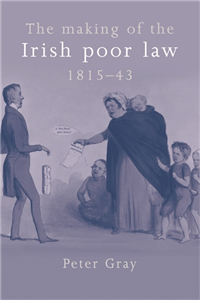
        The making of the Irish poor law, 1815–43

        None

        by Peter Gray

        The making of the Irish poor law, 1815-43 examines the debates preceding and surrounding the 1838 act on the nature of Irish poverty and the responsibilities of society towards it. It traces the various campaigns for a poor law from the later eighteenth century. The nature and internal frictions of the great Irish poor inquiry of 1833-36 are analysed, along with the policy recommendations made by its chair, Archbishop Whately. It considers the aims and limitations of the government's measure and the public reaction to it in Ireland and Britain. Finally, it describes the implementation of the Poor Law between 1838 and 1843 under the controversial direction of George Nicholls. It will be of particular importance to those with a serious interest in the history of social welfare, of Irish social thought and politics, and of British governance in Ireland in the early nineteenth century. ;

      • Trusted Partner
        Humanities & Social Sciences
        April 2010

        Bounded rationality in decision-making

        How cognitive shortcuts and professional values may interfere with market-based regulation

        by Helle Nielsen, Mikael Anderssen, Duncan Liefferink

        Challenging standard economic models, this book shows how farmers tend to use cognitive shortcuts in their decision-making and how their professional pride frequently outweighs profit considerations. This indicates that environmental regulation based on economic incentives may not be as effective as economic theorists and ex ante policy analysts maintain. Rather than assuming that regulations respond to incentive-based policies, this book examines the ways in which they do. Bounded rationality in decision-making has typically been studied in a laboratory setting, but this book uses original empirical research to demonstrate how bounded rationality plays out in the real world, examining the responses of Danish farmers to fertiliser regulation and their decision-making processes. The book will be of interest to a broad range of scholars within the fields of public policy, public administration, political science, behavioural economics and sociology. ;

      • Trusted Partner
        Humanities & Social Sciences
        May 2026

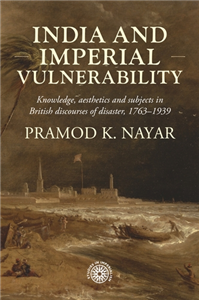
        India and imperial vulnerability

        Knowledge, aesthetics and subjects in British discourses of disaster, 1763-1939

        by Pramod K Nayar

        This study of famines, earthquakes and cyclones in British India, 1770-1934, moves from the aesthetics of representation through the knowledge cultures that sprang up around the disasters and finally the construction of the helpless native and the labouring Englishman. It studies the creation of imperial networks of knowledge acquisition, codification and training, as well as the employment of certain aesthetic modes when speaking of the land's disasters. It pays attention to the categorization of the disaster victims and the work of the Englishman in understanding and helping the native. The study shows how the disasters were shaped and were shaped by imperial discourses of knowledge and learning, aesthetics of fright and horror and the labouring English.

      • Trusted Partner
        Literature & Literary Studies
        April 2018

        Aspects of knowledge

        by Anke Bernau, Marilina Cesario, Hugh Magennis

      • Trusted Partner
      • Trusted Partner
        Self-help & personal development

        Do Whatever You Want to Do!

        How a Flatworm Demonstrates the Way to Satisfaction and Freedom

        by M. Storch

        Many people don't know what they want. In this book, a little worm shows the reader how to live life the best way possible. It shows, how often decisions or even entire lifestyles are determined by what is “intimated” by parents, friends, the media, or even the latest fad. Ultimately, the worm shows the reader, that it is only possible to be happy and free, if one knows what one wants and actually actively pursue this. Target Group: For people who want to improve their lives, psychologists, and therapists.

      • Trusted Partner
      • Trusted Partner
        The Arts
        October 2013

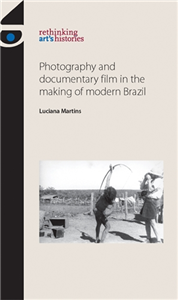
        Photography and documentary film in the making of modern Brazil

        by Luciana Martins, Amelia Jones, Marsha Meskimmon

        Photography and documentary film in the making of modern Brazil provides a major contribution to the field of visual culture through a study of still and moving images of Brazil in the first four decades of the twentieth century, when the camera played a key role in making Brazilian peoples and places visible to a variety of audiences. The book explores what is distinctive about the visual representation of Brazil in an era of modernisation, also attending to the significance of the different technical properties of film and photography for the writing of new histories of visual technologies. It offers new insights into the work of key writers, photographers, anthropologists and filmmakers, including Claude Lévi-Strauss, Mário de Andrade, Silvino Santos and Aloha Baker. Unearthing a wealth of materials from archives in the USA, Britain, and Brazil, the book seeks to contribute to the postcolonial theoretical project of pinpointing locally distinctive histories of visual technologies and practices. ;

      • Trusted Partner
      • Trusted Partner
        Humanities & Social Sciences
        December 2023

        Transitional justice in process

        Plans and politics in Tunisia

        by Mariam Salehi

        After the fall of the Ben Ali regime in 2011, Tunisia swiftly began dealing with its authoritarian past and initiated a comprehensive transitional justice process, with the Truth and Dignity Commission as its central institution. However, instead of bringing about peace and justice, transitional justice soon became an arena of contention. Through a process lens, the book explores why and how the process evolved, and explains how it relates to the country's political transition. Based on extensive field research in Tunisia and the US, and interviews with a broad range of international stakeholders and decision-makers, this is the first book to comprehensively study the Tunisian transitional justice process. It provides an in-depth analysis of a crucial period, examining the role of justice professionals in different stages, as well as the alliances and frictions between different actor groups that cut across the often-assumed local-international divide.

      • Trusted Partner
        Humanities & Social Sciences
        October 1993

        Sport and the making of Britain

        by Derek Birley

        The British love of sport is legendary. In this lively and stimulating book Derek Birley looks at the part it played in shaping British society. The book traces the development of sporting conventions from medieval chivalry to modern notions of sportsmanship and fair play. Particular sports from hunting and the tournament to ball-games and athletics are shown against the social background of the emerging nation. The first laws of favourite pastimes such as horse-racing, cricket and boxing were devised by the privileged for gambling purposes, but were enthusiastically followed by the lower orders for pleasure and profit. Amongst the topics explored are the changing fortunes and fashions in field sports, 'gentlemen and players' in cricket, the public school games cult, purity in amateur rowing, the urban middle-class discovery of lawn tennis and golf, and the 'north-south divide' in football. These social issues are cross-threads in the theme of sport's influence on national identity, patriotism and imperialism in the making of Britain. Remarkable in its scope and in its linking of sport to the changing social political scene, this is a splendidly readable history. ;

      • Trusted Partner
        Humanities & Social Sciences
        August 2023

        Picturing the Western Front

        Photography, practices and experiences in First World War France

        by Beatriz Pichel

        Between 1914 and 1918, military, press and amateur photographers produced thousands of pictures. Either classified in military archives specially created with this purpose in 1915, collected in personal albums or circulated in illustrated magazines, photographs were supposed to tell the story of the war. Picturing the Western Front argues that photographic practices also shaped combatants and civilians' war experiences. Doing photography (taking pictures, posing for them, exhibiting, cataloguing and looking at them) allowed combatants and civilians to make sense of what they were living through. Photography mattered because it enabled combatants and civilians to record events, establish or reinforce bonds with one another, represent bodies, place people and events in imaginative geographies and making things visible, while making others, such as suicide, invisible. Photographic practices became, thus, frames of experience.

      Subscribe to our

      newsletter