Your Search Results

      • Trusted Partner
        Humanities & Social Sciences
        May 2026

        The racial politics of police warfare

        by Jasbinder S. Nijjar

        Amid renewed anti-racist resistance to violent policing, The racial politics of police warfare unpacks the racisms that rationalise militarised policing in contemporary Britain. Jasbinder S. Nijjar shatters prevailing myths about British police as an impartial public service, by revealing it as an institution where racism and war reinforce one another. In examining flagship anti-gang and counter-terrorism policies and practices, the book offers a unique analysis of the relationship between anti-black and anti-Muslim racisms, to demonstrate how racialised populations are institutionalised as common enemies of modernity. Combining perspectives from sociology, history, criminology and social policy, Nijjar illustrates how British policing defends law and order and national security from the perceived threat of race through hyper-intrusive, pre-emptive and deathly measures. Accordingly, he gives a fresh take on resisting racial police warfare, calling for strategies that are at once political, collective, anti-militaristic and abolitionist.

      • Trusted Partner
        Humanities & Social Sciences
        April 2020

        Anarchism, 1914–18

        Internationalism, anti-militarism and war

        by Ruth Kinna, Matthew S. Adams

        Anarchism 1914-18 is the first systematic analysis of anarchist responses to the First World War. It examines the interventionist debate between Peter Kropotkin and Errico Malatesta which split the anarchist movement in 1914 and provides a historical and conceptual analysis of debates conducted in European and American movements about class, nationalism, internationalism, militarism, pacifism and cultural resistance. Contributions discuss the justness of war, non-violence and pacifism, anti-colonialism, pro-feminist perspectives on war and the potency of myths about the war and revolution for the reframing of radical politics in the 1920s and beyond. Divisions about the war and the experience of being caught on the wrong side of the Bolshevik Revolution encouraged anarchists to reaffirm their deeply-held rejection of vanguard socialism and develop new strategies that drew on a plethora of anti-war activities.

      • Trusted Partner
        Humanities & Social Sciences
        November 2025

        The lure of violence

        The Right and the Edwardian crisis in Britain, 1901–14

        by Alessandro Saluppo

        This book provides a comprehensive examination of conservative and right-wing responses to the Edwardian crisis in Britain (1901-1914). It stresses how the upsurge of right-wing extremism within and outside the Conservative party was accompanied by the crystallization of a culture of violence. The preparation, instigation or threatening of violent acts against all those who appeared to threaten the organic nature and vigour of the national community found expression in a myriad of ultra-nationalist organisations, citizen policing groups, private military associations, and paramilitary formations. The book innovatively reconstructs the belief system and the practices of those right-wing actors, which pursued the goals of military preparedness, "racial regeneration" and imperial unity, while defending the amorphous goals of authority, order and 'national efficiency' against the forces of radicalism and socialism. The book helps to cast light on the bellicose and authoritarian reflexes that traversed British conservatism in the turbulent prewar years.

      • Trusted Partner
      • Trusted Partner
      • Trusted Partner
        Humanities & Social Sciences
        August 2023

        The British Empire through buildings

        by John M. MacKenzie

      • Trusted Partner
        20th century history: c 1900 to c 2000
        October 2013

        Northern Ireland in the Second World War

        Politics, economic mobilisation and society, 1939–45

        by Philip Ollerenshaw

        This original and distinctive book surveys the political, economic and social history of Northern Ireland in the Second World War. Since its creation in 1920, Northern Ireland has been a deeply divided society and the book explores these divisions before and during the war. It examines rearmament, the relatively slow wartime mobilisation, the 1941 Blitz, labour and industrial relations, politics and social policy. Northern Ireland was the only part of the UK with a devolved government and no military conscription during the war. The absence of military conscription made the process of mobilisation, and the experience of men and women, very different from that in Britain. The book's conclusion considers how the government faced the domestic and international challenges of the postwar world. This study draws on a wide range of primary sources and will appeal to those interested in modern Irish and British history and in the Second World War.

      • Trusted Partner
      • Trusted Partner
        Humanities & Social Sciences
        June 2021

        Civil war London

        by Jordan S. Downs, Jason Peacey

      • Trusted Partner
        Humanities & Social Sciences
        September 2023

        Civil war London

        Mobilizing for parliament, 1641–5

        by Jordan S. Downs

        This book looks at London's provision of financial and military support for parliament's war against King Charles I. It explores for the first time a series of episodic, circumstantial and unique mobilisations that spanned from late 1641 to early 1645 and which ultimately led to the establishment of the New Model Army. Based on research from two-dozen archives, Civil war London charts the successes and failures of efforts to move London's vast resources and in the process poses a number of challenges to longstanding notions about the capital's 'parliamentarian' makeup. It reveals interactions between London's Corporation, parochial communities and livery companies, between preachers and parishioners and between agitators, propagandists and common people. Within these tangled webs of political engagement reside the untold stories of the movement of money and men, but also of parliament's eventual success in the English Civil War.

      • Trusted Partner
      • Trusted Partner
      • Trusted Partner
        Humanities & Social Sciences
        July 2024

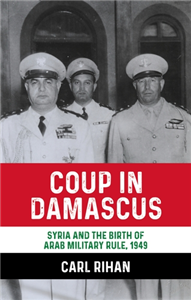
        Coup in Damascus

        Husni al-Za'im and the birth of Syrian military rule

        by Carl Rihan

        Coup in Damascus is a history of Syria's first military regime. It plots the the fall of Syria's democracy and the rise of its military rulers, particularly Husni al-Zaim, whose brief rule in 1949 represented a profoundly transformative moment for the Syrian nation. It is a history of the thoughts, intentions and motives of political actors underpinning the events that have marked Syria's history after the first Arab-Israeli war, and focuses mainly on the interaction between local, regional and international actors. Unlike most histories of the modern Middle East that tackle broad intervals and that focus on the sequences of events, this history seeks to reconstruct the thought processes behind the events, and anchor them within the epoch's existing political and socioeconomic conditions. It draws on several methodological influences, particularly R.G. Collingwood's 'history as re-enactment of the past'.

      • Trusted Partner
        Teaching, Language & Reference
        December 2020

        Living politics after war

        by Johanna Söderström, Emmanuel Pierre Guittet

      • Trusted Partner
        Humanities & Social Sciences
        June 2025

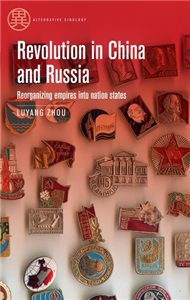
        Revolution in China and Russia

        Reorganizing empires into nation states

        by Luyang Zhou

        Most scholars believe that China's nationality policy, like that of other socialist states, imitated the Soviet nationality model, a system which has been termed an "affirmative action empire." This book offers two contributions to the literature which run counter to this convention. First, it argues that the People's Republic of China (PRC) and the Soviet Union (USSR) were different; while the PRC was aimed to build an ideal-typical nation-state, the USSR was an open union of nation-states that was only temporarily confined to a physical territory. Second, while scholars who have noted this difference attribute it to contextual factors, such as ethnic structure, geopolitical status, and Russia's intervention into the Chinese Revolution, this book contends that context shaped the Sino-Soviet difference, yet it did not determine it. Rather, there was significant leeway between the implications of the contextual factors, and what the policy-designers ultimately established. This book probes who held agency, and how these individuals bridged this gap.

      • Trusted Partner
        Humanities & Social Sciences
        March 2026

        Artificial Intelligence and international security

        Redefining arms races and contemporary warfare

        by Arshin Adib-Moghaddam, Alena Vieira, Mohammad Eslami

        As artificial intelligence continues to transform modern warfare, the rapid development of AI-driven weaponry presents profound ethical, legal, and security challenges. Artificial Intelligence and International Security: Redefining Arms Races and Contemporary Warfare offers a critical examination of this emerging arms race, exploring issues of arms control, international law, diplomacy, and long-term security. Bringing together expert perspectives, this volume assesses the risks and implications of autonomous weapon systems while proposing solutions to ensure ethical AI deployment. Through a comprehensive analysis of this urgent issue, it seeks to contribute to global debates and inform policies that foster peace, stability, and the responsible use of AI in warfare.

      • Trusted Partner
        Humanities & Social Sciences
        June 2025

        Unparalleled catastrophe

        by Rhys Crilley

      • Trusted Partner
        Geography & the Environment
        December 2018

        Architectures of survival

        by Adam Page

      Subscribe to our

      newsletter