
La Pollera Ediciones
La Pollera's catalog includes narrative, essay, and chronicle of contemporary and classic authors.
View Rights Portal
La Pollera's catalog includes narrative, essay, and chronicle of contemporary and classic authors.
View Rights Portal
IMF’s print and digital publications present the research, policy advice, and data on economic and financial sector issues at the global, regional, and country levels.
View Rights Portal
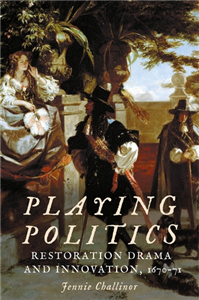
This study focuses on the 1670-71 season in the Restoration playhouses, an exciting and formative moment in theatrical and political history. The year proved to be difficult and damaging to King Charles II, as political, religious, and personal matters provoked controversy and disquiet, and the country teetered on the brink of major constitutional problems. My research sets drama against this backdrop. Theatrical records for this period are patchy and, for the most part, frustratingly incomplete: this book does not attempt to reconstruct the day-to-day operations of the playhouses, but rather it uses the available evidence of the extant new and revived plays we know (or believe) to have been performed in the 1670-71 theatrical season, and argues that this was the period in which serious and far-reaching political and dramatic questions began to be seriously asked and (tentatively) answered.
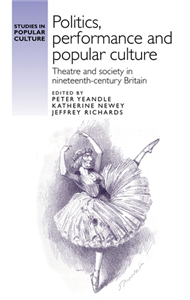
This collection brings together studies of popular performance and politics across the nineteenth century, offering a fresh perspective from an archivally grounded research base. It works with the concept that politics is performative and performance is political. The book is organised into three parts in dialogue regarding specific approaches to popular performance and politics. Part I offers a series of conceptual studies using popular culture as an analytical category for social and political history. Part II explores the ways that performance represents and constructs contemporary ideologies of race, nation and empire. Part III investigates the performance techniques of specific politicians - including Robert Peel, Keir Hardie and Henry Hyndman - and analyses the performative elements of collective movements.
 Trusted Partner
From Diane Abbott to Hugo Young via Keynesianism and Thatcherism, from Major to Millbank and from New Labour to Norman Tebbitt, this book is the ultimate student reference guide to British politics. The 2nd edition has been fully updated to take account of all the changes that have taken place in British politics since 2004. With over one thousand entries, the book covers the personalities, policies and institutions that have shaped British politics, with special emphasis on developments since the beginning of the twentieth century. This is the ideal instant reference book on British politics. It provides the reader with short, authoritative explanations and definitions of key terms, institutions, offices of state, political events, processes and policies as well as biographies of well known politicians, political thinkers, movements and theorists. Any student unsure of a term, an event, the details of the life of a prominent politician, or the inner workings of an institution can turn to this book for immediate assistance. ;
Trusted Partner

This book is a study of the ambitions, activities and achievements of Methodist missionaries in northern Burma from 1887-1966 and the expulsion of the last missionaries by Ne Win. The story is told through painstaking original research in archives which contain thousands of hitherto unpublished documents and eyewitness accounts meticulously recorded by the Methodist missionaries. This accessible study constitutes a significant contribution to a very little-known area of missionary history. Leigh pulls together the themes of conflict, politics and proselytisation in to a fascinating study of great breadth. The historical nuances of the relationship between religion and governance in Burma are traced in an accessible style. This book will appeal to those teaching or studying colonial and postcolonial history, Burmese politics, and the history of missionary work.
Trusted Partner

This important book provides new understandings of how the politics of memory impacts peace in societies transitioning from a violent past. It does so by developing a theoretical approach focusing on the intersection of sites, agency, narratives, and events in memory-making. Drawing on rich empirical studies of mnemonic formations in Cyprus, Bosnia and Herzegovina, Rwanda, South Africa and Cambodia, the book speaks to a broad audience. The in-depth, cross-case analysis shows that inclusivity, pluralism, and dignity in memory politics are key to the construction of a just peace. The book contributes crucial and timely knowledge about societies that grapple with the painful legacies of the past and advances the study of memory and peace.
Trusted Partner

The politics of Middle English parables examines the dynamic intersection of fiction, theology and social practice in late-medieval England. Parables occupy a prominent place in Middle English literature, appearing in dream visions and story collections as well as in lives of Christ and devotional treatises. While most scholarship approaches the translated stories as stable vehicles of Christian teaching, this book highlights the many variations and points of conflict across Middle English renditions of the same story. In parables related to labour, social inequality, charity and penance, the book locates a creative theological discourse through which writers attempted to re-construct Christian belief and practice. Analysis of these diverse retellings reveals not what a given parable meant in a definitive sense but rather how Middle English parables inscribe the ideologies, power structures and cultural debates of late-medieval Christianity.
Trusted Partner

This book applies social and political theory to the field of environmental politics in Ireland. It offers both a substantive contribution to understanding environmental politics in this country and a test case of the application of theory within the field of environmental scholarship more generally. The essays are integrated by a concern for analysing the relationship between culture, discourse and action in this political field, hence the emphasis on the communicative turn. The book is innovative in offering a sustained application of social and political theory within environmental scholarship as well as in combining theoretical and empirical approaches to advancing environmental scholarship in a particular case. This synergy of theory and substantive analysis is a key feature of the book and offers an important contribution to the environmental literature in the social sciences. The authors apply key developments in the modern social sciences and offer compelling evidence of their value for clarifying the cultural foundations of political action and for its evaluation and critique. Academics in the social sciences and in philosophy, postgraduate and advanced undergraduate, both in Ireland and beyond, will find this book highly rewarding for its multi-faceted application of social and political theories and associated methodologies to the environmental field. ;
Trusted Partner

Colonial governments, institutions and companies recognised that in many ways the effective operation of the Empire depended upon sexual arrangements. For example, nuclear families serving agricultural colonization, and prostitutes working for single men who powered armies and plantations, mines and bureaucracies. For this reason they devised elaborate systems of sexual governance, such as attending to marriage and the family. However, they also devoted disproportionate energy to marking and policing the sexual margins. In Sex, Politics and Empire, Richard Phillips investigates controversies surrounding prostitution, homosexuality and the age of consent in the British Empire, and revolutionises our notions about the importance of sex as a nexus of imperial power relations.
Trusted Partner
Trusted Partner
This book explores radical dissent from orthodox mainstream economics, and sets out a theoretically grounded vision for the emerging paradigm of social ecological economics. At the heart of this paradigmatic shift lies an acknowledgement of the inextricable embeddedness of economies in biophysical reality and social structure. The struggle for this transformative vision unfolds through a critical examination of mainstream environmental thought, followed by a nuanced evaluation of contributions from Marxists, socialists, critical institutionalists, feminists and Post-Keynesians grappling with the urgent environmental crisis. Synthesising insights from these diverse and heterodox schools, the book navigates the philosophical underpinnings of science, embracing a critical realist approach that challenges not only mainstream economic thought but also eclectic pluralism, relativism and strong constructionism. The question of what constitutes revolutionary science is explored in light of works by Kuhn, Schumpeter and Neurath, emphasising the pivotal role of values and ideology in works from Marx to Gramsci. Building on these radical and philosophical foundations, the book articulates a preanalytic vision of social ecological economics, dismantling entrenched notions of growth and efficiency in favour of a framework centered on social provisioning and needs embedded in ethics. In a thought-provoking conclusion, the book applies its analytical lens to the multiple crises of modernity within industrialised capital-accumulating economies. An agenda for social ecological transformation toward diverse alternative economies emerges, providing a compelling call to action in the face of contemporary challenges.
Trusted Partner
This is a clearly written, comprehensive and topical textbook on UK government and politics for AS and A Level students. It is suitable for the A Level Edexcel, OCR and AQA exam boards. The content of the book is structured according to the boards' specifications. It covers: political power, participation and democracy; the UK constitution; elections and referenda; MPs, parties and pressure groups; Parliament and government; the courts, judges and civil liberties; local government and devolution; and the European Union. All key terms and concepts are highlighted and succinctly defined. The book has an accessible style and very user-friendly format. It includes sample exam questions with answers, and fun quizzes with answers, plus features such as 'Talking Point' and 'Analyse This' to encourage class discussion and exploration of core topics. Each chapter begins with a summary of contents and ends with sample exam questions and useful websites.
Trusted Partner
This book offers a comprehensive study of racialisation of Romani communities in Europe (and beyond). Drawing on the idea of unbelonging it demonstrates how Romani communities are placed in a position of visceral visibility by local, national and international institutions as well as public media discourses. It shows how such positionality impacts the ability of Roma to self-represent politically and build capacity for change. From the position of unbelonging the book offers an account of Romani agency which both challenges the mainstream representations of Roma but also develops an alternative none-nation-state sense of belonging. In doing so the book outlines an account of Romani alternative expressions in order to take control of their relationship with their own history, future, knowledge, and identity, and the rest of the society.
Trusted Partner
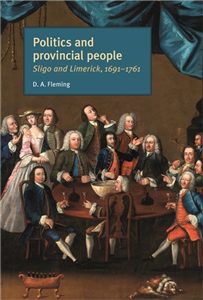
This ground-breaking study is the first to systematically examine the politics and political culture of provincial Ireland. The book compares two distinct localities that provide differing perspectives on how politics and power manifested itself in provincial Ireland: Sligo in the north west and Limerick in the south west. Drawing on a wealth of previously unknown and under-utilised contemporary material, David Fleming focuses on individuals who were determined to shape the political landscape and those who were affected by their actions. The book challenges many accepted models of how Ireland and the Irish were governed. While the propertied élite dominated many aspects of the political process, individuals and groups from the professional, mercantile, rural and other sections of society - the 'middling orders' - were also active in local institutions and office-holding. Their story, recounted here, reveals a far more complex set of relationships. Politics and provincial people is a carefully constructed story of people's motivations, ideas, and actions, and offers new insights into the complexity of their lives and the Irish political landscape. ;
Trusted Partner
Local government in the UK is in crisis. It is now neither local in terms of the geography and populations of its principle units, nor does it truly govern in these areas. As this book reveals, over the previous 200 years local government has moved from a system in which local interests held governance over localities to one in which central government and national and multi-national agencies such as corporate businesses hold governance over local and community decision-making. These changes seriously undermine the important role that local government can play in liberal democracy in the UK. The book explains the nature of local government today and asks if there is any possibility of change.
Trusted Partner

This book examines Turkey's integration with Europe within structural dynamics of globalisation from a critical political economy perspective. Critical approaches have been sidelined within European Studies. Turkish enlargement is not an exemption. The analyses are based on original data generated by 109 interviews conducted in 2010, 2017 and 2023 with five categories of actors: representatives of capital and labour, political parties, state officials, and struggles around ecology, patriarchy and migration. It argues that the pro-membership was hegemonic in the 2000s which was contested by two rival class strategies, Ha-vet and neo-mercantilism. In the 2010s, pro-membership is no longer hegemonic within rising critical tone of social forces supporting rival class strategies. Unevenness of Turkey's trajectory of integration to Europe is likely to be consolidated through market integration and management of migration through transactional approach.
Trusted Partner

Politics and peace in Northern Ireland analyses the complex and contradictory process of implementing the Good Friday Agreement. Using the lens of security dilemma theory, it begins with an original overview of the conflict, the Agreement and post-1998 politics. The book then explores post-Agreement Northern Ireland through the eyes of each of the four main political parties, showing how they tried to shape the course of peace implementation, and how implementation, in turn, shaped the fates and fortunes of the parties. Drawing on extensive original research, this book explains the promise and limits of the Agreement. It shows how and why the two sides' mutual insecurities repeatedly derailed peace implementation, and reflects on the likely direction of parties and politics in the future. This clearly written and up-to-date book will be of interest to scholars and students of recent Northern Irish history, ethnic conflict and peace-making. ;
Trusted Partner
Trusted Partner

This introductory text, written by an established authority on communist and post-communist politics, describes how Vladimir Putin has turned to those with backgrounds in the military and security structures to provide stability in today's Russian Federation, following the democratising reforms of Gorbachev and the ensuing instability of the Yeltsin presidency. Against the background of an increasing authoritarianism, which has restored features of the Soviet political system, it examines the attempts by social and economic groups to assert themselves against the state using embryonic democratic forms that fall far short of pluralism. The book's fourteen chapters offer an exceptionally broad coverage. It will appeal to first- and second-year students in higher education, but its deliberately accessible style will also make it attractive to sixth-form students and the general reader. ;
Trusted Partner
A short but comprehensive textbook for students of British politics which interprets changes over the last thirty years and analyses institutions within the context of British society and economics. ;
Trusted Partner
Penny politics offers a new way to read early Victorian popular fiction such as Jack Sheppard, Sweeney Todd, and The Mysteries of London. It locates forms of radical discourse in the popular literature that emerged simultaneously with Brittan's longest and most significant people's movement. It listens for echoes of Chartist fiction in popular fiction. The book rethinks the relationship between the popular and political, understanding that radical politics had popular appeal and that the lines separating a genuine radicalism from commercial success are complicated and never absolute. With archival work into Newgate calendars and Chartist periodicals, as well as media history and culture, it brings together histories of the popular and political so as to rewrite the radical canon.



