

Humanities & Social Sciences
January 2024
 Trusted Partner


Counterpractice highlights a generation of women who used art to define a culture of experimental thought and practice during the period of the French women's movement or Mouvement de Libération des Femmes (1970-81). It considers women's art in relation to some of the most exciting thinkers to have emerged from the French literature and philosophy of the 1970s - Hélène Cixous, Luce Irigaray and Julia Kristeva - forcing a timely reconsideration of the full spectrum of revolutionary practices by women in the years following the events of May '68. Lavishly illustrated with over 200 images, the book also features an illuminating foreword by art historian Griselda Pollock.
Trusted Partner

Why adopt a poststructural lens for the reading of the military strategy of national missile defence (NMD)? No doubt, when contemplating an attack on US territory by intercontinental ballistic missiles, consulting Michel Foucault and critical international relations theory scholars may not seem the obvious route to take. The answer to this lies in another question: why has there been so much interest and continuous investment in NMD deployment when there is such ambiguity surrounding the status of threat to which it responds, controversy over its technological feasibility and concern about its cost? Posed in this manner, the question cannot be answered on its own terms - the terms given in official accounts of NMD that justify the system's significance on the basis of strategic feasibility studies and conventional threat predictions guided by worst-case scenarios. Instead, this book argues that the preferences leading to NMD deployment must be understood as satisfying requirements beyond strategic approaches and issues. In turning towards the interpretative modes of inquiry provided by critical social theory and poststructuralism, this book contests the conventional wisdom about NMD and suggests reading the strategy in terms of US identity. Presented as an analysis of discourses on threats to national security, around which the need for NMD deployment is predominantly framed, this book is an effort to let the two fields of critical international relations theory and US foreign policy speak directly to each other. It seeks to do so by showing how the concept of identity can be harnessed to an analysis of a contemporary military-strategic practice. ;
Trusted Partner

This volume in the Critical Theory and Contemporary Society series explores the arguments between critical theory and epistemology in the twentieth and twenty-first centuries. Focusing on the first and second generations of critical theorists and Luhmann's systems theory, the book examines how each approaches epistemology. It opens by looking at twentieth-century epistemology, particularly the concept of lifeworld (Lebenswelt). It then moves on to discuss structuralism, poststructuralism, critical realism, the epistemological problematics of Foucault's writings and the dialectics of systems theory. This unique work takes a comparative look at structuralism and post-structuralism's epistemological theory with special reference to scientific reason. It also investigates Luhmann's works in epistemology. The aim is to explore whether the focal point for epistemology and the sciences remain that social and political interests actually form a concrete point of concern for the sciences as well.
Trusted Partner

The career of Wisconsin-born Joseph Losey spanned over four decades and several countries. A self-proclaimed Marxist and veteran of the 1930s Soviet agit-prop theater, he collaborated with Bertholt Brecht before directing noir B-pictures in Hollywood. A victim of McCarthyism, he later crossed the Atlantic to direct a series of seminal British films such as "Time Without Pity," "Eve," "The Servant," and "The Go-Between," which mark him as one of the cinema's greatest baroque stylists. His British films reflect on exile and the outsider's view of a class-bound society in crisis through a style rooted in the European art house tradition of Resnais and Godard. Gardner employs recent methodologies from cultural studies and poststructural theory, exploring and clarifying the films' uneasy tension between class and gender, and their explorations of fractured temporality.
Trusted Partner
 Trusted Partner
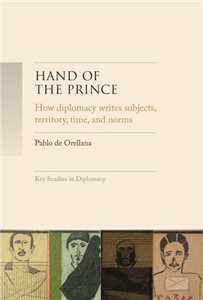
This book is dedicated to how diplomacy makes, develops, and trades in knowledge. It proposes an approach to examine how diplomatic knowledge production describes what diplomats see, how these descriptions develop, and whether they were convincing to one's own policymakers or even those of other actors. These descriptions are vital: actors can be inserted into global categories Communism or Terrorism that beget significant security, relational and policy consequences. Diplomacy and policy constitute the world we inhabit based on what policymakers made of descriptions, assessments, and analysis. Such is the power of knowing who we and the others are.
Trusted Partner
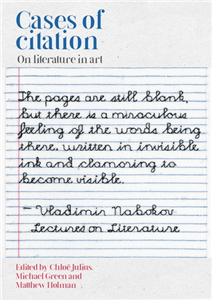
Cases of citation presents a history of artists who incorporated literary references into their work from the 1960s onwards. Through a series of object-focused chapters that each take up a singular 'case of citation', the collection considers how literary citation emerged as a viable and urgent strategy for artists during this period. It surveys eleven artworks by a diverse group of artists - including David Wojnarowicz, Lis Rhodes, Romare Bearden and Silvia Kolbowski - whose citations draw on works as varied as Karl Marx's Das Kapital and Mary Shelley's Frankenstein. The book also features an interview with pioneering feminist artist Elaine Reichek that discusses her career-long commitment to working with text. Together, the artworks and cited texts are approached from various critical angles, with each author questioning and complicating the ways in which we can 'read' textual citations in art.


