
Your Search Results
-

-

GAPSK Language Promotion Council Limited
GAPSK and YLPSK are the standardized test of Chinese language for children from 3 to 15. From the world- renowned Peking University, GAPSK and YLPSK are certified and approved by the Chinese Ministry of Education as language proficiency measuring tool for children . GAPSK, YLPSK could be conducted on site or completely online. Come join over 100,000 students who taken the tests, contact us at info@gapsk.org. Find out more at www.ylpsk.org
View Rights Portal
-
Promoted Content

 Humanities & Social SciencesFebruary 2017
Scottishness and Irishness in New Zealand since 1840
by Angela McCarthy, Andrew Thompson, John M. MacKenzie
This book examines the distinctive aspects that insiders and outsiders perceived as characteristic of Irish and Scottish ethnic identities in New Zealand. When, how, and why did Irish and Scots identify themselves and others in ethnic terms? What characteristics did the Irish and the Scots attribute to themselves and what traits did others assign to them? Did these traits change over time and if so how? Contemporary interest surrounding issues of ethnic identities is vibrant. In countries such as New Zealand, descendants of European settlers are seeking their ethnic origins, spurred on in part by factors such as an ongoing interest in indigenous genealogies, the burgeoning appeal of family history societies, and the booming financial benefits of marketing ethnicities abroad. This fascinating book will appeal to scholars and students of the history of empire and the construction of identity in settler communities, as well as those interested in the history of New Zealand.
-
Promoted Content
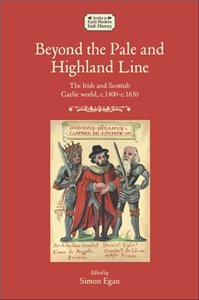 Humanities & Social SciencesApril 2025
Beyond the Pale and Highland Line
The Irish and Scottish Gaelic world
by Simon Egan
This book offers important new insights into the history and culture of the Gaelic-speaking world from the mid-fifteenth century through to the reign of James VI and I. Throughout this period, the reach of the English and Scottish crowns within these western regions was limited. The initiative lay with local communities and royal power was contingent upon negotiating with well-established and largely autonomous aristocratic lineages. Moreover, events within this western world could exert a powerful, often unpredictable, influence upon the affairs of the wider archipelago. Using a series of case studies, this collection examines the evolving relationship between Ireland and Scotland in rich detail. It demonstrates how this world interacted with the encroaching English and Scottish states and underlines the importance of paying closer attention to this neglected area of Irish and British history.
-
 Trusted Partner
-
Trusted Partner
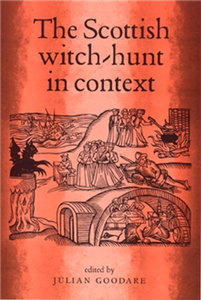 Humanities & Social SciencesJune 2002
The Scottish witch-hunt in context
by Julian Goodare
A collection of essays on Scottish witchcraft and witch-hunting, which covers the whole period of the Scottish witch-hunt, from the mid-sixteenth century to the early eighteenth. Includes studies of particular witchcraft panics such as a reassessment of the role of King James VI. Covers a wide range of topics concerned with Scottish witch-hunting and places it in the context of other topics such as gender relations, folklore, magic and healing, and moral regulation by the church and state. Provides a comparative dimension of witch-hunting beyond Scotland - one on the global context, and one comparing Scotland with England. It is a showcase for the latest thinking on the subject and will be of interest to all scholars studying witchcraft in early modern Europe, as well as the general reader wanting to move beyond shallow and sensational accounts of a subject of compelling in. ;
-
Trusted Partner
-
Trusted Partner
 Economic historyJuly 2000
Scottish society 1707–1830
Beyond Jacobitism, t
by Christopher A. Whatley
Scottish Society, 1707-1830 challenges much conventional wisdom and provides readers with many new insights into Scottish social and economic history.. Argues that the Union of 1707 was vital for Scottish success, but in ways which have hitherto been overlooked.. Contests received wisdom on issues such as the role of the Kirk and other agencies for inculcating order, and argues that the eighteenth and early nineteenth centuries in Scotland were years of upheaval and deep social conflict in both the Highlands and Lowlands, where commercialism and later the market economy revolutionised social relationships.. The period surrounding the Radical War in 1820 is identified as a watershed in Scottish history, almost making but also breaking the Scottish working class.. Not only on an exhaustive reading of secondary material but also incorporates a wealth of new evidence from previously little-used or unused primary sources.
-
Trusted Partner
 Literature & Literary StudiesJune 2026
The politics of Middle English parables
Fiction, theology, and social practice
by Mary Raschko
The politics of Middle English parables examines the dynamic intersection of fiction, theology and social practice in late-medieval England. Parables occupy a prominent place in Middle English literature, appearing in dream visions and story collections as well as in lives of Christ and devotional treatises. While most scholarship approaches the translated stories as stable vehicles of Christian teaching, this book highlights the many variations and points of conflict across Middle English renditions of the same story. In parables related to labour, social inequality, charity and penance, the book locates a creative theological discourse through which writers attempted to re-construct Christian belief and practice. Analysis of these diverse retellings reveals not what a given parable meant in a definitive sense but rather how Middle English parables inscribe the ideologies, power structures and cultural debates of late-medieval Christianity.
-
Trusted Partner
 Humanities & Social SciencesJuly 2010
Voting for a Scottish government
The Scottish Parliament election of 2007
by Robert Johns, David Denver, James Mitchell, Charles Pattie
In 2007 Labour lost an election in Scotland for the first time in half a century and the SNP went on to form the Scottish Government. This book explains why. Based on a unique three-wave survey of the Scottish electorate, it can truly be described as the first full-scale Scottish national election study. As such, it is notable not only for its innovative methodology but also because theories and concepts are taken from the recent electoral studies literature and applied to Scotland. Other questions investigated include the impact of campaigning and of the party leaders (at both Scottish and British level) on the election outcome. In addition, for the first time in the UK context, a special study is made of the causes and consequences of rejected ballots - the large number of which at this election caused a media outcry. This book will be required reading for anyone interested in, involved in, teaching or studying Scottish politics. It will also be an important text for those concerned with UK politics in general and attract particular interest among students of elections, both in the UK and internationally. ;
-
Trusted Partner
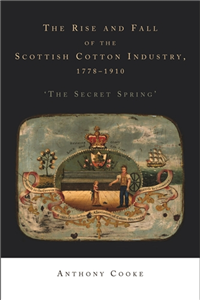 Business, Economics & LawMarch 2010
The rise and fall of the Scottish cotton industry, 1778–1914
'The secret spring'
by Anthony Cooke
This is the first full-length history of the Scottish cotton industry, from its beginnings in the late eighteenth century to its premature decline in the years leading up to the First World War. The book examines the industry chronologically and through themes such as precursors, technology, capital and employers, markets, labour and work, placed within their broader economic and scoial contexts. Its account of the cotton industry is set within important historiographical debates such as proto-industrialisation, the speed of industrial change, the diffusion of technology, the labour process, paternalism, workplace control, entrepreneurship and theories of industrial decline. Cotton was Scotland's premier industry during the Industrial Revolution and this book will be wlecomed by specialists, students and interested readers alike. ;
-
Trusted Partner
Literature & Literary StudiesMarch 2023
Sleep and its spaces in Middle English literature
Emotions, ethics, dreams
by Megan Leitch
Middle English literature is intimately concerned with sleep and the spaces in which it takes place. In the medieval English imagination, sleep is an embodied and culturally determined act. It is both performed and interpreted by characters and contemporaries, subject to a particular habitus and understood through particular hermeneutic lenses. While illuminating the intersecting medical and moral discourses by which it is shaped, sleep also sheds light on subjects in favour of which it has hitherto been overlooked: what sleep can enable (dreams and dream poetry) or what it can stand in for or supersede (desire and sex). This book argues that sleep mediates thematic concerns and questions in ways that have ethical, affective and oneiric implications. At the same time, it offers important contributions to understanding different Middle English genres: romance, dream vision, drama and fabliau.
-
Trusted Partner
 Humanities & Social SciencesMarch 2017
Martial races
The military, race and masculinity in British imperial culture, 1857–1914
by Heather Streets
This book explores how and why Scottish Highlanders, Punjabi Sikhs, and Nepalese Gurkhas became identified as the British Empire's fiercest, most manly soldiers in nineteenth century discourse. As 'martial races' these men were believed to possess a biological or cultural disposition to the racial and masculine qualities necessary for the arts of war. Because of this, they were used as icons to promote recruitment in British and Indian armies - a phenomenon with important social and political effects in India, in Britain, and in the armies of the Empire. Martial Races bridges regional studies of South Asia and Britain while straddling the fields of racial theory, masculinity, imperialism, identity politics, and military studies. Of particular importance is the way it exposes the historical instability of racial categories based on colour and its insistence that historically specific ideologies of masculinity helped form the logic of imperial defence, thus wedding gender theory with military studies in unique ways. Moreover, Martial Races challenges the marginalisation of the British Army in histories of Victorian popular culture, and demonstrates the army's enduring impact on the regional cultures of the Highlands, the Punjab and Nepal. This unique study will make fascinating reading for higher level students and experts in imperial history, military history and gender history.
-
Trusted Partner
 Literature & Literary StudiesAugust 2023
Poison on the early modern English stage
Plants, paints and potions
by Lisa Hopkins, Bill Angus
Many early modern plays use poison, most famously Hamlet, where the murder of Old Hamlet showcases the range of issues poison mobilises. Its orchard setting is one of a number of sinister uses of plants which comment on both the loss of horticultural knowledge resulting from the Dissolution of the Monasteries and also the many new arrivals in English gardens through travel, trade, and attempts at colonisation. The fact that Old Hamlet was asleep reflects unease about soporifics troubling the distinction between sleep and death; pouring poison into the ear smuggles in the contemporary fear of informers; and it is difficult to prove. This book explores poisoning in early modern plays, the legal and epistemological issues it raises, and the cultural work it performs, which includes questions related to race, religion, nationality, gender, and humans' relationship to the environment.
-
Trusted Partner
 Literature & Literary StudiesApril 2022
The narrative grotesque in medieval Scottish poetry
by Caitlin Flynn
-
Trusted Partner
 Literature & Literary StudiesOctober 2002
The Etruscan language
An Introduction
by Giuliano Bonfante, Larissa Bonfante
A revised, updated and expanded edition of the first concise introduction to the study of the Etruscan language in English. The standard historical reference and a popular textbook for students of languages, linguistics, ancient civilization and Etruscan studies. Provides the best collection of Etruscan inscriptions and texts currently in print. A substantial archeological introduction sets language and inscriptions in their historical, geographical and cultural context. The overview of Etruscan grammar, the glossary and chapters on mythological figures all incorporate the latest scholarship and innovative discoveries. ;
-
Trusted Partner
 Humanities & Social SciencesApril 2023
The fall and rise of the English upper class
Houses, kinship and capital since 1945
by Daniel R. Smith
The fall and rise of the English upper class explores the role traditionalist worldviews, articulated by members of the historic upper-class, have played in British society in the shadow of her imperial and economic decline in the twentieth century. Situating these traditionalist visions alongside Britain's post-Brexit fantasies of global economic resurgence and a socio-cultural return to a green and pleasant land, Smith examines Britain's Establishment institutions, the estates of her landed gentry and aristocracy, through to an appetite for nostalgic products represented with pastoral or pre-modern symbolism. It is demonstrated that these institutions and pursuits play a central role in situating social, cultural and political belonging. Crucially these institutions and pursuits rely upon a form of membership which is grounded in a kinship idiom centred upon inheritance and descent: who inherits the houses of privilege, inherits England.
-
Trusted Partner
 Literature & Literary StudiesAugust 2025
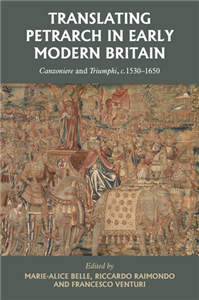
Translating Petrarch in early modern Britain
Canzoniere and Triumphi, c. 1530–1650
by Marie-Alice Belle, Riccardo Raimondo, Francesco Venturi
Translating Petrarch in early modern Britain gathers twelve essays by international scholars focusing on the translation of Petrarch's vernacular verse (Canzoniere and Triumphi) into English, from the Tudor age to the mid-seventeenth century (and beyond). Approaching translation as an interpretive process, but also a mode of literary emulation and cultural engagement with Petrarch's prestigious precedent, the collection explores the complex and interconnected trajectories of both poetic works in English and Scottish literary milieux. While situating each translation in its distinct historical, material, and literary context, the essays trace the reception of Petrarch's works in early modern Britain through the combined processes of linguistic and metric innovation, literary imitation, musical adaptation and cultural and material 'domestication'. The collection sheds light on the origins and development of early modern English Petrarchism as part of wider transnational - and indeed, translational-European literary culture.
-
Trusted Partner
The ArtsJanuary 2026
David Simon's American City
by Mikkel Jensen
This book examines the television serials created by influential showrunner David Simon. The book argues that Simon's main theme is the state of the contemporary American city and that all of his serials (barring one about the Iraq War) explore different facets of the metropolis. Each series offers distinctly different visions of the American city, but taken together they represent a sustained and intricate exploration of urban problems in modern America. From deindustrialisation in The Wire and residential segregation in Show Me a Hero to post-Katrina New Orleans in Treme and the transformation of the urban core in The Deuce, David Simon's American city traces the urban through-line in Simon's body of work. Based on sustained analysis of these serials and their engagement with contemporary politics and culture, David Simon's American city offers a compelling examination of one of television's most arresting voices.
-
Trusted Partner
 Literature & Literary StudiesOctober 2018
The politics of Middle English parables
by Mary Raschko, David Matthews, Anke Bernau
-
Trusted Partner

 2020
2020History of the German Language
A textbook for German studies; Part 1: Introduction, prehistory and history; Part 2: Old High German, Middle High German and Early New High German
by Wilhelm Schmidt, Edited by Dr. Elisabeth Berner and Prof. Dr. Dr. h.c. Dr. h.c. Norbert Richard Wolf
The 12th revised and updated version of the History of the German language – long regarded as an indispensable standard work for German Studies, has just been published. From now on, this comprehensive textbook on the history of the language is divided into two volumes. In addition to introducing questions about historical linguistics, the first volume provides a detailed account of the prehistory and history of German right up to the present day. Based on extensive source analyses, the focus is on aspects of culture and social history; only the chapters on the Indo-Germanic and Germanic language include key information about structural history. The second part contains concise, but readily understandable accounts of Old, Middle and Early New High German in terms of phonology, graphemics, morphology and syntax. Not only are synchronous descriptions given of the particular language period, but also the development of German language construction at all structural levels is explained. The association of grammatical synchrony and structural diachrony is a particular characteristic of this second part of Schmidt’s work on the history of language.
-
Trusted Partner
 Humanities & Social SciencesDecember 2025
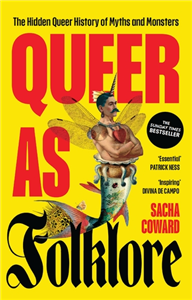
Queer as folklore
The hidden queer history of myths and monsters
by Sacha Coward
A celebration of queer history like you've never seen it before. Queer as folklore travels across centuries and continents to reveal the unsung heroes and villains of storytelling, magic and fantasy. Featuring images from archives, galleries and museums around the world, each chapter investigates the queer history of different mythic and folkloric characters, both old and new. Leaving no headstone unturned, Sacha Coward takes you on a wild ride through the night from ancient Greece to the main stage of RuPaul's Drag Race, visiting cross-dressing pirates, radical fairies and the graves of the 'queerly departed' along the way. Queer communities have often sought refuge in the shadows and created safe spaces in underworlds. But these forgotten narratives tell stories of resilience that deserve to be heard. Join any Pride march and you will see a glorious display of papier-mâché unicorn heads, drag queens in mermaid tails and more fairy wings than you can shake a trident at. These are not just accessories: they are queer symbols with historic roots. To truly understand who queer people are today, we must confront the twisted tales of the past.


