
Rachel Amphlett
USA Today bestselling author Rachel Amphlett is the creator of over 25 crime thrillers. Rachel’s titles are available for consideration to all parties interested in licensing IP.
View Rights Portal
USA Today bestselling author Rachel Amphlett is the creator of over 25 crime thrillers. Rachel’s titles are available for consideration to all parties interested in licensing IP.
View Rights Portal
TheUnited States Insitute of Peace was created by the US congress as a federally funded presscreatingworks toprevent and resolve global conflict by providing education and resources to work towards peace.
View Rights Portal

 Trusted Partner

 Trusted Partner

How do governing elites in the global South attempt to remake hegemony in a conjuncture of durable crisis? This is the question at the core of Southern interregnum, a comparative conjunctural analysis of hegemonic projects in Brazil, India, China, and South Africa. Working with a Gramscian notion of crisis, centred on the interregnum as an enduring period of instability and uncertainty, in which hegemonic authority erodes and competing projects for crisis resolution emerge, the book proposes a novel critical reading of the convulsions that are currently reshaping the political economy of the global South and the world-system. Mapping the variegated trajectories of elite projects to reconcile accumulation and legitimation - and probing the limits of these projects - the book breaks new ground in the study of the contemporary global South.
Trusted Partner
Trusted Partner


Liebe ist für Thomas Brasch (1945–2001) eine Haltung, die sich jeder Festlegung verweigert. Eine Haltung, die ihre Träume fürchtend und sehnend der Wirklichkeit aussetzt und das Mögliche stets in den Horizont des Unmöglichen stellt. Braschs dichterische Leidenschaft hofft und verzweifelt, vertraut und betrügt, preist und vernichtet. Und sie belehrt: Wann, wem und wie schreibt man ein erotisches Gedicht? In dem Band stehen Gedichte, die Brasch eigenständig und zu Lebzeiten publiziert hat, neben literarischen Hinterlassenschaften. Texte aus den frühen Jahren(»Anna, komm …«) sind ebenso vertreten wie Arbeiten aus jüngerer Zeit, etwa eine Gruppe mit Brunke-Gedichten, die in den 1990er Jahren entstanden sind.
Trusted Partner
 Trusted Partner
Trusted Partner
Trusted Partner
Islamophobia is one of the most misunderstood and pernicious forms of racism in Britain. But how do those committed to challenging Islamophobia understand it? And what does this mean for their practices 'on the ground'? Islamophobia, anti-racism and the British left combines first-hand accounts from activists and community workers across two British cities with sociological theory, critically interrogating Islamophobia's relationship to 'race', racial capitalism and other modalities of racism. Setting this discussion against some of the most pertinent political shifts in Britain in recent years - from the resurgence of left nationalism to Black Lives Matter - the book assesses the limits of recent attempts to think about and tackle Islamophobia, and considers the possibilities of an alternative approach from and for the anti-racist left.
Trusted Partner
Amid renewed anti-racist resistance to violent policing, The racial politics of police warfare unpacks the racisms that rationalise militarised policing in contemporary Britain. Jasbinder S. Nijjar shatters prevailing myths about British police as an impartial public service, by revealing it as an institution where racism and war reinforce one another. In examining flagship anti-gang and counter-terrorism policies and practices, the book offers a unique analysis of the relationship between anti-black and anti-Muslim racisms, to demonstrate how racialised populations are institutionalised as common enemies of modernity. Combining perspectives from sociology, history, criminology and social policy, Nijjar illustrates how British policing defends law and order and national security from the perceived threat of race through hyper-intrusive, pre-emptive and deathly measures. Accordingly, he gives a fresh take on resisting racial police warfare, calling for strategies that are at once political, collective, anti-militaristic and abolitionist.
Trusted Partner
Justifying (in)justice reveals how processes of ignorance are vital to legitimising punitive and discriminatory criminal justice policy and practices. Focusing on the state's startlingly harsh response to the English 'riots' of 2011, the book draws together unique insights from interviews with prosecutors, sentencers, defence lawyers and policymakers at the heart of the response, alongside analysis of media and political debates. Peacock explores the forms of unknowing that were mobilised to justify and normalise the harsh and inequitable punishment of the 'rioters', from amnesia about police racism and Britain's long history of unrest, to widespread denial about the violence of the prison system. Looking to recent events in Britain and beyond, the book offers timely insight into the cultural processes underpinning the punitive systems that disproportionately harm marginalised and racially minoritised communities.
Trusted Partner
 Trusted Partner
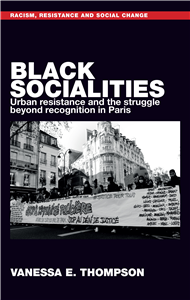
From author: This is a cutting-edge exploration of black urban politics in Parisian racialized working class and working poor districts, the formation of abolition geography, and the possibilities of new forms of political blackness. In Black Socialities. Urban resistance and the struggle beyond recognition in Paris, Vanessa E. Thompson argues that black urban politics in the French banlieues are multi-racial and spatially grounded towards abolition. Based on a close engagement with urban black activist practices against racial imagery in the city, policing and state racism, and housing insecurity, she shows how radical anti-racism goes beyond struggles for recognition and unfolds alongside new formations of political blackness that is based on urban conviviality. This form of black politics has much to teach us in this current conjuncture of liberal anti-racism and state recognition politics.
Trusted Partner

The imperatives of public health shaped our understanding of the cities of the global north in the first industrial revolutions of the nineteenth and twentieth centuries. They are doing so again today, reflecting new geographies of the urban age of the twenty-first. Emergent cities in parts of the globe experiencing most profound urban growth face major problems of economic, ecological and social sustainability when making sense of new health challenges and designing policy frameworks for public health infrastructures. The rapid evolution of complex 'systems of systems' in today's cities continually reconfigure the urban commons, reshaping how we understand urban public health, defining new problems and drawing on new data tools for analysis that work from the historical legacies and geographical variations that structure public health systems.
Trusted Partner
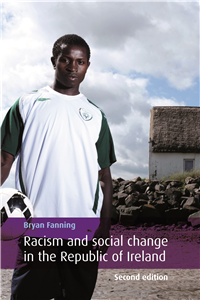
Now in its second edition, Racism and Social Change in the Republic of Ireland provides an original and challenging account of racism in twenty-first century Irish society and locates this in its historical, political, sociological and policy contexts. It includes specific case studies of the experiences of racism in twenty-first century Ireland alongside a number of historical case studies that examine how modern Ireland came to marginalize ethnic minorities. Various chapters examine responses by the Irish state to Jewish refugees before, during and after the Holocaust, asylum seekers and Travellers. Other chapters examine policy responses to and academic debates on racism in Ireland. A key focus of the various case studies is upon the mechanics of exclusion experienced by black and ethnic minorities within institutional processes and of the linked challenge of taking racism seriously in twenty-first century Ireland. ;
Trusted Partner
This book examines key moments in which collective and state violence invigorated racialized social boundaries around Mexican and African Americans in the United States, and in which they violently contested them. Bringing anti-Mexican violence into a common analytical framework with anti-black violence, A savage song examines several focal points in this oft-ignored history, including the 1915 rebellion of ethnic Mexicans in South Texas, and its brutal repression by the Texas Rangers and the 1917 mutiny of black soldiers of the 24th Infantry Regiment in Houston, Texas, in response to police brutality. Aragon considers both the continuities and stark contrasts across these different moments: how were racialized constructions of masculinity differently employed? How did African and Mexican American men, including those in uniform, respond to the violence of racism? And how was their resistance, including their claims to manhood and nation, understood by law enforcement, politicians, and the press? Building on extensive archival research, the book examines how African and Mexican American men have been constructed as 'racial problems', investigating, in particular, their relationship with law enforcement and ideas about black and Mexican criminality.
Trusted Partner
Trusted Partner
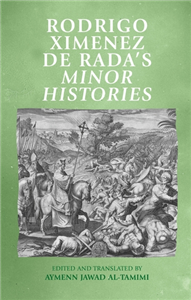
This work provides the first complete English translation of works by Toledan archbishop Rodrigo Ximénez de Rada (1170-1247 CE), whose 'Minor Histories' are sequels to his larger 'Gothic History' and thus round off his grand history of Spain project that he began at the request of King Ferdinand III. The 'Minor Histories' include Rodrigo's 'History of the Arabs' that can be considered the first surviving Western monograph focused on Arab and Islamic history and thus occupies a unique position in the medieval Latin corpus of writings. In addition to the translation, this book provides a thorough and accessible introduction to the life and works of Rodrigo, making sense of the context in which he wrote and his historical method. The translations are thoroughly annotated including cross-references to other Latin and Arabic sources for comparison.
Trusted Partner
Trusted Partner
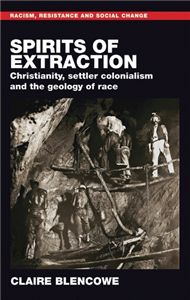
Spirits of extraction revisits the troubling history of socially reformist, ostensibly anti-racist, Christianity and its role in the expansion of the extractive industries, British imperialism, and settler colonialism. The book explores key moments in the history of Methodism and the evangelical movement. Colonial fears, and the attempt to 'civilise savages', were crucial to the movement's foundation in eighteenth-century industrialising Bristol, England. Through the culture of the Cornish mining diaspora of the nineteenth century, Methodism enmeshed with all the complexity of race and labour-structures of the British empire. At the same time, in Anishinaabewaki/Upper Canda/Ontario, Methodist missionaries laid the foundation of abusive education and racialised ideas of redemption that both enable and sacralise the mining industry. Through these histories of our present, the book theorises the relation of religion and education to racism, modernity, biopower, extractivism, and the geology of race.



