Your Search Results

      • Trusted Partner
      • Trusted Partner
        Humanities & Social Sciences
        June 2026

        Heritage and healing in Syria and Iraq

        by Zena Kamash

      • Trusted Partner
        Humanities & Social Sciences
        July 2024

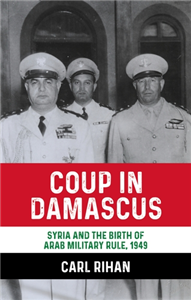
        Coup in Damascus

        Husni al-Za'im and the birth of Syrian military rule

        by Carl Rihan

        Coup in Damascus is a history of Syria's first military regime. It plots the the fall of Syria's democracy and the rise of its military rulers, particularly Husni al-Zaim, whose brief rule in 1949 represented a profoundly transformative moment for the Syrian nation. It is a history of the thoughts, intentions and motives of political actors underpinning the events that have marked Syria's history after the first Arab-Israeli war, and focuses mainly on the interaction between local, regional and international actors. Unlike most histories of the modern Middle East that tackle broad intervals and that focus on the sequences of events, this history seeks to reconstruct the thought processes behind the events, and anchor them within the epoch's existing political and socioeconomic conditions. It draws on several methodological influences, particularly R.G. Collingwood's 'history as re-enactment of the past'.

      • Trusted Partner
        Humanities & Social Sciences
        January 2027

        Saudi Arabia and Qatar

        Hegemony, power and crisis in the Gulf

        by Betul Dogan Akkas

        Saudi Arabia and Qatar offers a thorough analysis of post-Arab Spring Gulf politics, focusing on intra-Gulf Cooperation Council (GCC) dynamics and their regional impact. The book examines the actions and challenges faced by Qatar and Saudi Arabia in Syria and Egypt, while also exploring their power struggle within the GCC and the broader Middle East. It analyses how hegemonic and counter-hegemonic practices emerged in the Gulf after the Arab Uprisings and investigates the extent to which sectarian polarity and political Islam have been institutionalized as counter-hegemonic forces.

      • Trusted Partner
        Humanities & Social Sciences
        June 2026

        Romanticizing masculinity in Baathist Syria

        by Rahaf Aldoughli

      • Trusted Partner
        Humanities & Social Sciences
        March 2023

        Golden Mummies of Egypt

        Interpreting identities from the Graeco-Roman period

        by Campbell Price, Julia Thorne

        Golden Mummies of Egypt presents new insights and a rich perspective on beliefs about the afterlife during an era when Egypt was part of the Greek and Roman worlds (c. 300 BCE-200 CE). This beautifully illustrated book, featuring photography by Julia Thorne, accompanies Manchester Museum's first-ever international touring exhibition. Golden Mummies of Egypt is a visually spectacular exhibition that offers visitors unparalleled access to the museum's outstanding collection of Egyptian and Sudanese objects - one of the largest in the UK.

      • Trusted Partner
        Humanities & Social Sciences
        October 2023

        Arab youths

        by Laurent Bonnefoy, Myriam Catusse

      • Trusted Partner
        Humanities & Social Sciences
        December 2025

        Un-welcome to Denmark

        The paradigm shift and refugee integration

        by Michelle Pace

        Un-welcome to Denmark critically assesses Denmark's migration regime by directly engaging the voices of multiple stakeholders impacted by its harshness. It puts forward the theory of the unwelcome migrant by undertaking an extensive analysis of the programmatic and legal foundations for the undeserving migrant as well as of the lived experiences of Syrian refugees, and welfare professionals and private businesses tasked with supporting them. It thereby documents the ways in which the Danish migration gaze produces and perpetuates the hyper precarity of the everyday lives of Syrians and the anxiety that overshadows the manner in which Syrians and those who support them navigate its maze. By so doing, it traces how a once admired, liberal, tolerant and open society with a strong reverence for human rights has turned into one of the harshest migration regimes in Europe, if not internationally.

      • Trusted Partner
        Humanities & Social Sciences
        July 2025

        International Relations in a multipolar Middle East

        by Francesco Belcastro, Edward Wastnidge

        This volume explores the international relations of today's Middle East, a region that has become increasingly multi-polar. The tumult following the Arab Uprisings has expanded the arenas competed over by regional powers, global actors and non-state players. The United States, once seemingly intent on a hegemonic 'Pax Americana' has stepped back, leaving powers such as Russia, China, India and the EU, with opportunities to increase their reach and expand their influence. Meanwhile, regional rivalries and alliances have continued to shape conflict and cooperation in the Middle East. As global politics moves towards a new, multipolar era, this volume sheds important light on how this transition will impact on the region. Comprised of two macro sections that offer theoretical reflections and empirical case studies, this volume is essential reading for scholars of the politics and international relations of the Middle East.

      • Trusted Partner
        Humanities & Social Sciences
        March 2017

        The French empire between the wars

        Imperialism, politics and society

        by Martin Thomas

        By considering the distinctiveness of the inter-war years as a discrete period of colonial change, this book addresses several larger issues, such as tracing the origins of decolonization in the rise of colonial nationalism, and a re-assessment of the impact of inter-war colonial rebellions in Africa, Syria and Indochina. The book also connects French theories of colonial governance to the lived experience of colonial rule in a period scarred by war and economic dislocation.

      • Trusted Partner
        Humanities & Social Sciences
        July 2020

        Victorian literary culture and ancient Egypt

        by Eleanor Dobson

      • Trusted Partner
        Humanities & Social Sciences
        June 2026

        Rebel populism

        by Philip Proudfoot

      • Trusted Partner
        Humanities & Social Sciences
        March 2021

        Egypt of the Saite pharaohs, 664–525 BC

        by Roger Forshaw

      • Trusted Partner
        Humanities & Social Sciences
        April 2016

        Zionism in Arab discourses

        by Ofir Winter, Uriya Shavit

        Zionism in Arab discourses presents a ground-breaking study of the Arab-Israeli conflict. Through analyses of hundreds of texts written by Arab Islamists and liberals from the late-nineteenth century to the 'Arab Spring', the book demonstrates that the Zionist enterprise has played a dual function of an enemy and a mentor. Islamists and liberals alike discovered, respectively, in Zionism and in Israeli society qualities they sought to implement in their sown homelands. Focusing on Palestinian, Egyptian, Syrian and Jordanian political discourses, this study uncovers fascinating and unexpected Arab points of views on different aspects of Zionism; from the first Zionist Congress to the First Lebanon War; from gardening in the early years of Tel Aviv to women's service in the Israeli Defence Forces; from the role of religion in the creation of the state to the role of democracy in its preservation. This study presents the debates between and within contesting Arab ideological trends on a conflict that has shaped, and is certain to continue and shape, one of the most complicated regions in the world. ;

      • Trusted Partner
        Humanities & Social Sciences
        October 2024

        Egypt and the rise of fluid authoritarianism

        Political ecology, power and the crisis of legitimacy

        by Maria Gloria Polimeno

        Egypt and the rise of fluid authoritarianism focuses on the struggle of the post-2013 political authorities for internal political legitimacy after the crisis following the 2013 coup d'état. It explores the microstructural and macro-systemic dynamics of leadership, power, protests and the authority-making process in political systems. These cannot simply be defined as structural, political, social and economic projections of the authoritarianism of the past, but rather as a rupture with that past. The book offers a complex, ground-breaking socio-political and economic analysis into how the forging of an internal political legitimacy claim has eventually modified the regime in Egypt along the authoritarian spectrum, turning into a fluid autocracy closer to a non-exclusivist personalist regime. This shift had implications that resonated both politically and economically.

      • Trusted Partner
        Humanities & Social Sciences
        April 2007

        The French empire between the wars

        Imperialism, politics and society

        by Martin Thomas, Andrew Thompson, John Mackenzie

        By considering the distinctiveness of the inter-war years as a discrete period of colonial change, this book addresses several larger issues, such as tracing the origins of decolonization in the rise of colonial nationalism, and a re-assessment of the impact of inter-war colonial rebellions in Africa, Syria and Indochina. The book also connects French theories of colonial governance to the lived experience of colonial rule in a period scarred by war and economic dislocation. ;

      • Trusted Partner
        Medicine

        Humanitarian Aid

        Encounters with People in Need

        by Joachim Gardemann

        Joachim Gardemann outlines his encounters and experiences as a pediatrician in crisis zones while working for the Red Cross all over the world. He describes people in existential emergency situations, who have been traumatized but survived a genocide on the border with Rwanda. People who have fled from civil wars in Congo or escaped from the Kosovo war. He traces the suffering of people in Iran, China and Haiti after losing their relatives and all their possessions in severe earthquakes. At their moments of greatest vulnerability, in the shelters and dirt of a refugee camp in Jordan, he meets people who have fled from the turmoil of the civil wars in Sudan and Syria. He sketches poignant portraits of the victims of the tsunami disaster in Sri Lanka. He gives a striking account of the devastation wrought by the Ebola epidemic in Sierra Leone. He creates a worthy memorial to those who died of Ebola, who lost their lives as doctors and nurses in the fight against Ebola as well as to those who survived.

      • Trusted Partner
        Humanities & Social Sciences
        March 2017

        Air power and colonial control

        by David Omissi

        Air policing was used in many colonial possessions, but its most effective incidence occurred in the crescent of territory from north-eastern Africa, through South-West Arabia, to North West Frontier of India. This book talks about air policing and its role in offering a cheaper means of 'pacification' in the inter-war years. It illuminates the potentialities and limitations of the new aerial technology, and makes important contributions to the history of colonial resistance and its suppression. Air policing was employed in the campaign against Mohammed bin Abdulla Hassan and his Dervish following in Somaliland in early 1920. The book discusses the relationships between air control and the survival of Royal Air Force in Iraq and between air power and indirect imperialism in the Hashemite kingdoms. It discusses Hugh Trenchard's plans to substitute air for naval or coastal forces, and assesses the extent to which barriers of climate and geography continued to limit the exercise of air power. Indigenous responses include being terrified at the mere sight of aircraft to the successful adaptation to air power, which was hardly foreseen by either the opponents or the supporters of air policing. The book examines the ethical debates which were a continuous undercurrent to the stream of argument about repressive air power methods from a political and operational perspective. It compares air policing as practised by other European powers by highlighting the Rif war in Morocco, the Druze revolt in Syria, and Italy's war of reconquest in Libya.

      Subscribe to our

      newsletter