
Your Search Results

-
Promoted Content

 Humanities & Social SciencesMay 2026
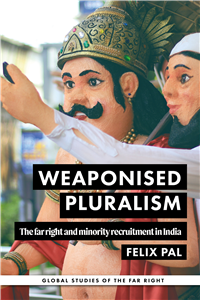
Weaponised pluralism
The far right and minority recruitment in India
by Felix Pal
Weaponised pluralism takes a fine-grained lens to understand why far-right organisations recruit from the very minorities they oppose. Why do these organisations seek to appear like pluralists? Building on his time with the Muslim wing of the Hindu far-right in India, Felix Pal proposes that bigots can strategically use what he calls weaponised pluralism. This political strategy counterintuitively uses progressive political performances to bolster bigoted political agendas. Basing his analysis in an Indian context, Weaponised pluralism nonetheless reveals much about contexts as varied as Palestinian soldiers in the Israeli army, Indigenous Australians on far-right television, and Black congressional candidates in the American Republican Party. Drawing on rare access to the Hindu far-right and its Muslim wing, Pal paints an evocative picture of the complexities of how far-right organising extends far beyond the pointy end of traditional bigotry.
-
Promoted Content
 Humanities & Social SciencesMarch 2017
'The better class' of Indians
Social rank, Imperial identity, and South Asians in Britain 1858–1914
by A. Wainwright
This is the first book-length study to focus primarily on the role of class in the encounter between South Asians and British institutions in the United Kingdom at the height of British imperialism. In a departure from previous scholarship on the South Asian presence in Britain, 'The better class' of Indians emphasizes the importance of class as the register through which British polite society interpreted other social distinctions such as race, gender, and religion. Drawing mainly on unpublished material from the India Office Records, the National Archives, and private collections of charitable organizations, this book examines not only the attitudes of British officials towards South Asians in their midst, but also the actual application of these attitudes in decisions pertaining to them. This fascinating book will be of particular interest to scholars and general readers of imperialism, immigration as well as British and Indian social history.

