
Your Search Results
-

-

Praphansarn Publishing Co., Ltd.
Praphansarn Publishing is a well-known publisher, established since 1961. With our experiences and history within the Thai Publishing market, we are one of the experts. Praphansarn Publishing publishes both Fiction, Non-fiction, Young Adults and Children books. We have altogether 3 other imprints: Woman Publisher, Rainbow Publisher and Asian Manga. Each imprints specialised in its own speciality.
View Rights Portal
-
Promoted Content

 Humanities & Social SciencesFebruary 2017
Curating empire
Museums and the British imperial experience
by Sarah Longair, John McAleer
Curating empire explores the diverse roles played by museums and their curators in moulding and representing the British imperial experience. This collection demonstrates how individuals, their curatorial practices, and intellectual and political agendas influenced the development of a variety of museums across the globe. Taken together, these contributions suggest that museums are not just sites for accessing history but need to be considered as historical sites of significance in themselves. Individual essays examine the work of curators in museums in Britain and the colonies, the historical display and interpretation of empire in Britain, and the establishment of 'museum networks' in the British imperial context. Curating empire sheds new light on the relationship between museums, as repositories for objects and cultural institutions for conveying knowledge, and the politics of culture and the formation of identities throughout the British Empire.
-
Promoted Content
 Humanities & Social SciencesJune 2016
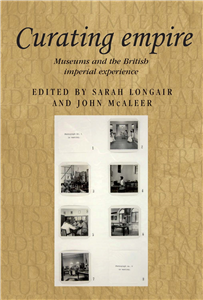
Curating empire
Museums and the British imperial experience
by Sarah Longair, Andrew Thompson, John McAleer, John Mackenzie
Curating empire explores the diverse roles played by museums and their curators in moulding and representing the British imperial experience. This collection demonstrates how individuals, their curatorial practices, and intellectual and political agendas influenced the development of a variety of museums across the globe. Taken together, these contributions suggest that museums are not just sites for accessing history but need to be considered as historical sites of significance in themselves. Individual essays examine the work of curators in museums in Britain and the colonies, the historical display and interpretation of empire in Britain, and the establishment of 'museum networks' in the British imperial context. Curating empire sheds new light on the relationship between museums, as repositories for objects and cultural institutions for conveying knowledge, and the politics of culture and the formation of identities throughout the British Empire. ;
-
 Trusted Partner
 Humanities & Social SciencesJanuary 2026
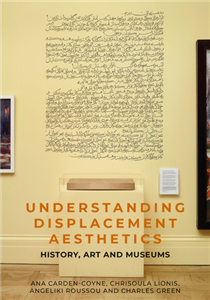
Understanding displacement aesthetics
History, art and museums
by Ana Carden-Coyne, Charles Green, Chrisoula Lionis, Angeliki Roussou
Since the Second World War and the formalisation of the international refugee regime, forced displacement has been marked by a set of aesthetic, practical, and institutional concerns. Understanding Displacement Aesthetics examines how visual culture and art practice constructs and challenges ideas about forced displacement and refugees. The novel framework for 'displacement aesthetics' moves beyond conventional understandings of aesthetics as merely representational, demonstrating the entanglement of visual culture, art practices, and forced displacement in postmigrant contexts. Bringing together the fields of cultural history, art history, and curatorial studies, Understanding Displacement Aesthetics identifies four areas for consideration: visual tropes of refugeedom; language and identity; institutional and artistic responses to displacement; and lived experiences of artists with backgrounds of displacement. Through archival research, visual culture and art, interviews, and collaborative curatorship, Understanding Displacement Aesthetics offers new insight into overcoming the limitations that contexts of displacement can present for artists, art galleries and institutions addressing refugeedom and its legacies.
-
Trusted Partner
 The ArtsOctober 2013
Gender, artWork and the global imperative
A materialist feminist critique
by Angela Dimitrakaki
Is gender implicated in how art does its work in the world created by global capital? Is a global imperative exclusive to capital's planetary expansion or also witnessed in oppositional practices in art and curating? And what is new in the gendered paradigms of art after the fall of the Berlin Wall? Angela Dimitrakaki addresses these questions in an insightful and highly original analysis of travel as artistic labour, the sexualisation of migration as a relationship between Eastern and Western Europe, the rise of female collectives, masculinity and globalisation's 'bad boys', the emergence of a gendered economic subject that has dethroned postmodernism, and the need for a renewed materialist feminism. This is a theoretically astute overview of developments in art and its contexts since the 1990s and the first study to attempt a critical refocusing of feminist politics in art history in the wake of globalisation. It will be essential reading in art history, gender, feminist and globalisation studies, curatorial theory, cultural studies and beyond. ;
-
Trusted Partner
 Teaching, Language & ReferenceMay 2023
Relational peace practices
by Anna Jarstad, Johanna Söderström, Malin Åkebo
-
Trusted Partner
 Humanities & Social SciencesSeptember 2025
Writing power
Intellectuals, legitimacy, and the making of knowledge
by Sarah Victoria Alexandra Burton
Writing power radically rethinks the place of the canon and canonicity as objects and concepts in contemporary academia and the everyday intellectual practices of academics. It is distinctive in its demonstration of how academics' engagements with canons shape their writing practices but also how scholars' writing practices, spaces, proclivities, and desires shape the canon and changing ideas of value in canonicity. The book thinks through frequently discussed problems of legitimacy and knowledge production from fresh perspectives of lived experience and the everyday to offer new insights into the politics of knowledge in contemporary social sciences.
-
Trusted Partner
 Humanities & Social SciencesAugust 2023
Picturing the Western Front
Photography, practices and experiences in First World War France
by Beatriz Pichel
Between 1914 and 1918, military, press and amateur photographers produced thousands of pictures. Either classified in military archives specially created with this purpose in 1915, collected in personal albums or circulated in illustrated magazines, photographs were supposed to tell the story of the war. Picturing the Western Front argues that photographic practices also shaped combatants and civilians' war experiences. Doing photography (taking pictures, posing for them, exhibiting, cataloguing and looking at them) allowed combatants and civilians to make sense of what they were living through. Photography mattered because it enabled combatants and civilians to record events, establish or reinforce bonds with one another, represent bodies, place people and events in imaginative geographies and making things visible, while making others, such as suicide, invisible. Photographic practices became, thus, frames of experience.
-
Trusted Partner
 Humanities & Social SciencesJanuary 2013
Crime, Law and Society in the Later Middle Ages
by Anthony Musson, Edward Powell
This book provides an accessible collection of translated legal sources through which the exploits of criminals and developments in the English criminal justice system (c.1215-1485) can be studied. Drawing on the wealth of archival material and an array of contemporary literary texts, it guides readers towards an understanding of prevailing notions of law and justice and expectations of the law and legal institutions. Tensions are shown emerging between theoretical ideals of justice and the practical realities of administering the law during an era profoundly affected by periodic bouts of war, political in-fighting, social dislocation and economic disaster. Introductions and notes provide both the specific and wider legal, social and political contexts in addition to offering an overview of the existing secondary literature and historiographical trends. This collection affords a valuable insight into the character of medieval governance as well as revealing the complex nexus of interests, attitudes and relationships prevailing in society during the later Middle Ages.
-
Trusted Partner
 2022
2022Pharmacy Practice Workbook
practise, consolidate, revise
by Annette Thomas / Nadine Sprecher
Advising patients, dispensing, preparing and checking drugs – that is the essence of pharmacy practice and – at the same time – a broad field. This workbook enables knowledge about legal and regulatory requirements concerning the dispensing of drugs, the use of particular dosage forms, specific risks of drugs as well as the handling of medical devices or hazardous substances to be deepened – and in an amusing and entertaining way, thanks to a varied range of exercises! It is the ideal complement to the textbook Pharmacy Practice of the Deutschen Apotheker Verlag and the perfect preparation for the final examination. But quite apart from that, it guarantees fun for all prospective and active pharmaceutical technicians, returnees and pharmacy interns when learning and revising. It provides valuable ideas and support for pharmaceutical technician schools and pharmacies with teaching and training.
-
Trusted Partner
 2022
2022The Practice of Pharmacy
Textbook for pharmacy interns Handbook for the pharmacy
by Dr. Michael Sax, founded by Dr. Herbert Gebler and Dr. Gerd Kindl
After pharmacy studies have ended, the fascinating world of the pharmacy awaits – simultaneously varied and challenging. This is no problem with this well-established standard work to hand! The 7th edition, with a new editor and new structure, goes through the various stages of pharmacy operation. Beginning with the social mandate to supply medicines and then considering the organisational and economic orientation of a pharmacy, one delves ever deeper into its inner workings. In every area, the appropriate specific information can be found about pharmaceutical law and practice – whether this concerns the back office, over-the-counter medicines, dispensary and dispensing, or the supply of care homes, or preparation of cytotoxic drugs. In addition to the important topic “Dispensing of drugs and medical devices on prescription”, particular attention is paid to the principal activity in the pharmacy – giving advice on self-medication. The contents are based on the regulations for registration of pharmacists and the guidelines of the Federal Chamber of Pharmacists for the practical training of pharmacy interns in the pharmacy. The Practice of Pharmacy safely navigates the user through the practical training year and is the ideal preparation for the 3rd State Examination! Returnees, pharmacies that provide training and pharmacists of many years’ experience, will also benefit from this textbook and reference work.
-
Trusted Partner
 Teaching, Language & ReferenceApril 2025
Anti-colonial research praxis
Methods for knowledge justice
by Caroline Lenette
How can anti-colonial research methodologies be transformative and achieve knowledge justice? This book brings together an eclectic group of leading scholars from around the world to share methodological knowledge grounded in First Nations and majority-world expertise and wisdom. The authors challenge western-centric and colonial approaches to knowledge production and redefine the possibilities of what we can achieve through social research. First Nations and majority-world perspectives are contextual and unique. They share a common aim of disrupting established beliefs on research methodologies and the unquestioned norms that dictate whose knowledge the academy values. The ten chapters in this edited collection describe how the authors draw on Indigenous knowledge systems, feminist frameworks, and creative methodologies as anti-colonial research praxis. The examples span several disciplines such as development studies, geography, education, sexual and reproductive health, humanitarian studies, and social work. Authors use a reflexive approach to discuss specific factors that shape how they engage in research ethically, to lead readers through a reflection on their own practices and values. The book reimagines social research using an anti-colonial lens and concludes with a collaboratively developed and co-written set of provocations for anti-colonial research praxis that situate this important work in the context of ongoing colonial violence and institutional constraints. This book is an essential guide for researchers and scholars within and beyond the academy on how anti-colonial research praxis can produce meaningful outcomes, especially in violent and troubled times. Cover art courtesy of Tawny Chatmon
-
Trusted Partner

 2022
2022Phytotherapy in Equine Practice
Pocket guide
by Dr. Herbert Konrad
Lemon balm tea for competition anxiety, cottonwood bark for myositis, devil’s claw root for laminitis – yes, herbal preparations promote healing in horses too! An experienced veterinarian has gathered together the skills of his holistic treatment - Profiles of herbal drugs: Therapy-relevant characteristics of the medicinal plants - Veterinary practice: Examination, repertorisation (finding the suitable remedy), treatment plan, calculation of the dose for a horse, including examples of equine patients - Indications: Proven phytotherapeutic agents for the most common diseases This book shows that even chronic cases or those refractory to conventional medicine can be successfully treated with the healing power of plants.
-
Trusted Partner
 Humanities & Social SciencesJuly 2025
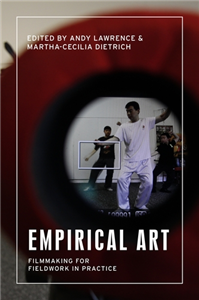
Empirical art
Filmmaking for fieldwork in practice
by Andy Lawrence, Martha-Cecilia Dietrich
Empirical art: Filmmaking for fieldwork in practice is an insightful exploration of what the craft of filmmaking brings to social science research. Providing creative avenues on how to narrate encounters, relationships, and experiences during fieldwork, this comprehensive volume offers a rich tapestry of theoretical explorations and explorative methodologies. Skilfully connecting the worlds of ethnography, art and cinema, the contributors in this book act as a compass for filmmakers and researchers venturing to use a camera and microphone to relate and narrate their research collaborations and fieldsites. Drawing from the authors' extensive experience in disciplines like social anthropology, environmental humanities, and political science, "Empirical Art" breaks down the intricate process of crafting ethnographic films that departs from the researcher's subjectivity. Covering aspects of filmmaking from conceptualisation to production and distribution, readers are equipped with a treasure trove of collaborative techniques, innovative approaches, and ethical considerations necessary to generate and examine storytelling practices in contemporary fields of study. The authors discuss the significance of the multiple roles that technologies of filmmaking play in reflecting on cultural practices, social dynamics, and (beyond) human storytelling and their transformative potentials. Whether a seasoned filmmaker, an aspiring ethnographer, or an academic seeking new dimensions for their research, Empirical Art serves as a guide to integrating visual storytelling, cinema craft and empirical research.
-
Trusted Partner
 Humanities & Social SciencesFebruary 2025
Missing persons, political landscapes and cultural practices
Violent absences, haunting presences
by Laura Huttunen
This book examines human disappearances anthropologically in various contexts, ranging from enforced disappearances under oppressive governments and during armed conflicts to disappearing undocumented migrants and, finally, to people who go missing under more everyday circumstances. Two focuses run through the book: the relationship between the state and disappearances, and the consequences of disappearances for the families and communities of missing persons. The book analyses both the circumstances that make some people disappear and the variety of responses that disappearances give rise to; the latter include projects focused on searching for the missing and identifying human remains, as well as political projects that call for accountability for disappearances. While providing empirical examples from a variety of places, with Bosnia-Herzegovina as they key empirical site, the book develops an analytic grip on the slippery category of the 'disappeared'.
-
Trusted Partner
 2020
2020Anthroposophic Medicine
Medicinal therapy for 350 disease pictures
by Edited by Dr. Matthias Girke,Dr. Michaela Glöckler and Georg Soldner
100 years after it was founded in Switzerland, anthroposophic medicine is nowadays an approach to treatment that is used worldwide. In this jubilee edition, 39 general practitioners and specialists experienced in anthroposophic therapy describe 350 disease pictures and their medicinal treatment – including Covid-19 – in understandable therapeutic concepts.
-
Trusted Partner

 2020
2020How Animals Hammer, Drill and Strike
Tool Use in the Animal Kingdom
by Peter-René Becker
From insects to fish as well as birds and primates: the use of tools is amazingly widespread in the animal kingdom. It’s a misnomer to presume that humans are distinguished by tool use and conscious capacity. So where is culture initiated? The biologist Peter-René Becker has evaluated numerous studies and cites plenty of evidence for the use of the hammer and anvil, lances, bait or sponges. Animals also use “tools as social implements”. Ultimately, the depth of man’s conscience singles him out from other animals.
-
Trusted Partner
 2021
2021Psychotropic Drugs in General Practice
How to recognise, understand and treat patients successfully
by PD Dr. Daniel Schüpbach and Dr. Otto Dietmaier
The purpose of this book is to support general practitioners in finding the optimum, guideline-compliant therapy for their patients. The focus is on the clinical pictures of depression, psychosis as well as anxiety and sleep disorders and the handling of psychiatric emergencies. The reader will learn everything about the epidemiology, aetiology, diagnosis and medical treatment of these diseases, about switching therapy and about treatment in pregnancy and lactation. All the available psychotropic drugs and their pharmacological properties are described in detail – including key specific features of active substances and drug safety aspects. The table of substances in the appendix provides a clear summary of the information and simplifies the choice of the appropriate drug. The extras: - 13 factsheets with concise, summarised information to cope with tricky situations in the practice - The authors take the current treatment guidelines from Germany, Austria and Switzerland into account and name examples of proprietary medicinal products in the three countries.
-
Trusted Partner
 2021
2021aporello - Drugs in Palliative Medicine
by Christian Redmann
In the last stage of life, it is all about giving care in a professional manner and providing efficient relief of suffering. In addition to all the important key points about in-label use, this book consisting of drug monographs, includes: - Information about off-label indications with dosages, - Lists of the different dosage forms available, - Instructions about use in renal failure. A clear structure and icons enable rapid orientation in everyday practice. Focussed knowledge at your fingertips? That’s aporello!
-
Trusted Partner
 Humanities & Social SciencesNovember 2024
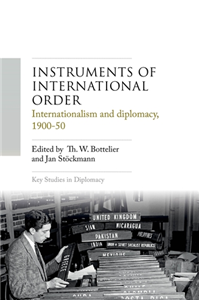
Instruments of international order
Internationalism and diplomacy, 1900-50
by Thomas W. Bottelier, Jan Stöckmann
During the first half of the twentieth century, world politics was reshaped in pursuit of a new international order. The ideological foundations of the 'new diplomacy' (and its fate during the interwar period) are well known. This book instead examines the practices of internationalism and diplomacy from the First Hague Conference of 1899 to the aftermath of the Second World War. By focusing on these practices, such as disarmament regimes or public diplomacy, and their use as instruments to build international order(s), it emphasises the constructed, contested, and experimental character of what subsequently became a standard repertoire of international politics. Essays from a range of interdisciplinary scholars address well-established principles such as self-determination, and also less prominent practices such as small arms control or parliamentary inquiry. The book makes a major contribution to the growing historiography on twentieth-century internationalism.
-
Trusted Partner
Humanities & Social SciencesJune 2026
Instruments of international order
Internationalism and diplomacy, 1900-50
by Th. W. Bottelier, Jan Stöckmann
During the first half of the twentieth century, world politics was reshaped in pursuit of a new international order. The ideological foundations of the 'new diplomacy' (and its fate during the interwar period) are well known. This book instead examines the practices of internationalism and diplomacy from the First Hague Conference of 1899 to the aftermath of the Second World War. By focusing on these practices, such as disarmament regimes or public diplomacy, and their use as instruments to build international order(s), it emphasises the constructed, contested, and experimental character of what subsequently became a standard repertoire of international politics. Essays from a range of interdisciplinary scholars address well-established principles such as self-determination, and also less prominent practices such as small arms control or parliamentary inquiry. The book makes a major contribution to the growing historiography on twentieth-century internationalism.

