
Humanities & Social Sciences
September 2019


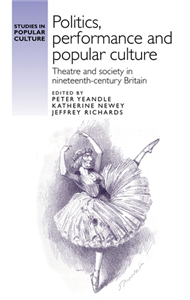
This collection brings together studies of popular performance and politics across the nineteenth century, offering a fresh perspective from an archivally grounded research base. It works with the concept that politics is performative and performance is political. The book is organised into three parts in dialogue regarding specific approaches to popular performance and politics. Part I offers a series of conceptual studies using popular culture as an analytical category for social and political history. Part II explores the ways that performance represents and constructs contemporary ideologies of race, nation and empire. Part III investigates the performance techniques of specific politicians - including Robert Peel, Keir Hardie and Henry Hyndman - and analyses the performative elements of collective movements.
 Trusted Partner
Trusted Partner
Trusted Partner

Penny politics offers a new way to read early Victorian popular fiction such as Jack Sheppard, Sweeney Todd, and The Mysteries of London. It locates forms of radical discourse in the popular literature that emerged simultaneously with Brittan's longest and most significant people's movement. It listens for echoes of Chartist fiction in popular fiction. The book rethinks the relationship between the popular and political, understanding that radical politics had popular appeal and that the lines separating a genuine radicalism from commercial success are complicated and never absolute. With archival work into Newgate calendars and Chartist periodicals, as well as media history and culture, it brings together histories of the popular and political so as to rewrite the radical canon.
Trusted Partner

The documents in this stimulating volume span from 1245 to 1424 but focus on the 'contagion of rebellion' from 1355 to 1382 that followed in the wake of the plague. They comprise a diversity of sources and cover a variety of forms of popular protest in different social, political and economic settings. Their authors range across a wide political and intellectual horizon and include revolutionaries, the artistocracy, merchants and representatives from the church. They tell gripping and often gruesome stories of personal and collective violence, anguish, anger, terror, bravery, and foolishness. Of over 200 documents presented here, most have been translated into English for the first time, providing students and scholars with a new opportunity to compare social movements across Europe over two centuries, allowing a re-evaluation of pre-industrial revolts, the Black Death and its consequences for political culture and action. This book will be essential reading for those seeking to better understand popular attitudes and protest in medieval Europe.
Trusted Partner

Brazil has one of the most significant and productive film industries in Latin America. This ground-breaking study provides an entertaining insight into the Brazilian films that have most captured the imagination of domestic audiences over the years. The recent international success of films such as Central Station and City of God, has stimulated widespread interest in Brazilian film, but studies written in English focus on the 'auteur' cinema of the 1960s. This book focuses on individual films in their socio-historical context, drawing on extensive fieldwork in Brazil and Latin America. It argues that Brazilian cinema has almost always been grounded in intrinsically home-grown cultural forms, dating back to the nineteenth century, such as the Brazilian music-hall, the travelling circus, radio shows, carnival, and, later, comedy television. Combining a chronological structure with groundbreaking research and a lively approach, Popular cinema in Brazil is the ideal introduction to Brazilian cinema.
Trusted Partner
Trusted Partner
 Trusted Partner
Trusted Partner
Trusted Partner

Why is the search for democratic renewal so elusive? This book examines both the political and policy implications of efforts by the centre-left to transform democracy. This is a story not only about democratic change, but also the identity crisis of centre-left political parties. The book offers a fresh critique of the Big Society agenda, and analyses why both left and right are searching for democratic renewal. Drawing on high-profile interviews and examining an in-depth series of comparative cases, the book argues that the centre-left's search for democratic renewal contains a range of policy and political aims, contradictions and tensions. It will be of interest to students, academics, researchers, interest groups and policy analysts interested in consultation, democratic renewal, labour politics, and Australian and British politics. ;
Trusted Partner

Design and Popular Entertainment offers a selection of nine essays that examine the range of design for popular entertainment, from theatre and film, to television and radio. Investigating entertainment design from the late nineteenth century to the 1960s, the book is divided into two sections. The first addresses the 'hardware' of popular entertainment, in other words the objects through which images, sound and performance are transmitted. The second explores the construction of cinematic and televisual imagery and the design of objects for the screen, the 'software' of entertainment. In so doing it offers important insights into this little explored aspect of design. Topics covered by the collection include the design of theatrical lighting and stage sets, cinema and radio design, the representation of designers within film, and the relationship between design and television. The book's concentration on the 1950s and 1960s reflects the profound changes in modes of entertainment that took place during that period, in particular the spread of television, which not only attracted a huge popular audience but also stimulated experimental designing approaches and thinking. With particular focus on the way that both the objects and the construction of entertainment have altered audience's experience, the essays present a novel approach to the subject. This book will be of particular interest to students and teachers working in design and cultural history as well as film and theatre studies. ;
Trusted Partner

Popular television drama: critical perspectives' is a collection of essays examining landmark programmes of the last forty years, from 'Doctor Who' to 'The Office', and from 'The Demon Headmaster' to 'Queer As Folk'. Contributions from prominent academics focus on the full range of popular genres, from sitcoms to science fiction, gothic horror and children's drama, and challenge received wisdom by reconsidering how British television drama can be analysed. Each section is preceded by an introduction in which the editors discuss how the essays address existing problems in the field and also suggest new directions for study. The book is split into three sections, addressing the enduring appeal of popular genres, the notion of 'quality' in television drama, and analysing a range of programmes past and present. Popular television drama: critical perspectives will be of interest to students and researchers in many academic disciplines that study television drama. Its breadth and focus on popular programmes will also appeal to those interested in the shows themselves.
Trusted Partner

'Popular television drama: critical perspectives' is a collection of essays examining landmark programmes of the last forty years, from 'Doctor Who' to 'The Office', and from 'The Demon Headmaster' to 'Queer As Folk'. Contributions from prominent academics focus on the full range of popular genres, from sitcoms to science fiction, gothic horror and children's drama, and challenge received wisdom by reconsidering how British television drama can be analysed. Each section is preceded by an introduction in which the editors discuss how the essays address existing problems in the field and also suggest new directions for study. The book is split into three sections, addressing the enduring appeal of popular genres, the notion of 'quality' in television drama, and analysing a range of programmes past and present. Popular television drama: critical perspectives will be of interest to students and researchers in many academic disciplines that study television drama. Its breadth and focus on popular programmes will also appeal to those interested in the shows themselves. ;
Trusted Partner

This book examines the contribution of different Christian traditions to the waves of democratisation that have swept various parts of the world in recent decades. It offers a historical overview of Christianity's engagement with the development of democracy, before focusing in detail on the period since the 1970s. Successive chapters deal with: the Roman Catholic conversion to democracy and the contribution of that church to democratisation; the Eastern Orthodox 'hesitation' about democracy; the alleged threat to American democracy posed by the politicisation of conservative Protestantism; and the likely impact on democratic development of the global expansion of Pentecostalism. The author draws out several common themes from the analysis of these case studies, the most important of which is the 'liberal-democracy paradox'. This ensures that there will always be tensions between faiths that proclaim some notion of absolute truth and political orders that are rooted in the idea of compromise, negotiation and bargaining. Written in an accessible style, this book will appeal to students of politics, sociology and religion, and prove useful on a range of advanced undergraduate and postgraduate courses. ;
Trusted Partner

Democratizing AI offers a powerful rethinking of how artificial intelligence should be governed. Challenging the dominance of tech elites in shaping AI's future, Zimmermann argues that AI deployment is a political act-one that must be subject to democratic control. She proposes a practical "playbook" for reclaiming agenda-setting power through civic participation, public ownership, and institutional reform. Engaging with leading critics, Zimmermann defends a risk-sensitive proceduralist approach while acknowledging the deeper structural challenges posed by capitalism, inequality, and democratic fatigue. This book is a call to action: to resist learned helplessness, confront techno-authoritarianism, and shape AI's trajectory in line with democratic values. Thoughtful, urgent, and visionary, the book is essential reading for anyone concerned with the future of technology and democracy.
Trusted Partner

This book analyses the political legitimacy of the European Union, taking democratic citizenship seriously. Developing a distinctive normative theory of political association, it evaluates the project of European integration in terms of democratic values. It argues that the goods of democratic citizenship have been advanced by European integration in many respects, including environmental policy. In other respects, including social policy, democratic citizenship is best advanced by keeping primary political authority at the level of the nation-state. Weale develops these arguments through an original interplay of political science and political theory. The contents combine original normative political theory, drawing on the concept of practical reason, with applications to the fields of social policy, environmental policy, security policy and enlargement. The book is primarily an original work of political theory, but it will be of interest to all those concerned about the future of the European Union. It is written in a style that makes it accessible to students on advanced courses as well as specialists. ;
Trusted Partner

Accessible, introductory student guide which identifies key feminist approaches to popular culture from the 1960s to the present.. The only introduction to both feminist cultural studies and feminism and popular culture published in the UK.. Presents its information in a reader friendly series of case studies on: women's film romantic fiction soap opera consumption and material culture fashion and beauty proactices youth culture and popular music. Will appeal to students across a wide range of disciplines as a variety of popular cultural forms are discussed. ;
Trusted Partner

Can terrorism and state violence cause democratic breakdown? Although the origins of violence have been studied, only rarely are its consequences examined. In this detailed comparative study of Uruguay, Spain, and Peru, Holmes claims that to understand the consequences of violence on democratic stability, terrorism and state responses to terrorism must be studied together. This extensively revised and expanded second edition takes advantage of new historical sources, an extended time span, and new theories that have emerged since the original publication. In addition to adding new data sources in the Peruvian and Spanish cases, the time period covered has been expanded from the late 1990s to early 2007, allowing a more comprehensive treatment of the consequences of state and non-state violence on democratic stability and the prospects for stability. The literature reviews have been significantly revised and updated and an entirely new chapter covers the special case of Spain, which faces both a domestic and an international threat. ;
Trusted Partner

Can the participation of civil society organisations democratise policy making in the European Union? This book challenges the widespread optimism about civil society participation in European governance and offers a nuanced and realistic evaluation of its democratic potential. Friedrich argues that the participation of these groups is only of democratic value if participatory patterns are democratised through appropriate institutional means. This book systematically brings together insights from normative democratic theory with an empirical evaluation of concrete policy-processes. It demonstrates that the participation of civil society organisation cannot be conceived as a panacea for the European Union's democratic deficit, because the participatory pattern of EU policy-making violates the key democratic value of political equality. This book will be of interest to all of those concerned about the future of European democracy, those studying and teaching European politics, the European Union, international relations and democratic theory. ;
Trusted Partner

A concise history of smoking in British popular culture from the early nineteenth century to the present day.. Provides the historical backdrop to the current debates about the politics of tobacco and health, demonstrating that both pro- and anti-smokers have consistently failed to understand the position of smoking within popular culture.. Important themes explored include: the importance of consumption to constructions of masculinity and femininity, the role of the state in the official regulation of the 'minor vices', the morality of consumption and the position of scientific knowledge within popular culture.. Traces the production, promotion and consumption of tobacco as well as outlining the arguments that have variously opposed this ever-controversial drug.. Genuinely interdisciplinary, combining elements of social, cultural and economic history whilst contributing to debates in sociology and cultural studies, the anthropology of material culture, design history, medical history and public health policy. ;



