Your Search Results

      • El Emporio

        Como grupo editorial, estamos orgullosos de decir que somos creadores de best-sellers, que pasan de ser éxitos locales a éxitos nacionales. Apostamos tanto por autores reconocidos como por autores noveles y nos interesamos en ampliar y renovar nuestro catálogo de manera constante. Como actores activos de la cultura, nuestro horizonte es ofrecer libros que participen de la construcción colectiva de contenidos de calidad.

        View Rights Portal
      • Trusted Partner
        The Arts
        January 2019

        Medieval film

        by Anke Bernau, Bettina Bildhauer

        Medieval film explores theoretical questions about the ideological, artistic, emotional and financial investments inhering in cinematic renditions of the medieval period. What does it mean to create and watch a 'medieval film'? What is a medieval film and why are they successful? This is the first work that attempts to answer these questions, drawing, for instance, on film theory, postcolonial theory, cultural studies and the growing body of work on medievalism. Contributors investigate British, German, Italian, Australian, French, Swedish and American film, exploring topics such translation, temporality, film noir, framing and period film - and find the medieval lurking in unexpected corners. In addition it provides in-depth studies of individual films from different countries including The Birth of a Nation to Nosferatu, and Robin Hood: Prince of Thieves. Medieval film will be of interest to medievalists working in disciplines including literature, history, art history, to scholars working on film and in cultural studies. It will also be of interest to undergraduates, postgraduates and to an informed enthusiast in film or/and medieval culture.

      • Trusted Partner
        The Arts
        June 2021

        Medieval film

        by Anke Bernau, Bettina Bildhauer

        Medieval film explores theoretical questions about the ideological, artistic, emotional and financial investments inhering in cinematic renditions of the medieval period. What does it mean to create and watch a 'medieval film'? What is a medieval film and why are they successful? This is the first work that attempts to answer these questions, drawing, for instance, on film theory, postcolonial theory, cultural studies and the growing body of work on medievalism. Contributors investigate British, German, Italian, Australian, French, Swedish and American film, exploring topics such translation, temporality, film noir, framing and period film - and find the medieval lurking in inexpected corners. In addition it provides in-depth studies of individual films from different countries including The Birth of a Nation to Nosferatu, and Robin Hood: Prince of Thieves. Medieval Film will be of interest to medievalists working in disciplines including literature, history, to scholars working on film and in cultural studies. It will also be of interest to undergraduates, postgraduates and to an informed enthusiast in film or/and medieval culture.

      • Trusted Partner
        The Arts
        January 2019

        Realist film theory and cinema

        The nineteenth-century Lukácsian and intuitionist realist traditions

        by Ian Aitken

        'Realist film theory and cinema' embraces studies of cinematic realism and 19th century tradition, the realist film theories of Lukács, Grierson, Bazin and Kracauer, and the relationship of realist film theory to the general field of film theory and philosophy. This is the first book to attempt a rigorous and systematic application of realist film theory to the analysis of particular films. The book suggests new ways forward for a new series of studies in cinematic realism, and for a new form of film theory based on realism. It stresses the importance of the question of realism both in film studies and in contemporary life. Aitken's work will be of interest to scholars and advanced students of film studies, literary studies, media studies, cultural studies and philosophy.

      • Trusted Partner
        The Arts
        June 2021

        Lukácsian film theory and cinema

        A study of Georg Lukács' writing on film 1913–1971

        by Ian Aitken

        Lukácsian film theory and cinema explores Georg Lukács' writings on film. The Hungarian Marxist critic Georg Lukács is primarily known as a literary theorist, but he also wrote extensively on the cinema. These writings have remained little known in the English-speaking world because the great majority of them have never actually been translated into English - until now. Aitken has gathered together the most important essays and the translations appear here, often for the first time. This book thus makes a decisive contribution to understandings of Lukács within the field of film studies, and, in doing so, also challenges many existing preconceptions concerning his theoretical position. For example, whilst Lukács' literary theory is well known for its repudiation of naturalism, in his writings on film Lukács appears to advance a theory and practice of film that can best be described as naturalist. Lukácsian film theory and cinema is divided into two parts. In part one, Lukács' writings on film are explored, and placed within relevant historical and intellectual contexts, whilst part two consists of the essays themselves. This book will be of considerable interest to scholars and students working within the fields of film studies, literary studies, intellectual history, media and cultural studies. It is also intended to be the final volume in a trilogy of works on cinematic realism, which includes the author's earlier European film theory and cinema (2001), and Realist film theory and cinema (2006).

      • Trusted Partner
        The Arts
        January 2019

        European Film Noir

        by Andrew Spicer

        European Film Noir is the first book to bring together specialist discussions of film noir in specific European national cinemas. Written by leading scholars, this groundbreaking study provides an authoritative understanding of an important aspect of European cinema and of film noir itself, for too long considered as a solely American form. The Introduction reviews the problems of defining film noir, its key characteristics and discusses its significance to the development of European film, the relationship of specific national films noirs to each other, to American noir and to historical and social change. Eight chapters then discuss film noir in France, Germany, Britain and Spain, analysing both earlier developments and the evolution of neo-noir through to the present. A further chapter explores film noir in Italian cinema where its presence is not so well defined. Each piece provides a critical overview of the most significant films in relation to their industrial and social contexts. European Film Noir is an important contribution to the study of European cinema that will have a broad appeal to undergraduates, cinéastes, film teachers and researchers.

      • Trusted Partner
        The Arts
        December 2022

        The cinema of Pedro Almodóvar

        by Ana María Sanchez-Arce

        This book offers a comprehensive film-by-film analysis of Spain's most famous living director, Pedro Almodóvar. It shows how Almodóvar's films draw on various national cinemas and genres, including Spanish cinema of the dictatorship, European art cinema, Hollywood melodrama and film noir. It also argues that Almodóvar's work is a form of social critique, his films consistently engaging with and challenging stereotypes about traditional and contemporary Spain in order to address Spain's traumatic historical past and how it continues to inform the present. Drawing on scholarship in both English and Spanish, the book will be of interest to undergraduate and postgraduate students of film studies and Hispanic studies, scholars of contemporary cinema and general readers with a passion for the films of Pedro Almodóvar.

      • Trusted Partner
      • Trusted Partner
        Film theory & criticism
        July 2013

        Memory and popular film

        by Edited by Paul Grainge

        One of the first books to put memory at the centre of analysis when exploring the relationship between film culture and the past. Provides a sustained, interdisciplinary perspective on memory and film from early cinema to the present, drawing from film studies, American studies and cultural studies. Adopts a resolutely cultural perspective and unlike psychoanalytic or formalist approaches to memory, explores questions of culture, power and identity. Contributes to the growing debate about the status and function of the past in cultural life and discourse, discussing issues of memory in film, and of film as memory. Considers such well known films as Forrest Gump, Pleasantville, and Jackie Brown.

      • Trusted Partner
        The Arts
        January 2019

        The British working class in postwar film

        by Philip Gillett

        An incidental pleasure of watching a film is what it tells us about the society in which it is made. Using a sociological model, The British working class in postwar film looks at how working-class people were portrayed in British feature films in the decade after the Second World War. Though some of the films examined are well known, others have been forgotten and deserve reassessment. Original statistical data is used to assess the popularity of the films with audiences. With its interdisciplinary approach and the avoidance of jargon, this book seeks to broaden the approach to film studies. Students of media and cultural studies are introduced to the skills of other disciplines, while sociologists and historians are encouraged to consider the value of film evidence in their own fields. This work should appeal to all readers interested in social history and in how cinema and society works.

      • Trusted Partner
        Humanities & Social Sciences
        February 2017

        Curating empire

        Museums and the British imperial experience

        by Sarah Longair, John McAleer

        Curating empire explores the diverse roles played by museums and their curators in moulding and representing the British imperial experience. This collection demonstrates how individuals, their curatorial practices, and intellectual and political agendas influenced the development of a variety of museums across the globe. Taken together, these contributions suggest that museums are not just sites for accessing history but need to be considered as historical sites of significance in themselves. Individual essays examine the work of curators in museums in Britain and the colonies, the historical display and interpretation of empire in Britain, and the establishment of 'museum networks' in the British imperial context. Curating empire sheds new light on the relationship between museums, as repositories for objects and cultural institutions for conveying knowledge, and the politics of culture and the formation of identities throughout the British Empire.

      • Trusted Partner
        The Arts
        April 2025

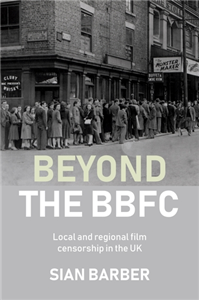
        Beyond the BBFC

        Local and regional film censorship in the UK

        by Sian Barber

        This work scrutinises British film censorship from a local perspective. Examining different regions and areas, the work of individual councils and their relations with one another and with the BBFC, it offers a broad historical exploration of the intricacies of film censorship in action. Drawing on local archival material and considering the activities of local government in enforcing Cinematograph legislation, this work considers the significance of film censorship apparatus and processes in shaping and informing responses to and control of film culture in different locations across the twentieth century.

      • Trusted Partner
      • Trusted Partner
        Humanities & Social Sciences
        October 2025

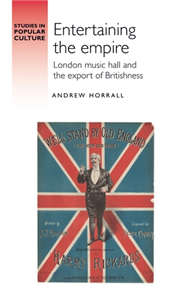
        Entertaining the empire

        London music hall and the export of Britishness

        by Andrew Horrall

        The stage entertainments known as music hall emerged in mid-Victorian London just as the British began colonising large parts of the world.Settlers recreated this metropolitan popular culture throughout the empire and in places under foreign control. They erected music halls resembling those at home, imported songs and sketches, performed inamateur shows and watched touring professionals. London originals were rewritten as commentaries on local conditions. This activity transformed music hall into a marker of an exclusionary British identity overseas and made colonies look and sound more like Britain. The result was that settlers separated by vast distances were linked by a shared popular culture. The touring circuits and cultural affinities the Victorians created endure to this day.

      • Trusted Partner
        Humanities & Social Sciences
        March 2017

        Silk and empire

        by Brenda King

        In this book, Brenda M. King challenges the notion that Britain always exploited its empire. Creativity, innovation and entrepreneurship were all part of the Anglo-Indian silk trade and were nurtured in the era of empire through mutually beneficial collaboration. The trade operated within and without the empire, according to its own dictates and prospered in the face of increasing competition from China and Japan. King presents a new picture of the trade, where the strong links between Indian designs, the English silk industry and prominent members of the English the arts and crafts movement led to the production of beautiful and luxurious textiles. Lavishly illustrated, this book will be of interest to those interested in the relationship between the British Empire and the Indian subcontinent, as well as by historians of textiles and fashion.

      • Trusted Partner
        Humanities & Social Sciences
        March 2017

        Child, nation, race and empire

        Child rescue discourse, England, Canada and Australia, 1850–1915

        by Margot Hillel, Shurlee Swain, Andrew Thompson, John M. MacKenzie

        Child, nation, race and empire is an innovative, inter-disciplinary, cross cultural study that contributes to understandings of both contemporary child welfare practices and the complex dynamics of empire. It analyses the construction and transmission of nineteenth-century British child rescue ideology. Locating the origins of contemporary practice in the publications of the prominent English Child rescuers, Dr Barnardo, Thomas Bowman Stephenson, Benjamin Waugh, Edward de Montjoie Rudolf and their colonial disciples and literature written for children, it shows how the vulnerable body of the child at risk came to be reconstituted as central to the survival of nation, race and empire. Yet, as the shocking testimony before the many official enquiries into the past treatment of children in out-of-home 'care' held in Britain, Ireland, Australia and Canada make clear, there was no guarantee that the rescued child would be protected from further harm.

      • Trusted Partner
        Humanities & Social Sciences
        March 2017

        Air empire

        British imperial civil aviation, 1919–39

        by Gordon Pirie, Andrew Thompson, John M. MacKenzie

        Air empire is a fresh study of civil aviation as a tool of late British imperialism. The first pioneering flights across the British empire in 1919-20 were flag-waving adventures that recreated an era of plucky British maritime exploration and conquest. Britain's development of international air routes and services was approved, organised and celebrated largely in London; there was some resistance in and beyond the subordinate colonies and dominions. Negotiating the financing and geopolitics of regular commercial air service delayed its inception until the 1930s. Technological, managerial and logistical problems also meant that Britain was slow into the air and slow in the air. Propaganda concealed underperformance and criticism. The study uses archival sources, biographies, industry magazines and newspapers to chronicle the disputed progress toward air empire. The rhetoric behind imperial air service offers a glimpse of late imperial hopes, fears, attitudes and style. Empire air service had emotional appeal and symbolic value, but disappointed in practice.

      • Trusted Partner
        Humanities & Social Sciences
        November 2007

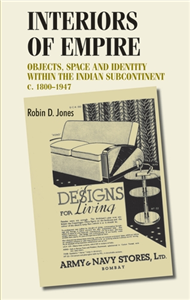
        Interiors of empire

        Objects, space and identity within the Indian Subcontinent, c. 1800–1947

        by Robin Jones, Christopher Breward, Bill Sherman, Alan Rutter

        Interiors of Empire uses the methods of design history and material culture studies to analyse the domestic and public interiors of the British and local middle class during the heyday of the British Raj. It contrasts representations of that space within contemporary discourse with analysis of historical evidence, the varying uses of such space, and relevant social practices. Through detailed discussion of these texts, spaces, objects and practices, this study locates the domestic interiors and public spaces of empire in the history of the British colonisation of India. The book discusses the imagined barrier of the domestic against the local environment, the intrusions of the local and the effects of this on the British in India, and assesses the gradual westernisation of domestic and public spaces of empire. This work will be of interest to students and scholars of design history, material culture and colonial history. ;

      • Trusted Partner
        Humanities & Social Sciences
        December 2024

        British culture after empire

        Race, decolonisation and migration since 1945

        by Josh Doble, Liam Liburd, Emma Parker

        British culture after Empire is the first collection of its kind to explore the intertwined social, cultural and political aftermath of empire in Britain from 1945 up to and beyond the Brexit referendum of 2016, combining approaches from the fields of history, English and cultural studies. Against those who would deny, downplay or attempt to forget Britain's imperial legacy, the various contributions expose and explore how the British Empire and the consequences of its end continue to shape Britain at the local, national and international level. As an important and urgent intervention in a field of increasing relevance within and beyond the academy, the book offers fresh perspectives on the colonial hangovers in post-colonial Britain from up-and-coming as well as established scholars.

      Subscribe to our

      newsletter