
Your Search Results


-
Promoted Content

 June 2010
Kinder in Deutschland 2010
2. World Vision Kinderstudie
by Herausgegeben von World Vision Deutschland e.V., World
-
Promoted Content

 December 1987
Allegorien des Lesens
by Paul Man, Werner Hamacher, Peter Krumme, Werner Hamacher
Im Falle Paul de Mans ist die begriffliche Charakterisierung seines Vorgehens zusätzlich erschwert dadurch, daß die Theorie nie losgelöst von den Texten, an denen sie gewonnen wird, betrachtet werden kann.
-
 Trusted Partner
 June 1993
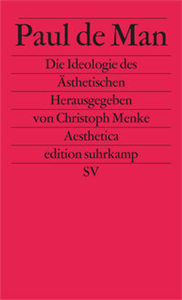
Die Ideologie des Ästhetischen
by Paul Man, Karl Heinz Bohrer, Christoph Menke, Jürgen Blasius, Christoph Menke
Als Paul de Man 1983 starb, war er der wohl bekannteste und einflußreichste Vertreter einer Richtung der Literaturkritik und ihrer Theore, die allgemein als »dekonstruktiv« bezeichnet wird. Kennzeichnend für diese Richtung ist eine erneute Konzentration auf die innere Verfaßtheit der literarischen Texte. Eine erste Auswahl dieser methodisch vorbildlich wie brillant geschriebenen Texte ist 1988 unter dem Titel »Allegorien des Lesens« in der edition suhrkamp erschienen. Die vorliegende Auswahl konzentriert sich auf die methodologischen und theoretischen Prämissen dieses Vorhabens, wie sie die Abhandlungen über die Zeitlichkeit der Literatur, über Shelley und über die Autobiographie deutlich machen. Sich auf die immanente Verfaßtheit und Bewegung von Texten einzulassen ist nach de Man kein selbstzweckhaftes, folgenloses Unternehmen. De Man beansprucht vielmehr für seine »Rückkehr zur Philologie« eine allgemeine Bedeutung; die Literaturkritik ist zugleich philosophische und politische Kritik. Damit ist der zweite Schwerpunkt dieser Auswahl bezeichnet. De Man erläutert diese These zum einen in kritischer Auseinandersetzung mit der Philosophie Jacques Derridas. Zum anderen zeigt er an zentralen Texten der ästhetischen Tradition, an Kant und Hegel, daß ihr falsches – »ideologisches« – Verständnis literarischer Texte unter der Kategorie des »Ästhetischen« ebenso weitreichende philosophische wie politische Konsequenzen hat.
-
Trusted Partner

 January 2017
Der Deutsch-Russische Handels- und Schiffahrtsvertrag vom 20. März 1894.
(Staats- und socialwissenschaftliche Forschungen XVII.3).
by Human, Arthur
-
Trusted Partner

 June 2017
Frauen der 1920er Jahre
Glamour, Stil und Avantgarde
by Thomas Bleitner, Man Ray, Edward Steichen, Claude Cahun, Dora Kallmus
In den 1920er Jahren war vieles wagemutiger, unkonventioneller und exzessiver als heute. Keine Zeit hat so viel Glamour, Stil und Avantgarde hervorgebracht, und eine nie gekannte Experimentierlust erobert Bühnen, Kunstateliers, den Sport und so manches Schlafzimmer. Frauen machen den Flug- und Führerschein, sie greifen zur Filmkamera, sie designen eine neue Mode, sie rauchen und trinken und tanzen fröhlich am Abgrund. Thomas Bleitner stellt in diesem opulent bebilderten Band legendäre und unvergleichliche Frauen aus Film, Fotografie, Sport, Mode und Kunst vor, die in den 1920er Jahren in Berlin, Paris und New York alte Rollenmuster auf den Kopf stellten und damit für Furore sorgten. »Als die Frauen begannen, ihre Röcke zu kürzen und ihre Haare zu stutzen, war dies der größte Umbruch in der Geschichte der Mode der letzten hundert Jahre.« New York Vogue vom 1. Juli 1928
-
Trusted Partner

 April 2003
Crazy New York
Die Frauen von Harlem und Greenwich Village
by Barnet, Andrea / Illustriert von Abbott, Berenice; Illustriert von Ray, Man; Deutsch Stromberg, Kyra
-
Trusted Partner
 March 2008
Kleine Entdecker – Bleibt die Zeit auch manchmal stehen?
Über unseren Zeitbegriff
by Kang, Seong-Eun / Koreanisch Zaborowski, Hans-Jürgen; Illustriert von Oh, Seung-Man
-
Trusted Partner
 November 2007
Kinder in Deutschland 2007
1. World Vision Kinderstudie
by Herausgegeben von World Vision Deutschland e.V.
-
Trusted Partner
-
Trusted Partner
-
Trusted Partner
 January 1983
Der Naturgarten
Mehr Platz für einheimische Pflanzen und Tiere
by Schwarz, Urs / Vorwort von Stern, Horst; Herausgegeben von World Wildlife Fund
-
Trusted Partner
 April 2002
Performanz
Zwischen Sprachphilosophie und Kulturwissenschaften
by Uwe Wirth, John L. Austin, John R. Searle, Roland Barthes, Michel Foucault, Jacques Derrida, Wolfgang Iser, Paul Man, Jürgen Habermas, Erving Goffman, Victor Turner, Stanley J. Tambiah, Umberto Eco, Erika Fischer-Lichte, Judith Butler, Sybille Krämer, Doris Kolesch, Annette Jael Lehmann, Niels Werber, Eckhard Schumacher, Uwe Wirth, Uwe Wirth
Nach seinem Erfinder, dem Sprachphilosophen John L. Austin, ist Performanz »ein neues Wort und ein garstiges Wort, und vielleicht hat es auch keine sonderlich großartige Bedeutung«. Mittlerweile findet dieser Begriff jedoch in unterschiedlichster Bedeutung Anwendung in den Kulturwissenschaften, von der Philosophie über die Linguistik, Soziologie, Anthropologie, Ethnologie, Theaterwissenschaft, Literaturtheorie, Medientheorie bis hin zu den Gender Studies. Der Band versammelt die Grundlagentexte von Austin bis Butler und zeigt in Originalbeiträgen Perspektiven der aktuellen Performanzdebatte auf.
-
Trusted Partner
 Humanities & Social SciencesNovember 2023
Critical theory and human rights
From compassion to coercion
by David McGrogan
This book describes how human rights have given rise to a vision of benevolent governance that, if fully realised, would be antithetical to individual freedom. It describes human rights' evolution into a grand but nebulous project, rooted in compassion, with the overarching aim of improving universal welfare by defining the conditions of human well-being and imposing obligations on the state and other actors to realise them. This gives rise to a form of managerialism, preoccupied with measuring and improving the 'human rights performance' of the state, businesses and so on. The ultimate result is the 'governmentalisation' of a pastoral form of global human rights governance, in which power is exercised for the general good, moulded by a complex regulatory sphere which shapes the field of action for the individual at every turn. This, unsurprisingly, does not appeal to rights-holders themselves.
-
Trusted Partner

 2022
2022aporello: Human Parasites
by Christine Bender-Leitzig, Dr. Reiner Pospischil
Infestation with parasites usually causes revulsion in those affected and many infections are kept secret through shame. In recent times there has also been a rise in non-native parasites, which often remain undetected. This book gives an overview of the most significant human parasites as well as their - prevalence - symptoms - treatment possibilities. The text is accompanied by illustrations that help when giving everyday advice. Practical icons show at a glance when, for example, the authorities must be notified and what special things need to be considered. Highly concentrated knowledge in an instant? That’s aporello!
-
Trusted Partner
Business, Economics & LawJanuary 2026
Latin America and international investment law
A mosaic of resistance
by Sufyan Droubi, Cecilia Juliana Flores Elizondo
Latin America has been a complex laboratory for the development of international investment law. While some governments and non-state actors have remained true to the Latin American tradition of resistance towards the international investment law regime, other governments and actors have sought to accommodate said regime in the region. Consequently, a profusion of theories and doctrines, too often embedded in clashing narratives, has emerged. In Latin America, the practice of international investment law is the vivid amalgamation of the practice of governments sometimes resisting and sometimes welcoming mainstream approaches; the practice of lawyers assisting foreign investors from outside and within the region; and the practice of civil society, indigenous peoples and other actors in their struggle for human rights and sustainable development. Latin America and international investment law describes the complex roles that governments have played vis-à-vis foreign investors and investments; the refreshing but clashing forces that international organizations, corporations, civil society, and indigenous peoples have brought to the field; and the contribution that Latin America has made to the development of the theory and practice of international investment law, notably in fields in which the Latin American experience has been traumatic: human rights and sustainable development. Latin American scholars have been contributing to the theory of international investment law for over a century; resting on the shoulders of true giants, this volume aims at pushing this contribution a little further.
-
Trusted Partner
 Humanities & Social SciencesApril 2021
Critical theory and human rights
by David McGrogan, Darrow Schecter
-
Trusted Partner
-
Trusted Partner
 Genocide & ethnic cleansingMay 2017
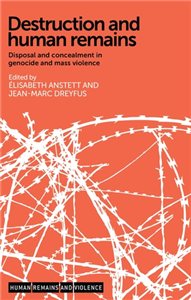
Destruction and human remains
Disposal and concealment in genocide and mass violence
by Series edited by Jean-Marc Dreyfus, Élisabeth Anstett. Edited by Élisabeth Anstett, Jean-Marc Dreyfus
Destruction and human remains investigates a crucial question frequently neglected in academic debate in the fields of mass violence and genocide studies: what is done to the bodies of the victims after they are killed? In the context of mass violence, death does not constitute the end of the executors' work. Their victims' remains are often treated and manipulated in very specific ways, amounting in some cases to true social engineering, often with remarkable ingenuity. To address these seldom-documented phenomena, this volume includes chapters based on extensive primary and archival research to explore why, how and by whom these acts have been committed through recent history. Interdisciplinary in scope, Destruction and human remains will appeal to readers interested in the history and implications of genocide and mass violence, including researchers in anthropology, sociology, history, politics and modern warfare.
-
Trusted Partner
 Humanities & Social SciencesMarch 2010
Negotiating sovereignty and human rights
International society and the International Criminal Court
by Sibylle Scheipers
Negotiating sovereignty and human rights takes the transatlantic conflict over the International Criminal Court as a lens for an enquiry into the normative foundations of international society. The author shows how the way in which actors refer to core norms of the international society such as sovereignty and human rights affect the process and outcome of international negotiations. The book offers an innovative take on the long-standing debate over sovereignty and human rights in international relations. It goes beyond the simple and sometimes ideological duality of sovereignty versus human rights by showing that sovereignty and human rights are not competing principles in international relations, as is often argued, but complement each other. The way in which the two norms and their relationship are understood lies at the core of actors' broader visions of world order. The author shows how competing interpretations of sovereignty and human rights and the different visions of world order that they imply fed into the transatlantic debate over the ICC and transformed this debate into a conflict over the normative foundations of international society. ;
-
Trusted Partner
 Business, Economics & LawMay 2005
The UN, human rights and post-conflict situations
by Nigel White, Dirk Klaasen
The United Nations is one of the largest providers of assistance in post-conflict situations in the world. This book considers the human rights standards applicable to the United Nations and applied by the United Nations in post-conflict situations, including East Timor, Kosovo and Afghanistan. It looks at legal principles, peace agreements, support of democracy, human rights protection, development and other forms of reconstruction with which the UN has become involved, including the grandly-named task of "state-building". It deals both with the obligation upon the UN to respect human rights in post-conflict situations, and the obligation upon the UN to ensure that human rights are respected by those in positions of power in post-conflict situations. Written by an internationally renowned list of contributors, this book will be of vital use to anyone studying conflict analysis, international relations, international law and the role of the United Nations on the world stage. ;



