Your Search Results

      • iCharacter Ltd.

        Books for children that focus on character building topics. Passing values on to our children can be challenging. Being parents ourselves, we enjoy creating fun stories, games and activities with the goal of helping kids think about positive character traits.

        View Rights Portal
      • Good values

        Picture books on values and social issues. (Kidible imprint)

        View Rights Portal
      • Trusted Partner
        Literature & Literary Studies
        May 2023

        The problem of literary value

        by Robert J. Meyer-Lee

      • Trusted Partner
        Computing & IT
        May 2026

        Democratizing AI

        by Annette Zimmermann

        Democratizing AI offers a powerful rethinking of how artificial intelligence should be governed. Challenging the dominance of tech elites in shaping AI's future, Zimmermann argues that AI deployment is a political act-one that must be subject to democratic control. She proposes a practical "playbook" for reclaiming agenda-setting power through civic participation, public ownership, and institutional reform. Engaging with leading critics, Zimmermann defends a risk-sensitive proceduralist approach while acknowledging the deeper structural challenges posed by capitalism, inequality, and democratic fatigue. This book is a call to action: to resist learned helplessness, confront techno-authoritarianism, and shape AI's trajectory in line with democratic values. Thoughtful, urgent, and visionary, the book is essential reading for anyone concerned with the future of technology and democracy.

      • Trusted Partner
        Humanities & Social Sciences
        April 2026

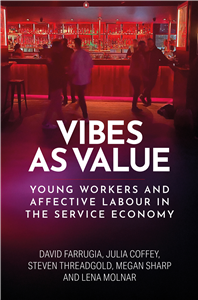
        Vibes as value

        Young workers and affective labour in the service economy

        by David Farrugia, Julia Coffey, Steven Threadgold, Megan Sharp, Lena Molnar

        Vibes as value explores the relationship between subjectivity, labour and value in the hospitality industry, and thereby how youth, gender, sexuality, race and social class are embodied and made productive in the service economy. It shows that the key product of hospitality labour is 'vibes', or moments of enjoyment and relationality co-produced through exploitative relationships amongst workers and consumers. In the process, the book theorises hospitality as a form of affective labour organised through the normative and structural relations of precarious service work. It shows how identity construction produces value within the highly unequal social terrain of the service economy, and how hospitality labour enacts hierarchies of value extending far beyond the limits of the industry itself.

      • Trusted Partner
        The Arts
        January 2019

        The British working class in postwar film

        by Philip Gillett

        An incidental pleasure of watching a film is what it tells us about the society in which it is made. Using a sociological model, The British working class in postwar film looks at how working-class people were portrayed in British feature films in the decade after the Second World War. Though some of the films examined are well known, others have been forgotten and deserve reassessment. Original statistical data is used to assess the popularity of the films with audiences. With its interdisciplinary approach and the avoidance of jargon, this book seeks to broaden the approach to film studies. Students of media and cultural studies are introduced to the skills of other disciplines, while sociologists and historians are encouraged to consider the value of film evidence in their own fields. This work should appeal to all readers interested in social history and in how cinema and society works.

      • Trusted Partner
        Geography & the Environment
        June 2018

        Time for mapping

        Cartographic temporalities

        by Sybille Lammes, Chris Perkins, Alex Gekker, Sam Hind, Clancy Wilmott, Daniel Evans

        Maps take place in time as well as representing space. The Google map on your smartphone appears to fix the world, serving as a practical spatial tool, but in practice is deployed in ways that draw attention to memories, rhythm, synchronicity, sequence and duration. This interdisciplinary collection focuses on how these temporal aspects of mapping might be understood, at a time when mapping technologies have been profoundly changed by digital developments. It contrasts different aspects of this temporality, bringing together experts from critical cartography, media studies and science and technology studies. Together the chapters offer a unique interdisciplinary focus revealing the complex and social ways in which time in wrapped up with digital technologies and revealed in everyday mapping tasks: from navigating across cities, to serving as scientific groundings for news stories; from managing smart cities, to visual art practice. It brings time back into the map!

      • Trusted Partner
        February 2007

        Depeche Mode

        Roman

        by Serhij Zhadan, Juri Durkot, Sabine Stöhr

        Charkiw 1993. Sowjetische Kriegsveteranen und neureiche biznesmeny lauschen im Konzertsaal einem amerikanischen Erweckungsprediger. In ehemaligen Komsomolbüros der ostukrainischen Metropole residieren Werbeleute. Das Jugendradio bringt in Kooperation mit London ein Feature über die »irische Volksmusikgruppe Depeche Mode« und die Rolle der Mundharmonika beim Kampf gegen kapitalistische Unterdrückung. Durch diese hybride Szenerie irren drei Freunde – Dog Pawlow, Wasja Kommunist und der Ich-Erzähler Zhadan, neunzehn Jahre alt und arbeitslos –, um ihren Kumpel Sascha Zündkerze zu finden. Sie müssen ihm mitteilen, daß sich sein Stiefvater erschossen hat. Ihre Suche führt sie auf ein verfallendes Fabrikgelände, wo sie eine Molotow-Büste klauen, ins Roma-Viertel zu einem befreundeten Dealer und schließlich per Nahverkehrszug ins Pionierlager »Chemiker«, wo Zündkerze als Betreuer arbeitet. Depeche Mode, Zhadans erster Roman, führt mitten hinein in die Anarchie der postsowjetischen Umbruchszeit und entfaltet ihre enorme ästhetische Produktivkraft.

      • Trusted Partner
        Humanities & Social Sciences
        March 2017

        Popular imperialism and the military, 1850-1950

        by John M. MacKenzie

        Colonial war played a vital part in transforming the reputation of the military and placing it on a standing equal to that of the navy. The book is concerned with the interactive culture of colonial warfare, with the representation of the military in popular media at home, and how these images affected attitudes towards war itself and wider intellectual and institutional forces. It sets out to relate the changing image of the military to these fundamental facts. For the dominant people they were an atavistic form of war, shorn of guilt by Social Darwinian and racial ideas, and rendered less dangerous by the increasing technological gap between Europe and the world. Attempts to justify and understand war were naturally important to dominant people, for the extension of imperial power was seldom a peaceful process. The entertainment value of war in the British imperial experience does seem to have taken new and more intensive forms from roughly the middle of the nineteenth century. Themes such as the delusive seduction of martial music, the sketch of the music hall song, powerful mythic texts of popular imperialism, and heroic myths of empire are discussed extensively. The first important British war correspondent was William Howard Russell (1820-1907) of The Times, in the Crimea. The 1870s saw a dramatic change in the representation of the officer in British battle painting. Up to that point it was the officer's courage, tactical wisdom and social prestige that were put on display.

      • Trusted Partner
        August 1992

        Bengalische Märchen

        by Arun Ray, Heinz Mode, Heinz Mode, Heinz Mode

        Die überwiegende Mehrzahl der hier vereinigten 56 Geschichten bilden die Zaubermärchen, die novellenartigen und die Schwankmärchen, nicht zu vergessen die in Bengalen beliebten Schwanjungfraumärchen.

      • Trusted Partner
        Literature & Literary Studies
        September 2009

        The Trial of Treasure

        By anonymous

        by Peter Happe

        This edition of The Trial of Treasure will be a photographic facsimile of one of the five extant copies of this apparently anonymous play which was printed in 1567 by Thomas Purfoote. It will reproduce the copy at the Harry Ransome Library, Austin, Texas which has an anomaly in the printing not found in the other copies. In considering typographical characteristics of the text the Introduction discusses the place of this play in Purfoote's extensive output. It also addresses the relationship with William Wager's Enough is as Good as a Feast with which it shares some seventy lines, and considers the possibility of common authorship. The text is rich in stage directions and aspects of performance are discussed including the doubling scheme for five players and the role of the Vice which is exemplified here. ;

      • Trusted Partner
        September 1985

        Die Sprache der Mode

        by Roland Barthes, Horst Brühmann

        »Das Vorhaben von Die Sprache der Mode entstand unmittelbar im Anschluß an das Nachwort der Mythen des Alltags, in dem ich die Möglichkeit einer immanenten Analyse anderer Zeichensysteme als der Sprache entdeckt habe - oder zu entdecken geglaubt hatte. Ich hatte von diesem Augenblick an den Wunsch, eines dieser Systeme, eine von allen gesprochene und zugleich allen unbekannte Sprache, Schritt für Schritt zu rekonstruieren. So habe ich die Kleidung gewählt.« Roland Barthes

      • Trusted Partner
        Humanities & Social Sciences
        March 2026

        The dilemma of Authority

        by Allyn Fives

        The moral problem of authority is the challenge of reconciling legitimate authority (the right to rule) with the demands of freedom and rationality. In this book, I argue that authority can have legitimacy, but when it does it generates a moral dilemma, where the obligation to obey comes at some cost to freedom and reason. Hence, not only do I depart from the views of those who insist that authority can never have legitimacy, but also those who maintain that insofar as authority is legitimate it simply satisfies the demands of freedom or rationality. My focus here will be on both what it is that justifies authority (in particular focusing on membership, and the goods of membership) as well what type of reason an authoritative directive is, how it can come into conflict with others reasons, and how those conflicts are resolved.

      • Trusted Partner
        Humanities & Social Sciences
        January 2013

        The EU and its neighbours

        Values versus security in European foreign policy

        by Gergana Noutcheva, Emil Kirchner, Karolina Pomorska, Thomas Christiansen, Giselle Bosse

        Is there a tension between the normative fundamentals and strategic objectives of European Neighbourhood Policy (ENP)? Is 'values versus security' an unavoidable choice to be made by the EU and its neighbours or, rather, a false dichotomy? The book argues that what is often considered a fundamental dilemma of EU foreign policy - a choice between the EU's values and its quest for security - misrepresents a much more complex reality in which values and security interplay to shape the EU's external positions. The book proposes an original conceptual framework for examining the complex interaction between values and security and situates the ENP in the broader conceptual debate about European Foreign Policy. In this way, it goes beyond the early scholarship on ENP, mainly inspired by the EU enlargement literature. The book examines the EU's evolving relations with its immediate neighbours in areas such as democracy promotion, Common Foreign and Security Policy, conflict management and resolution and soft security issues such as energy or immigration policy. By covering the whole range of EU external relations policies, the contributions to the volume provide a very unique opportunity to compare the complex interplay between values and security and its impacts across the wide policy spectrum of ENP. ;

      • Trusted Partner

        Concept Maps and Concept Mapping in Nursing

        How to Record and Structure Complex Care Situations

        by Dave Zanon-Di Nardo, Claudia Leoni-Scheiber

        Concept maps are graphical representations of interrelationships in complex care situations. They show patterns from the features and characteristics of a situation and thus visualize the specific image of the patient. In the process of concept mapping, the case-related nursing situation can be analyzed and assessed in a differentiated manner within the framework of the nursing process. Concept maps visualize case-related assessment data as well as nursing diagnoses and their relationships to each other in a bundled way. Thus, nursing interventions are derived to solve or alleviate current or potential health problems. Nursing goals and desired nursing outcomes can be named. The book is a valuable toolbox for teaching, training, and studying nursing and the nursing process.

      • Trusted Partner
      • Trusted Partner
        Business, Economics & Law
        July 2022

        The value of a whale

        by Adrienne Buller

      • Trusted Partner
        Humanities & Social Sciences
        November 2023

        Solidarity: Nature, grounds, and value

        by Andrea Sangiovanni

      • Trusted Partner
      • Trusted Partner

      Subscribe to our

      newsletter