Your Search Results

      • Literárne informacné centrum

        The Literary Information Center (LIC) is the window through which Slovak literature is presented to the world. Our primary goal is to facilitate live contact between Slovak and foreign publishers, authors, illustrators and cultural-events organizers and to support mutual collaboration and cultural exchange. LIC acts as an agent for the majority of Slovak authors and houses SLOLIA, the popular grant program for translators and publishers of Slovak literature. LIC also organizes national stands at foreign bookfairs sucha s Bologna, London, Paris, Prague and Budapest.

        View Rights Portal

      • Trusted Partner
        Geography & the Environment
        June 2025

        Demystifying informal urban design and planning

        Insights from Asia

        by Mahyar Arefi

        Touting informal settlements or informality in general as illegal, crime-ridden, unsafe, filthy, chaotic, and formal developments as legal, orderly or safe, and so forth has not solved anything and informality as a way of life or an economic reality lingers and grows. Demystifying informal urban design and planning delves deeper into this conundrum and seeks to debunk some common misguided perceptions about it. Borrowing popular philosophical and political analogies from Isaiah Berlin and Gregory Treverton and others, it encourages urban designers and planners to become multitaskers like foxes rather than hedgehogs who can do one thing right. The book ends with some general takeaways on assuming more proactive roles in informal urban design issues and avoiding two potential pitfalls while interacting with them.

      • Trusted Partner
      • Trusted Partner
        Humanities & Social Sciences
        January 2019

        Sickness, medical welfare and the English poor, 1750-1834

        by Steven King, Keir Waddington, David Cantor

        At the core of this book are three central contentions: That medical welfare became the totemic function of the Old Poor Law in its last few decades; that the poor themselves were able to negotiate this medical welfare rather than simply being subject to it; and that being doctored and institutionalised became part of the norm for the sick poor by the 1820s, in a way that had not been the case in the 1750s. Exploring the lives and medical experiences of the poor largely in their own words, Sickness, medical welfare and the English poor offers a comprehensive reinterpretation of the so-called crisis of the Old Poor Law from the later eighteenth century. The sick poor became an insistent presence in the lives of officials and parishes and the (largely positive) way that communities responded to their dire needs must cause us to rethink the role and character of the poor law.

      • Trusted Partner
        Humanities & Social Sciences
        April 2025

        Bordering social reproduction

        Migrant mothers and children making lives in the shadows

        by Rachel Rosen, Eve Dickson

        Bordering social reproduction explores what happens when migrants subject to policies that seek to deny them the means of life nonetheless endeavour to make and sustain meaningful lives. Developing innovative theorisations of welfare bordering, the volume provides rich ethnographic insights into the everyday lives of destitute mothers and children who are denied mainstream welfare support in the United Kingdom due to their immigration status. This book shows how enforced destitution and debt work alongside detention and deportation as part of a tripartite of exclusionary technologies of the racial state. It advances the novel concept of weathering to comprehend mother's and children's life-making practices under duress - arguing that these are neither acts of heroic resilience nor solely symptomatic of lives rendered disposable, but indications of the fragilities of repressive migration regimes and, on occasion, refusals to accept their terms of existence.

      • Trusted Partner
        Humanities & Social Sciences
        November 2010

        Globalisation, Integration and the Future of European Welfare States

        by Theodora-Ismene Gizelis, Emil Kirchner, Thomas Christiansen

        This book argues that the welfare state cannot be understood purely as a set of social policy arrangements, but must be seen as a political institution, intended to achieve certain political objectives. The political dimension of the welfare state is essential for understanding its initial emergence as well as assessing its ability to deal with contemporary challenges. Governments use welfare transfers to decrease the risk of political instability that may be politically disruptive and threaten to undermine social cohesion. The success of welfare institutions stems from their ability to foster a redistribution of resources and political consensus that has enabled long-term political stability and economic development. The book develops a general model that looks at the interactive effects between welfare transfers, political instability and state capacity. It provides a unique theoretical contribution to the study of welfare spending in the context of globalisation and integration, analyses the key politial rationale for welfare programmes, namely their role in preserving social cohesion and governance and demonstrates clearly that welfare policies can be successfully adopted to meet new challenges and that retrenchment of the welfare state is not inevitable, using Scandinavia as a leading example of modern thinking policies. ;

      • Trusted Partner
        Humanities & Social Sciences
        September 2000

        Poverty and Welfare in England, 1700–1850

        A regional perspective

        by Steve King

        The first comprehensive and up-to-date overview of the literature on poverty, communal welfare systems and alternative welfare strategies. Offers a new perspective on how we should conceptualise poverty and how ordinary families and communities responded to that poverty.. Indicates the need for new directions in the study of poverty and welfare using previously unpublished results form one of the biggest poor law databases in existence.. Argues that welfare historians have paid too little attention to the complexities of defining and measuring poverty, and a variety of primary source material is used to reconsider the extent of poverty in the period 1700-1850.. Provides the first systematic attempt to discuss the regional dimensions of the welfare system in an English context. ;

      • Trusted Partner
        Humanities & Social Sciences
        July 2022

        The social world of the school

        by Hester Barron

      • Trusted Partner
        Medicine
        May 2024

        Creative approaches to wellbeing

        The pandemic and beyond

        by Victoria Tischler, Karen Gray

        A compilation of case studies illustrating the use of arts, culture and other community assets individuals and communities used to cope and develop resilience during the Covid-19 pandemic, demonstrating valuable lessons that might help us develop resilience in similar future crises.

      • Trusted Partner
        Humanities & Social Sciences
        December 2024

        Critical theory and Independent Living

        by Teodor Mladenov

        Critical theory and Independent Living explores intersections between contemporary critical theory and disabled people's struggle for self-determination. The book highlights the affinities between the Independent Living movement and studies of epistemic injustice, biopower, and psychopower. It discusses in depth the activists' critical engagement with welfare-state paternalism, neoliberal marketisation, and familialism. This helps develop a pioneering comparison between various welfare regimes grounded in Independent Living advocacy. The book draws on the activism of disabled people from the European Network on Independent Living (ENIL) by developing case studies of the ENIL's campaigning for deinstitutionalisation and personal assistance. It is argued that this work helps rethink independence as a form of interdependence, and that this reframing is pivotal for critical theorising in the twenty-first century.

      • Trusted Partner
        Humanities & Social Sciences
        July 2026

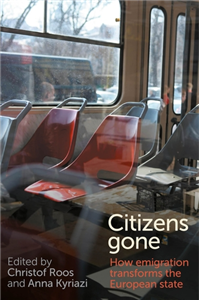
        Citizens gone

        How emigration transforms the European state

        by Christof Roos, Anna Kyriazi

        Emigration of scale challenges states at the European periphery at their core. The book documents these struggles along their effects for politics and policy within their economic and welfare dimensions. The politics of emigration describe changing voter attitudes and behaviour pointing towards more support for nationalist and right-wing parties. The policies of emigration show state and local level efforts for the return of emigrant citizens. The welfare and economic dimensions explore the context for emigration and its effects for growth models and systems of health and care within the European single market. The book observes two types of state transformations: the re-emergent nation-state that re-discovers its core resource, the citizenry, as well as states that functionally and socially adapt to population loss.

      • Trusted Partner
        Humanities & Social Sciences
        July 2024

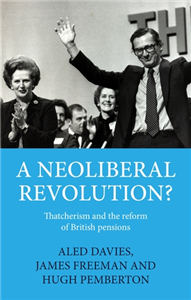
        A neoliberal revolution?

        Thatcherism and the reform of British pensions

        by Hugh Pemberton, James Freeman, Aled Davies

        This book examines the Thatcher government's attempt to revolutionise Britain's pensions system in the 1980s and create a nation of risk-taking savers with an individual stake in capitalism. Drawing upon recently-released archival records, it shows how the ideas motivating these reforms journeyed from the writings of neoliberal intellectuals into government and became the centrepiece of a plan to abolish significant parts of the UK's welfare state and replace these with privatised personal pensions. Revealing a government that veered between political caution and radicalism, the book explains why this revolution failed and charts the malign legacy left by the evolutionary changes that ministers salvaged from the wreckage of their reforms. The book contributes to understanding of policy change, Thatcherism, and international neoliberalism by showing how major reforms to social security could reflect neoliberal thought and yet profoundly disappoint their architects.

      • Trusted Partner
        Humanities & Social Sciences
        June 2026

        A neoliberal revolution?

        Thatcherism and the reform of British pensions

        by Aled Davies, James Freeman, Hugh Pemberton

        This book examines the Thatcher government's attempt to revolutionise Britain's pensions system in the 1980s and create a nation of risk-taking savers with an individual stake in capitalism. Drawing upon recently-released archival records, it shows how the ideas motivating these reforms journeyed from the writings of neoliberal intellectuals into government and became the centrepiece of a plan to abolish significant parts of the UK's welfare state and replace these with privatised personal pensions. Revealing a government that veered between political caution and radicalism, the book explains why this revolution failed and charts the malign legacy left by the evolutionary changes that ministers salvaged from the wreckage of their reforms. The book contributes to understanding of policy change, Thatcherism, and international neoliberalism by showing how major reforms to social security could reflect neoliberal thought and yet profoundly disappoint their architects.

      • Trusted Partner
        Literature & Literary Studies
        July 2022

        Nordic Gothic

        by Maria Holmgren Troy, Johan Hõglund, Yvonne Leffler, Sofia Wijkmark

        Nordic Gothic traces Gothic fiction in the Nordic region from its beginnings in the nineteenth century, with a main focus on the development of Gothic from the 1990s onwards in literature, film, TV and new media. The volume gives an overview of Nordic Gothic fiction in relation to transnational developments and provides a number of case studies and in-depth analyses of individual narratives. It creates an understanding of this under-researched cultural phenomenon by showing how the narratives make visible cultural anxieties haunting the Nordic countries, their welfare systems, identities and ideologies. Nordic Gothic examines how figures from Nordic folklore function as metaphorical expressions of Gothic themes and Nordic settings are explored from perspectives such as ecocriticism and postcolonialism. The book will be of interest to researchers and post- and- undergraduate students in various fields within the Humanities.

      • Trusted Partner
        Social & cultural history
        July 2013

        War and welfare

        by Barbara Hately-Broad

      • Trusted Partner
        Humanities & Social Sciences
        March 2017

        Child, nation, race and empire

        Child rescue discourse, England, Canada and Australia, 1850–1915

        by Margot Hillel, Shurlee Swain, Andrew Thompson, John M. MacKenzie

        Child, nation, race and empire is an innovative, inter-disciplinary, cross cultural study that contributes to understandings of both contemporary child welfare practices and the complex dynamics of empire. It analyses the construction and transmission of nineteenth-century British child rescue ideology. Locating the origins of contemporary practice in the publications of the prominent English Child rescuers, Dr Barnardo, Thomas Bowman Stephenson, Benjamin Waugh, Edward de Montjoie Rudolf and their colonial disciples and literature written for children, it shows how the vulnerable body of the child at risk came to be reconstituted as central to the survival of nation, race and empire. Yet, as the shocking testimony before the many official enquiries into the past treatment of children in out-of-home 'care' held in Britain, Ireland, Australia and Canada make clear, there was no guarantee that the rescued child would be protected from further harm.

      • Trusted Partner
      • Trusted Partner
        The Arts
        July 2024

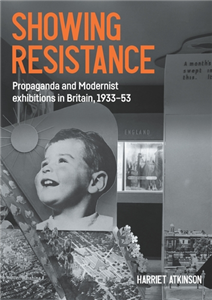
        Showing resistance

        Propaganda and Modernist exhibitions in Britain, 1933–53

        by Harriet Atkinson

        This is the first book-length analysis of exhibitions used for propaganda and political interventions in Britain during the two decades from 1933. It analyses how exhibitions were mounted in public places - from station concourses to workers' canteens, empty shops and bombsites - becoming a key tool for public communication. Richly illustrated, the book extends our existing knowledge of the work of a range of prominent artists, architects and designers active in Britain, including Edith Tudor-Hart, Edward McKnight-Kauffer, Paul Nash, F. H. K. Henrion, Misha Black, John Heartfield, Oskar Kokoschka and Erno Goldfinger.

      • Trusted Partner

      Subscribe to our

      newsletter