Your Search Results

      • Second Story Press

        Our books are sold around the world, have been translated into over 50 languages, won many awards, and have been adapted for film and stage.   We publish stories that feature strong female characters and explore themes of social justice, human rights, equality, and ability issues. Our list spans adult fiction and nonfiction; children’s fiction, nonfiction and picture books; and young adult fiction and nonfiction.

        View Rights Portal
      • Agriculture & International Development

        Textbooks, research and professional titles in Agriculture and International Development

        View Rights Portal
      • Trusted Partner
        Business, Economics & Law
        January 2026

        Cinematic perspectives on international law

        by Olivier Corten, Francois Dubuisson, Martyna Falkowska-Clarys

        Why are constitutionalist ideals so prominent in science fiction? Does Independence Day depict self-defence as a legal concept with absolute limits? Is international law lost in space? This innovative interdisciplinary volume represents the first exploration of the relationship between international law and cinema. From Star Wars to Werner Herzog, The Godfather to The West Wing, this book uncovers a diverse range of representations of international law and its norms in film and television. Examining the wider links between international law, cinema, and ideology, the contributions not only examine visual representations of international law, but they offer an essential insight into the functions fulfilled by these cinematic representations. Providing an extraordinary introduction to a variety of perspectives on core international legal questions, Cinematic perspectives on international law extends a valuable methodology by which international lawyers can critique the depiction of international law in film.

      • Trusted Partner
        Humanities & Social Sciences
        November 2009

        Re-evaluating Irish national security policy

        Affordable threats?

        by Michael Mulqueen

        On the afternoon of September 11 2001 the Irish Prime Minister (Taoiseach), Bertie Ahern ordered the 'heads of the security services of key government departments' to undertake a complete re-evaluation of measures to protect the state from attack. Hence, underway within hours of the 9/11 outrage in the United States was potentially the most far-reaching review of Irish national security in decades. This book, the first major academic investigation of Irish national security policy as it has operated since 9/11, provides a theoretically informed analysis of that re-evaluation and the decisions which have been taken as a consequence of it up until September 2008. In so doing it draws on unprecedented access to Ireland's police, security and intelligence agencies; over twenty senior personnel agreed to be interviewed. Theoretically the author demonstrates the utility to the analysis of national security policy of three conceptual models of historical institutionalism, governmental politics and threat evaluation. The text is of interest to scholars of Security Studies, International Relations and Politics, as well as state and NGO personnel, journalists and general readers. ;

      • Trusted Partner
        Sociology
        November 2016

        Death and security

        Memory and mortality at the bombsite

        by Charlotte Heath-Kelly. Series edited by Peter Lawler, Emmanuel Pierre Guittet

        Making a bold intervention into critical security studies literature, this book explores the ontological relationship between mortality and security. It considers the mortality theories of Heidegger and Bauman alongside literature from the sociology of death, before undertaking a comparative exploration of the memorialisation of four prominent post-terrorist sites: the World Trade Centre in New York, the Bali bombsite, the London bombings and the Norwegian sites attacked by Anders Breivik. By interviewing the architects and designers of these reconstruction projects, the book shows that practices of memorialisation are a retrospective security endeavour - they conceal and re-narrate the traumatic incursion of death. Disaster recovery is replete with security practices that return mortality to its sublimated position and remove the disruption posed by mortality to political authority. The book will be of significant interest to academics and postgraduates working in the fields of critical security studies, memory studies and international politics.

      • Trusted Partner
        Humanities & Social Sciences
        October 2020

        Japan's new security partnerships

        by Wilhelm Vosse, Paul Midford

      • Trusted Partner
        Business, Economics & Law
        January 2026

        International organisations, non-State actors, and the formation of customary international law

        by Sufyan Droubi, Jean d'Aspremont

        This volume offers new practical and theoretical perspectives on one of the most complex questions regarding the formation of international law, namely that actors other than states contribute to the making of customary international law. Notwithstanding the International Law Commission's valuable contribution, the making of customary international law remains riddled with acute practical and theoretical controversies that continue to be intensively debated. Making extensive reference to the case-law of international law courts and tribunals, as well as the most recent scholarly work on customary international law, this volume provides a comprehensive study of the contribution of international organisations and non-state actors to the formation of customary international law. With innovative tools and guidance for law students, legal scholars, and researchers in law, as well as legal practitioners, advisers, judges, arbitrators, and counsels, this collection is essential reading for those wishing to understand and address contemporary questions of international law-making.

      • Trusted Partner
        Humanities & Social Sciences
        July 2013

        EU foreign and security policy in Bosnia

        The politics of coherence and effectiveness

        by Ana Juncos, Emil Kirchner, Thomas Christiansen

        This book represents the first ever comprehensive study of the EU's foreign and security policy in Bosnia. Drawing on a wealth of fresh empirical material, it demonstrates that institutions are a key variable in explaining levels of common foreign security policy (CFSP) coherence and effectiveness over time. In doing so, it also sheds new light on the role that intergovernmental, bureaucratic and local political contestation have played in the formulation and implementation of a European foreign policy. The study concludes that the EU's involvement in Bosnia has not only had a significant impact on this Balkan country in its path from stabilisation to integration, but has also transformed the EU, its foreign and security policy and shaped the development of the EU's international identity along the way. The book will be of great interest to researchers and students of EU politics, International Relations and Bosnian politics. ;

      • Trusted Partner
        Civil rights & citizenship
        July 2015

        Anti-terrorism, citizenship and security

        by Lee Jarvis, Michael Lister

        This book explores how different publics make sense of and evaluate anti-terrorism powers within the UK, and the implications of this for citizenship and security. Drawing on primary empirical research, the book argues that whilst white individuals are not unconcerned about the effects of anti-terrorism, ethnic minority citizens (including, but not only those identifying as Muslim) believe that anti-terrorism powers have impacted negatively on their citizenship and security. This book thus offers the first systematic engagement with 'vernacular' or 'everyday' understandings of anti-terrorism policy, citizenship and security. It argues that while transformations in anti-terrorism frameworks impact on public experiences of security and citizenship, they do not do so in a uniform, homogeneous, or predictable manner. At the same time, public understandings and expectations of security and citizenship themselves shape how developments in anti-terrorism frameworks are discussed and evaluated. This important new book will be of interest to researchers and students working in a wide range of disciplines including Political Science, International Relations, Security Studies and Sociology.

      • Trusted Partner
        Humanities & Social Sciences
        November 2007

        EU security governance

        by Emil Kirchner, James Sperling

        EU security governance assesses the effectiveness of the EU as a security actor. The book has two distinct features. Firstly, it is the first systematic study of the different economic, political and military instruments employed by the EU in the performance of four different security functions. The book demonstrates that the EU has emerged as an important security actor, not only in the non-traditional areas of security, but increasingly as an entity with force projection capabilities. Secondly, the book represents an important step towards redressing conceptual gaps in the study of security governance, particularly as it pertains to the European Union. The book links the challenges of governing Europe's security to the changing nature of the state, the evolutionary expansion of the security agenda, and the growing obsolescence of the traditional forms and concepts of security cooperation. ;

      • Trusted Partner
      • Trusted Partner
      • Trusted Partner
        Humanities & Social Sciences
        November 2024

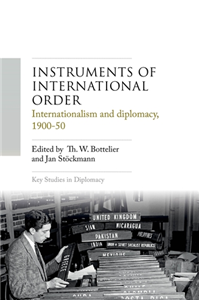
        Instruments of international order

        Internationalism and diplomacy, 1900-50

        by Thomas W. Bottelier, Jan Stöckmann

        During the first half of the twentieth century, world politics was reshaped in pursuit of a new international order. The ideological foundations of the 'new diplomacy' (and its fate during the interwar period) are well known. This book instead examines the practices of internationalism and diplomacy from the First Hague Conference of 1899 to the aftermath of the Second World War. By focusing on these practices, such as disarmament regimes or public diplomacy, and their use as instruments to build international order(s), it emphasises the constructed, contested, and experimental character of what subsequently became a standard repertoire of international politics. Essays from a range of interdisciplinary scholars address well-established principles such as self-determination, and also less prominent practices such as small arms control or parliamentary inquiry. The book makes a major contribution to the growing historiography on twentieth-century internationalism.

      • Trusted Partner
        Humanities & Social Sciences
        June 2026

        Instruments of international order

        Internationalism and diplomacy, 1900-50

        by Th. W. Bottelier, Jan Stöckmann

        During the first half of the twentieth century, world politics was reshaped in pursuit of a new international order. The ideological foundations of the 'new diplomacy' (and its fate during the interwar period) are well known. This book instead examines the practices of internationalism and diplomacy from the First Hague Conference of 1899 to the aftermath of the Second World War. By focusing on these practices, such as disarmament regimes or public diplomacy, and their use as instruments to build international order(s), it emphasises the constructed, contested, and experimental character of what subsequently became a standard repertoire of international politics. Essays from a range of interdisciplinary scholars address well-established principles such as self-determination, and also less prominent practices such as small arms control or parliamentary inquiry. The book makes a major contribution to the growing historiography on twentieth-century internationalism.

      • Trusted Partner
        International relations
        September 2005

        Naming security - constructing identity

        ‘Mayan-women’ in Guatemala on the eve of ‘peace’

        by Maria Stern

        How do people seek security in relation to their sense of 'who they are'? How can one make sense of insecurity at the intersection of competing identity claims? Based on the voices of Mayan women, Stern critically re-considers the connections between security, subjectivity and identity. By engaging in a careful reading of how Mayan women 'speak' security in relation to the different contexts that inform their lives, she explores the multiplicity of both identity and security, and questions the main story of security imbedded in the modern 'paradox of sovereignty.' Her provocative analysis thus raises vital questions about what might constitute 'security', and the 'insecurity' that is its inevitable supplement. Her study also offers an innovative methodology that bridges many different disciplines and substantively develops the method of 'reading' politics as a 'textual practice'. It will be essential reading for students of security, identity politics, feminism, and Latin American studies.

      • Trusted Partner
        Humanities & Social Sciences
        July 2010

        In/security in Colombia

        Writing political identities in the Democratic Security Policy

        by Josefina A. Echavarría, Peter Lawler, Emmanuel Pierre Guittet

        Based on geo- and biopolitical analyses, this book reconsiders how security policies and practices legitimate state and non-state violence in the Colombian conflict. Using the case study of the official Democratic Security Policy (DSP), Echavarría examines how security discourses write the political identities of state, self and others. She claims that the DSP delimits politics, the political, and the imaginaries of peace and war through conditioning the possibilities for identity formation. In/security in Colombia offers an innovative application of a large theoretical framework on the performative character of security discourses and furthers a nuanced understanding of the security problematique in a postcolonial setting. This wide-reaching study will benefit students, scholars and policy-makers in the fields of security, peace and conflict, and Latin American issues. ;

      • Trusted Partner
      • Trusted Partner
        Humanities & Social Sciences
        July 2016

        Romantic narratives in international politics

        by Alexander Spencer

      • Trusted Partner
        Business, Economics & Law
        January 2026

        Latin America and international investment law

        A mosaic of resistance

        by Sufyan Droubi, Cecilia Juliana Flores Elizondo

        Latin America has been a complex laboratory for the development of international investment law. While some governments and non-state actors have remained true to the Latin American tradition of resistance towards the international investment law regime, other governments and actors have sought to accommodate said regime in the region. Consequently, a profusion of theories and doctrines, too often embedded in clashing narratives, has emerged. In Latin America, the practice of international investment law is the vivid amalgamation of the practice of governments sometimes resisting and sometimes welcoming mainstream approaches; the practice of lawyers assisting foreign investors from outside and within the region; and the practice of civil society, indigenous peoples and other actors in their struggle for human rights and sustainable development. Latin America and international investment law describes the complex roles that governments have played vis-à-vis foreign investors and investments; the refreshing but clashing forces that international organizations, corporations, civil society, and indigenous peoples have brought to the field; and the contribution that Latin America has made to the development of the theory and practice of international investment law, notably in fields in which the Latin American experience has been traumatic: human rights and sustainable development. Latin American scholars have been contributing to the theory of international investment law for over a century; resting on the shoulders of true giants, this volume aims at pushing this contribution a little further.

      • Trusted Partner

      Subscribe to our

      newsletter