
Your Search Results


-
Promoted Content

 Humanities & Social SciencesJanuary 2017
Men in reserve
by Juliette Pattinson, Arthur McIvor, Linsey Robb, Penny Summerfield
-
Promoted Content
 Literature & Literary StudiesNovember 1995
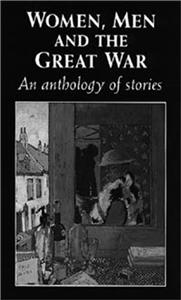
Women, men and the Great War
An anthology of story
by Trudi Tate
"A wide ranging, challenging and constantly surprising collection ... focusing on the divisions the war created between men and women." Pat Barker This is an anthology of short stories of World War I from 25 classic writers. Gertrude Stein, Virginia Woolf and Katherine Mansfield are among the women writers whose works account for half the volume. The stories are by turn poignant, violent, harsh, tender and desolating. ;
-
 Trusted Partner
 Humanities & Social SciencesAugust 2023
The bad German and the good Italian
by Paul Barnaby, Filippo Focardi
-
Trusted Partner
-
Trusted Partner

 2024
2024My Italy with Berlusconi
And what has become of it. Essays, conversations, reports
by Michaela Namuth
The political era of media entrepreneur and multi-billionaire Silvio Berlusconi began in 1994. German journalist Michaela Namuth also arrived in Rome at that time. He became prime minister, she became a freelance correspondent for various newspapers. She spent the long period of his government with him. During this time, the populist Berlusconi not only paved the way for a far-right government, he was also an ice-breaker for other right-wing populists in Europe and elsewhere. What else happened during and after Berlusconi's time in power is told in 20 chapters of articles, reports and interviews. The result is a colourful mosaic of contemporary Italy. It is about publishing, design, crime fiction, the mafia, a women's factory, the south and Nutella. Under Berlusconi, the country has changed. Many speak of “Berlusconisation”, by which they mean the gradual weakening of democracy. It is a critical book, but also a declaration of love to a contradictory country whose name still has a special ring to many ears.
-
Trusted Partner
 2018
2018Rediscovering Sex
From pressure to pleasure in bed - an excersise book for men
by Michael Sztenc
Penises are clever guys, sensitive and touchy. At least that’s what Michael Sztenc says. And as a sex and couples’ therapist who has worked on male sexuality for over 25 years, he should know. With practical exercises that have been tried and tested for years, he helps the men who come to him with their problems to develop a sense for their bodies and their own eroticism.
-
Trusted Partner
 The ArtsJanuary 2019
Cinema - Italy
by Stefania Parigi, Des O'Rawe
A journey to the Italian cinema that overturns established views and opens up new perspectives and interpretations. Its itinerary is organized in four stages. The first is an analysis of the theories of Cesare Zavattini on neorealism which overturns widely accepted positions both on Zavattini and on neorealism. The second confronts a key film of the post-war Italian cinema, Roberto Rossellini's Paisà, by examining the nature of its realism. The third is dedicated to Luchino Visconti: to questions of the use of language exemplified in his La terra trema, the use of settings, costume and light as agents of meaning in his Il Gattopardo and Vaghe stelle dell'Orsa. The final voyage of the film is to the physical and symbolic construction of heaven and earth in the work of Pasolini. Particular attention is given to the representation of the body in his last four films: the grotesque and mythical bodies in popular tradition in his Trilogia di vita and the tortured bodies destroyed by the mass media in Salò.
-
Trusted Partner
 Humanities & Social SciencesJuly 2025
The adventure
Violent borders, illegal migration and the uncertain quest for life in Morocco
by Sébastien Bachelet
This ethnographic exploration of irregular migration from Western and Central Africa in Morocco deconstructs dehumanising narratives of a "migration crisis" and a "sub-Saharan problem" in politics of migration. The book provides an original focus on how migrants understood and experienced their entrapped mobility. The emic notion of "the adventure" at the heart of this study sheds light on a transformative, epic quest to carve out a better life and future. The book traces how young men from Western and Central Africa sought to assert themselves as agents of their own destinies, despite uncertain, illegalising processes. In steering away from aesthetics of despair and fearmongering narratives, the book brings new insights into inter-disciplinary debates (e.g. illegality, uncertainty, immobility, violence, suffering, transit, etc.). Such focus is essential to draw out the complexity and existential depth of (irregular) migrants' lives, journeys, and stories.
-
Trusted Partner
 Humanities & Social SciencesJuly 2010
Women, men and the representation of women in the British Parliaments
Magic numbers?
by Anna Manasco-Dionne
This is the first book to consider the difference women MPs make for women constituents in Britain by comparing women parliamentarians' activities, priorities and perceptions to those of their male colleagues. It uncovers complicated gender dynamics that have been neglected in other works because of an exclusive focus on the activities of women MPs, and mounts a systematic challenge to the idea that a critical mass of women is necessary for women's presence to matter. By comparing the representation received by women from a parliament with few women to that received from a parliament with many women, Anna Dionne leads the reader to understand why numbers are not magic. Her empirical research includes interviews with over eighty parliamentarians in London, Scotland, Wales and Northern Ireland, and the amassing of an unprecedented and comprehensive database of representatives' legislative activities. She compares how men and women and different political parties introduce and support bills and motions, ask parliamentary questions, participate in committee and floor debates, and work behind the scenes for cross-party consensus and on constituency casework. The analysis considers gender similarities and differences throughout the policy process and explains the gender dynamics with a new sensitivity to their fluctuation. ;
-
Trusted Partner
 Humanities & Social SciencesNovember 2023
Rethinking Norman Italy
Studies in honour of Graham A. Loud
by Joanna Drell, Paul Oldfield
This volume on Norman Italy (southern Italy and Sicily, c. 1000-1200) honours and reflects the pioneering scholarship of Graham A. Loud. An international group of scholars reassesses and recasts the paradigm by which Norman Italy has been conventionally understood, addressing varied subjects across four key themes: historiographies, identities and communities, religion and Church, and conquest. The chapters revise and refine our understanding of Norman Italy in the eleventh and twelfth centuries, demonstrating that it was not just a parochial Norman or Mediterranean entity but also an integral player in the medieval mainstream.
-
Trusted Partner
 Literature & Literary StudiesJanuary 2013
The towns of Italy in the later Middle Ages
by Trevor Dean
The towns of Italy in the later middle ages presents over one hundred fascinating documents, carefully selected and coordinated from the richest, most innovative and most documented society of the European Middle Ages. No other English language sourcebook has the same geographical or chronological range. This collection is carefully structured around the crisis of the fourteenth century and arranged in contrasting groups of texts. By connecting documents in translation to recent scholarship and debates, it addresses five key areas of medieval urban history: the physical environment, civic religion, economy, society and politics. Offers students well-translated and effectively contextualised documents along with some guidance to the secondary work of Italian scholars which is largely inaccessible to undergraduate students.
-
Trusted Partner
 Humanities & Social SciencesFebruary 2026
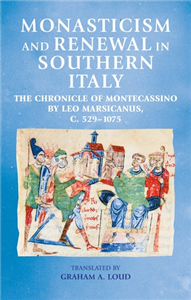
Monasticism and renewal in southern Italy
The Chronicle of Montecassino by Leo Marsicanus, c. 529–1075
by Graham Loud
The chronicle of Leo Marsicanus recounts the history of the abbey of Montecassino from its foundation by St. Benedict in the sixth-century up to 1075. It presents a detailed and compelling story of tribulation and renewal, with the abbey twice destroyed and abandoned in the early Middle Ages and then rebuilt. It concludes with an informative account of the building and dedication of the new abbey church by Abbot Desiderius in 1066-71. The chronicle is also a key source for the more general history of southern Italy in the early Middle Ages, and of the conquest of the region by the Normans during the eleventh century. In addition, Montecassino was one of the great intellectual centres of western Christendom and a major contributor to the reform movement within the Church during the later eleventh century. Leo's chronicle is a crucial witness to that role.
-
Trusted Partner
-
Trusted Partner
 Humanities & Social SciencesJanuary 2025
England’s military heartland
Preparing for war on Salisbury Plain
by Vron Ware, Antonia Lucia Dawes, Mitra Pariyar, Alice Cree
What is it like to live next door to a British Army base? England's military heartland provides an eye-opening account of the sprawling military presence on Salisbury Plain, drawing on a wide range of voices from both sides of the divide. Targeted for expansion under government plans to reorganise the UK's global defence estate, the Salisbury 'super garrison' offers a unique opportunity to explore the impact of the military footprint in a particular place. But this is no ordinary environment: as well as being the world-famous site of Stonehenge, the grasslands of Salisbury Plain are home to rare plants and wildlife. How does the army take responsibility for conserving this unique landscape as it trains young men and women to use lethal weapons? Are its claims that its presence is a positive for the environment anything more than propaganda? This book investigates these questions against the backdrop of a historic landscape inscribed with the legacy of perpetual war.
-
Trusted Partner
-
Trusted Partner
-
Trusted Partner
 Humanities & Social SciencesMarch 2009
Men in political theory
by Terrell Carver
Men in political theory builds on feminist re-readings of the traditional canon of male writers in Political Philosophy by turning the 'gender lens' on to the representation of men in widely studies texts. It explains the distinction between 'man' as an apparently de-gendered 'individual' or 'citizen', and 'man' as an overtly gendered being in human society. Both these representations of 'man' are crucial to a clearer understanding of the operation of gender. Newly available in paperback, the book is the first to use the 'men's studies' and 'masculinities' literatures in re-thinking the political problems that students and specialists in the social sciences and humanities must encounter: consent, obligation, patriarchy, gender, sexuality, life-cycle, and discriminatory disadvantage related to sex, age, class, race/ethnicity and disability. It does this by re-examining the historical materials from which present-day concepts of citizenship, individuality, identity, subjectivity, normativity and legitimacy arise. The ten chapters on Plato, Aristotle, Jesus, Augustine, Machiavelli, Hobbes, Locke, Rousseau, Marx and Engels show the operation of the 'gender lens' in different ways, depending on how the philosopher deploys concepts of men and masculinity to pose and solve classic problems. They can all be read independently and are as suitable for those just making the acquaintance of these classic writers as for those with specialist knowledge and interests. ;
-
Trusted Partner

 2020
2020Nutritional Practice Women and Men
Concise advisory knowledge
by Edited by Prof. Dr. Martin Smollich. With contributions by Birgit Blumenschein, Dr. oec. troph. Annett Hilbig, Julia Kugler, Dr. Claudia Laupert-Deick, Julia Sausmikat and PD Dr. Birgit-Christiane Zyriax
This volume in the book series Nutritional Practice sheds light on gender-specific aspects of the prevention and treatment of dietary deficiencies in women and men. Part I presents the principles, with an overview of the sociocultural influences on nutritional behaviour and differences in dietary practice between women and men, which lead to relevant consequences for gender-specific communication about nutrition. Part II explains in practical detail the wide range of topics concerning nutrition in pregnancy and lactation. Part III focusses on aspects of nutrition in life situations and on diseases that exclusively or predominantly occur in women. In addition to the menopause, these include various psychogenic eating disorders, breast cancer and polycystic ovary syndrome (PCOS).
-
Trusted Partner
 Literature & Literary StudiesJuly 2025
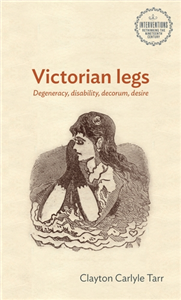
Victorian legs
Degeneracy, disability, decorum, desire
by Clayton Tarr
Victorian legs is about the science (sometimes spurious) and sexuality (often frivolous) of legs during the Victorian period. The book argues that legs occupy a particularly vexed position in Victorian culture. Strong legs formed the foundation (or the columns) of the civilized subject, but the politics of who could show their legs remained gendered. For the most part, men exhibited and admired, while women concealed and demurred. This book not only joins and advances the lively critical discourse on the Victorian body, but also marks new paths to pursue. While legs made us human, they could also dehumanize.
-
Trusted Partner
 Humanities & Social SciencesDecember 2022
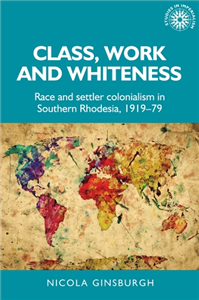
Class, work and whiteness
Race and settler colonialism in Southern Rhodesia, 1919–79
by Nicola Ginsburgh
This book offers the first comprehensive history of white workers from the end of the First World War to Zimbabwean independence in 1980. It reveals how white worker identity was constituted, examines the white labouring class as an ethnically and nationally heterogeneous formation comprised of both men and women, and emphasises the active participation of white workers in the ongoing and contested production of race. White wage labourers' experiences, both as exploited workers and as part of the privileged white minority, offer insight into how race and class co-produced one another and how boundaries fundamental to settler colonialism were regulated and policed. Based on original research conducted in Zimbabwe, South Africa and the UK, this book offers a unique theoretical synthesis of work on gender, whiteness studies, labour histories, settler colonialism, Marxism, emotions and the New African Economic History.



