Your Search Results

      • Mediatoon Licensing

        Mediatoon Foreign Rights sells international publishing rights to comic books, graphic novels, and illustrated books for all ages.   We represent the following Media-Participations group publishers: Dargaud, Le Lombard, Dupuis, Kana, Lucky Comics, Little Urban, as well as independent publishers: Ankama, Les  Edtitions de La Gouttière, Petit à Petit.   We sell rights to renowned works of the Ninth Art such as Lucky Luke, Blake and Mortimer, Valérian, Thorgal, Spirou, and Blacksad. Works from our catalogue have found their way into dozens of languages and have won awards and prizes in contests around the world. Our department is also responsible for handling the foreign rights for derivative editions of the animation series produced by the Media-Participations group.   We have a network of around 1,900 businesses, publishers, sub-agents and scouts, with over 4,300 individual contacts in 81 countries. Contracts are signed annually for an average of 1,600 titles.

        View Rights Portal
      • Australian Licensing Corporation

        Mary Hare Director mary@alcagency.com +44 (0)7718 586425

        View Rights Portal
      • Trusted Partner
        2020

        Chemistry I: Examination Questions

        Original annotated questions through autumn 2017. General and inorganic chemistry for pharmacists

        by Prof. Dr. Eberhard Ehlers

        This catalogue of examination question is the ideal companion to the Short Textbook on Chemistry I. Together, both volumes help you prepare effectively for semester finals and for the first section of the German pharmaceutical licensing examination. ■ 1788 original IMPP questions from the years 1979–2017 ■ With annotated solutions ■ Covers Pharmacy I, or arranged by examination ■ Comments use the same chapter numbering as the Short Textbook on Chemistry I ■ Highlighting marks questions which have appeared more than once in the same wording.   Ace your exams with Ehlers!

      • Trusted Partner
      • Trusted Partner
        Society & culture: general
        May 2014

        The end of the experiment?

        From competition to the foundational economy

        by Andrew Bowman, Julie Froud, Sukhdev Johal, John Law, Adam Leaver, Mick Moran and Karel Williams

        For thirty years, the British economy has repeated the same old experiment of subjecting everything to competition and market because that is what works in the imagination of central government. This book demonstrates the repeated failure of that experiment by detailed examination of three sectors: broadband, food supply and retail banking. The book argues for a new experiment in social licensing whereby the right to trade in foundational activities would be dependent on the discharge of social obligations in the form of sourcing, training and living wages. Written by a team of researchers and policy advocates based at the Centre for Research on Socio Cultural Change, this book combines rigour and readability, and will be relevant to practitioners, policy makers, academics and engaged citizens.

      • Trusted Partner
        Business, Economics & Law
        June 2016

        Licensed larceny

        by Nicholas Hildyard, Mick Moran

      • Trusted Partner
        Business, Economics & Law
        July 2022

        Licensed larceny

        Infrastructure, financial extraction and the global South

        by Nicholas Hildyard

      • Trusted Partner
        The Arts
        April 2025

        Beyond the BBFC

        Local and regional film censorship in the UK

        by Sian Barber

        This work scrutinises British film censorship from a local perspective. Examining different regions and areas, the work of individual councils and their relations with one another and with the BBFC, it offers a broad historical exploration of the intricacies of film censorship in action. Drawing on local archival material and considering the activities of local government in enforcing Cinematograph legislation, this work considers the significance of film censorship apparatus and processes in shaping and informing responses to and control of film culture in different locations across the twentieth century.

      • Trusted Partner
        Business, Economics & Law
        January 2026

        Law and healing

        by Margaret Brazier

      • Trusted Partner
        Computing & IT
        May 2026

        Democratizing AI

        by Annette Zimmermann

        Democratizing AI offers a powerful rethinking of how artificial intelligence should be governed. Challenging the dominance of tech elites in shaping AI's future, Zimmermann argues that AI deployment is a political act-one that must be subject to democratic control. She proposes a practical "playbook" for reclaiming agenda-setting power through civic participation, public ownership, and institutional reform. Engaging with leading critics, Zimmermann defends a risk-sensitive proceduralist approach while acknowledging the deeper structural challenges posed by capitalism, inequality, and democratic fatigue. This book is a call to action: to resist learned helplessness, confront techno-authoritarianism, and shape AI's trajectory in line with democratic values. Thoughtful, urgent, and visionary, the book is essential reading for anyone concerned with the future of technology and democracy.

      • Trusted Partner
      • Trusted Partner
        Business, Economics & Law
        January 2026

        Latin America and international investment law

        A mosaic of resistance

        by Sufyan Droubi, Cecilia Juliana Flores Elizondo

        Latin America has been a complex laboratory for the development of international investment law. While some governments and non-state actors have remained true to the Latin American tradition of resistance towards the international investment law regime, other governments and actors have sought to accommodate said regime in the region. Consequently, a profusion of theories and doctrines, too often embedded in clashing narratives, has emerged. In Latin America, the practice of international investment law is the vivid amalgamation of the practice of governments sometimes resisting and sometimes welcoming mainstream approaches; the practice of lawyers assisting foreign investors from outside and within the region; and the practice of civil society, indigenous peoples and other actors in their struggle for human rights and sustainable development. Latin America and international investment law describes the complex roles that governments have played vis-à-vis foreign investors and investments; the refreshing but clashing forces that international organizations, corporations, civil society, and indigenous peoples have brought to the field; and the contribution that Latin America has made to the development of the theory and practice of international investment law, notably in fields in which the Latin American experience has been traumatic: human rights and sustainable development. Latin American scholars have been contributing to the theory of international investment law for over a century; resting on the shoulders of true giants, this volume aims at pushing this contribution a little further.

      • Trusted Partner
        Humanities & Social Sciences
        January 2020

        Disability in industrial Britain

        A cultural and literary history of impairment in the coal industry, 1880-1948

        by Kirsti Bohata, Alexandra Jones, Mike Mantin, Steven Thompson

        This electronic version has been made available under a Creative Commons (BY-NC-ND) open access license. An electronic version of this book is also available under a Creative Commons (CC-BY-NC-ND) license, thanks to the support of the Wellcome Trust. Coalmining was a notoriously dangerous industry and many of its workers experienced injury and disease. However, the experiences of the many disabled people within Britain's most dangerous industry have gone largely unrecognised by historians. This book looks at British coal through the lens of disability, using an interdisciplinary approach to examine the lives of disabled miners and their families. A diverse range of sources are used to examine the economic, social, political and cultural impact of disability in the coal industry, looking beyond formal coal company and union records to include autobiographies, novels and existing oral testimony. It argues that, far from being excluded entirely from British industry, disability and disabled people were central to its development. The book will appeal to students and academics interested in disability history, disability studies, social and cultural history and representations of disability in literature.

      • Trusted Partner
        Humanities & Social Sciences
        July 2020

        Race talk

        Languages of racism and resistance in Neapolitan street markets

        by Antonia Lucia Dawes

        This electronic version has been made available under a Creative Commons (BY-NC-ND) open access license. Race talk is about language use as an anti-racist practice in multicultural city spaces. The book contends that attention to talk reveals the relations of domination and subordination in heterogeneous, ethnically diverse and multilingual contexts, while also helping us to understand how transcultural solidarity might be expressed. Drawing on original ethnographic research conducted on licensed and unlicensed market stalls in in heterogeneous, ethnically diverse and multilingual contexts, this book examines the centrality of multilingual talk to everyday struggles about difference, positionality and entitlement. In these street markets, Neapolitan street vendors work alongside documented and undocumented migrants from Bangladesh, China, Guinea Conakry, Mali, Nigeria and Senegal as part of an ambivalent, cooperative and unequal quest to survive and prosper. As austerity, anti-immigration politics and urban regeneration projects encroached upon the possibilities of street vending, talk across linguistic, cultural, national and religious boundaries underpinned the collective action of street vendors struggling to keep their markets open. The edginess of their multilingual organisation offered useful insights into the kinds of imaginaries that will be needed to overcome the politics of borders, nationalism and radical incommunicability.

      • Trusted Partner
        November 2011

        The Honest Man's Fortune

        by Grace Ioppolo

        This edition of The Honest Man's Fortune, a play co-written by John Fletcher, Nathan Field, and Philip Massinger for the Lady Elizabeth's Men in 1613 and revived for the King's Men in 1625, is the first diplomatic edition of one of the most remarkable dramatic manuscripts of the early modern period. Almost uniquely, the fair-copy manuscript records the entire process of the circular transmission of the text from authors to censor to bookkeeper to actors to playhouse, as well as the types of revision each required. In the hand of Edward Knight, the King's Men's book-keeper, this manuscript's title-page notes that it was '/Plaide In the yeare 1613/' and contains one of the few surviving complete licences by Master of the Revels Sir Henry Herbert who states, 'This Play. Being an olde One and the Originall Lost was reallowd by mee. This: 8 febru. 1624 [i.e., 1625]'. In fact, Herbert accepted as payment for the new licence a printed edition of Sir Philip Sidney's /Arcadia/. More excitingly, the many cuts, deletions, and marginal and interlinear additions and revisions as well as the names of three actors in its stage directions show us two transmissions of this text: the first in 1613, when it was composed and licensed and then adjusted by the authors, and the second in 1625, when it went through almost the same process for revival. With a full discussion of the manuscript's material properties, provenance, transcription history, and the play's composition and performance history, this new edition of /The Honest Man's Fortune/ puts the play where it belongs: at the centre of the canon of Jacobean drama. ;

      • Trusted Partner
        Humanities & Social Sciences
        June 2025

        Bulletin of the John Rylands Library 101/1

        by Fred Schurink, Rachel Winchcombe, Huw Twiston Davies

        The John Rylands Library houses one of the finest collections of rare books, manuscripts and archives in the world. The collections span five millennia, have a global reach and cover a wide range of subjects, including art and archaeology; economic, social, political, religious and military history; literature, drama and music; science and medicine; theology and philosophy; travel and exploration. For over a century, the Bulletin of the John Rylands Library has published research that complements the Library's special collections. An electronic edition of this issue is freely available under a Creative Commons (CC BY-NC-ND) licence.

      • Trusted Partner
        Humanities & Social Sciences
        December 2025

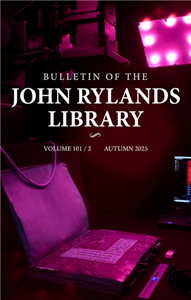
        Bulletin of the John Rylands Library 101/2

        Imaging Heritage Science Initiatives at The John Rylands Research Institute and Library

        by Stefan Hanß, James Robinson

        The John Rylands Library houses one of the finest collections of rare books, manuscripts and archives in the world. The collections span five millennia, have a global reach and cover a wide range of subjects, including art and archaeology; economic, social, political, religious and military history; literature, drama and music; science and medicine; theology and philosophy; travel and exploration. For over a century, the Bulletin of the John Rylands Library has published research that complements the Library's special collections. An electronic edition of this issue is freely available under a Creative Commons (CC BY-NC-ND) licence.

      • Trusted Partner
        Humanities & Social Sciences
        March 2019

        Managing diabetes, managing medicine

        Chronic disease and clinical bureaucracy in post-war Britain

        by Martin D. Moore, Keir Waddington, David Cantor

        This book is available as an open access ebook under a CC-BY-NC-ND licence. Through its study of diabetes care in twentieth-century Britain, Managing diabetes, managing medicine offers the first historical monograph to explore how the decision-making and labour of medical professionals became subject to bureaucratic regulation and managerial oversight. Where much existing literature has cast health care management as either a political imposition or an assertion of medical control, this work positions managerial medicine as a co-constructed venture. Although driven by different motives, doctors, nurses, professional bodies, government agencies and international organisations were all integral to the creation of managerial systems, working within a context of considerable professional, political, technological, economic and cultural change.

      • Trusted Partner
        2020

        Interactions between Medicines and Food

        by Prof. Dr. Martin Smollich and Dr. Julia Podlogar

        Interactions between medicines and foodstuffs may be just as clinically relevant as interactions between individual drugs. A single meal contains several hundred potentially interacting compounds that, in an individual patient, may be the deciding factor as to whether a treatment is successful or not. The resulting, sometimes serious risks are not known to most patients – nor to many physicians and pharmacists. This practical handbook enables anyone interested in applied pharmacotherapy to keep abreast of the complex field of drug interactions. The authors – proven experts in clinical pharmacology and pharmaconutrition – describe the most important interactions and give concrete recommendations for action. Tables and overviews permit fast access to potentially problematic combinations. This completely updated edition now also includes information about fruit juices and curcumin as well as a new chapter on food interactions in oncology.

      • Trusted Partner
        The Arts
        January 2013

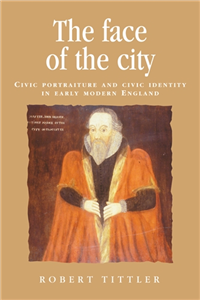
        The face of the city

        Civic portraiture and civic identity in early modern England

        by Robert Tittler, Peter Lake, Anthony Milton, Jason Peacey, Alexandra Gajda

        Our conventional understanding of English portraiture from the age of Holbein and Henry VIII on to Reubens, VanDyck and Charles I clings to the mainstream images of royalty and aristocracy and to the succession of known practitioners of 'Renaissance' portraiture. In almost every respect, the 'civic' portraits examined here stand in sharp contrast to these traditional narratives. Depicting mayors and aldermen, livery company masters, school and college heads, they were meant to be read as statements about the civic leaders and civic institutions rather than about the sitters in their own right. Displayed in civic premises rather than country homes, exemplifying civic rather than personal virtues, and usually commissioned by institutions rather than their sitters, they have yet to be considered as a type of their own, or in their appropriate social and political context. This fascinating work will appeal to both art historians and historians of early modern Britain. ;

      Subscribe to our

      newsletter