
Good values
Picture books on values and social issues. (Kidible imprint)
View Rights Portal

Corregidor is an independent Argentine publisher with more than five decades, dedicated to publishing and distributing a catalog focused in Latin American and Argentine literature.
View Rights Portal
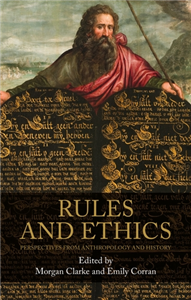
This book investigates the pronounced enthusiasm that many traditions display for codes of ethics characterised by a multitude of rules. Recent anthropological interest in ethics and historical explorations of 'self-fashioning' have led to extensive study of the virtuous self, but existing scholarship tends to pass over the kind of morality that involves legalistic reasoning. Rules and ethics corrects that omission by demonstrating the importance of rules in everyday moral life in a variety of contexts. In a nutshell, it argues that legalistic moral rules are not necessarily an obstruction to a rounded ethical self, but can be an integral part of it. An extended introduction first sets out the theoretical basis for studies of ethical systems that are characterised by detailed rules. This is followed by a series of empirical studies of rule-oriented moral traditions in a comparative perspective.


Guidance for psychologists on ethical dilemmas that mattertoday• New updated edition• Based on the Meta-code of Ethics of the EuropeanFederation of Psychologists’ Associations (EFPA)• Full of practical examplesThe understanding of and adherence to professional ethicsis fundamental in navigating the moral encounters and dilemmasthat all psychologists face in their daily work, whetherin research or professional practice. Core values and principlesremain stable. However, as more complex andconflicting societal contexts come into play, the individualpsychologist and the professional community need supportin upholding a solid moral integrity. The volume is a welcomeresource for any psychologist or student wanting to foresee,prevent, and professionally manage, in an ethically responsibleway, the moral challenges that arise.
 Trusted Partner
 Trusted Partner
Democratizing AI offers a powerful rethinking of how artificial intelligence should be governed. Challenging the dominance of tech elites in shaping AI's future, Zimmermann argues that AI deployment is a political act-one that must be subject to democratic control. She proposes a practical "playbook" for reclaiming agenda-setting power through civic participation, public ownership, and institutional reform. Engaging with leading critics, Zimmermann defends a risk-sensitive proceduralist approach while acknowledging the deeper structural challenges posed by capitalism, inequality, and democratic fatigue. This book is a call to action: to resist learned helplessness, confront techno-authoritarianism, and shape AI's trajectory in line with democratic values. Thoughtful, urgent, and visionary, the book is essential reading for anyone concerned with the future of technology and democracy.


The object of this paper is to discuss money-making; to examine its prevalence as an aim among people generally and the moral standards which obtain among those who consciously seek to make money.
Trusted Partner
The Irish writer, Deirdre Madden, has written key novels about the Northern Irish Troubles and about contemporary Ireland. In these works, she weighs up the aftermath of violence and the impact of the shift to a more open but materialist society in the country overall. Memory, trauma, and the abiding but elusive links between the past and the present are central concerns of her fiction. This pioneering set of essays by leading experts in Irish Studies explores the many dimensions of her novels from a wide variety of perspectives. Madden's skill at interweaving novels of ideas with artist novels that draw out the complex inner predicaments of her characters is highlighted. States of dislocation are concentrated on in her texts, but also the quest for a home in the world and a lasting set of values that allows for personal integrity and authenticity. These multifaceted explorations bear out the compelling and enduring aspects of Madden's highly regarded novels.


Examining the nature of law and grace, the novel elaborates upon the history of France, the architecture and urban design of Paris, politics, moral philosophy, antimonarchism, justice, religion, and the types and nature of romantic and familial love. Les Misérables has been popularized through numerous adaptations for the stage, television, and film, including a musical and a film adaptation of that musical.
Trusted Partner
Since the mid-2000s, the harsh reality of call centre employment for a generation of young workers in Portugal has been impossible to ignore. With its endless rows of small cubicles, where human agents endure repetitive telephone conversations with abusive clients under invasive modes of technological surveillance, discipline and control, call centre work remains a striking symbol of labour precarity, a condition particularly associated with the neoliberal generational disenchantment that 'each generation does better than its predecessor'. This book describes the emergence of a regime of disciplined agency in the Portuguese call centre sector. Examining the ascendancy of call centres as icons of precarity in contemporary Portugal, this book argues that call centre labour constitutes a new form of commodification of the labouring subject. De Matos argues that call centres represent an advanced system of non-manual labour power exploitation, due to the underestimation of human creativity that lies at the centre of the regimented structures of call centre labour. Call centres can only guarantee profit maintenance, de Matos argues, through the commodification of the human agency arising from the operators' moral, relational and social embedded agentive linguistic interventions of creative improvisation, decision-making, problem-solving and ethical evaluation.
Trusted Partner

This book is a powerful addition to a developing literature informed by arts and humanities research carried out during the COVID-19 pandemic. Investigating the impacts of crisis governance and decision-making on people and populations, the book brings together microbial organisms and humans, children and data, decision-making and infection prevention, publics and process, global vaccine distribution and citizens' juries. Through its eight chapters, the book stimulates broadly-drawn discussions about exceptional executive powers in an emergency, the role of trust, and the importance of the principles of good governance - such as selflessness, ethics, integrity, accountability and honesty in leadership. The lessons drawn out in this book will support future decision-makers in both ordinary times and extra-ordinary emergencies.
Trusted Partner


"Die Beiträge zu diesem Band haben ihren Ausgangspunkt in der Frage, ob eine moralfreie Theorie der Moral möglich und ob sie wissenschaftlich boten ist. Angesichts einer langen, ergebnislosen Diskussion der Wertfreiheit der Wissenschaft wird dieses Thema hier nicht wissenschaftstheoretisch weiterbehandelt. Statt dessen versuchen die Autoren vorzuführen, wie verschiedene Auffassungen zu diesem Thema durchführbar sind. Die vier Zugangsweisen, die sie wählen, sind: funktionale Analyse; ein Herauspräparieren der Grenzen, die der wissenschaftlichen Begriffsbildung durch die Besonderheit des Gegenstandes der Moral gezogen sind; eine Fallanalyse; Typenbildung. Das Ziel ist, mit der theorietechnischen Ausarbeitung möglicher Optionen Klarheit über die Möglichkeit einer moralfreien Theorie der Moral und über Moral se zu gewinnen."
Trusted Partner
The moral problem of authority is the challenge of reconciling legitimate authority (the right to rule) with the demands of freedom and rationality. In this book, I argue that authority can have legitimacy, but when it does it generates a moral dilemma, where the obligation to obey comes at some cost to freedom and reason. Hence, not only do I depart from the views of those who insist that authority can never have legitimacy, but also those who maintain that insofar as authority is legitimate it simply satisfies the demands of freedom or rationality. My focus here will be on both what it is that justifies authority (in particular focusing on membership, and the goods of membership) as well what type of reason an authoritative directive is, how it can come into conflict with others reasons, and how those conflicts are resolved.
Trusted Partner
Trusted Partner
In an age when engraving and photography were making artistic images available to a much wider public, artists were able to influence public attitudes more powerfully than ever before. This book examines works of art on military themes in relation to ruling-class ideologies about the army, war and the empire. The first part of the book is devoted to a chronological survey of battle painting, integrated with a study of contemporary military and political history. The chapters link the debate over the status and importance of battle painting to contemporary debates over the role of the army and its function at home and abroad. The second part discusses the intersection of ideologies about the army and military art, but is concerned with an examination of genre representations of soldiers. Another important theme which runs through the book is the relation of English to French military art. During the first eighty years of the period under review France was the cynosure of military artists, the school against which British critics measured their own, and the place from which innovations were imported and modified. In every generation after Waterloo battle painters visited France and often trained there. The book shows that military art, or the 'absence' of it, was one of the ways in which nationalist commentators articulated Britain's moral superiority. The final theme which underlies much of the book is the shifts which took place in the perception of heroes and hero-worship.

Little Women "has been read as a romance or as a quest, or both. It has been read as a family drama that validates virtue over wealth", but also "as a means of escaping that life by women who knew its gender constraints only too well".[6]:34 According to Sarah Elbert, Alcott created a new form of literature, one that took elements from Romantic children's fiction and combined it with others from sentimental novels, resulting in a totally new format. Elbert argued that within Little Women can be found the first vision of the "All-American girl" and that her multiple aspects are embodied in the differing March sisters.
Trusted Partner
Risk, anxiety and moral panic are endemic to contemporary societies and media forms. How do these phenomena manifest in a place like South Africa, which features heightened insecurity, deep inequality and accelerated social change? What happens when cultures of fear intersect with pervasive systems of gender, race and class? Worrier state investigates four case studies in which fear and anxiety appear in radically different ways: the far right myth of 'white genocide'; so-called 'Satanist' murders of young women; an urban legend about township crime; and social theories about safety and goodness in the suburbs. Falkof foregrounds the significance of emotion as a socio-political force, emphasising South Africa's imbrication within globalised conditions of anxiety and thus its fundamental and often-ignored hypermodernity. The book offers a bold and creative perspective on the social roles of fear and emotion in South Africa and thus on everyday life in this complex place.

This 1926 survey, written by a distinguished social and economic historian, examines the role of religion in the rise of capitalism. Arguing that material acquisitiveness is morally wrong and a corrupting social influence, the author draws upon his profound knowledge of labor and politics to show how concentrated wealth distorts economic policies. Colorful but credible, this study offers a timeless vision of alternative means toward a just economic, social, and intellectual order.


This book is made up largely from the experiences of hunters and trappers who have dug "seng" and "seal" and who know much of their peculiarities, and scores are now successful growers.In adidtion to Ginseng and Golden Seal nearly 50 other medicinal plants are described--habits, range, price, uses, etc.
Trusted Partner


— By two renowned authors from the fields of philosophy and education — Julian Nida-Rümelin – a popular talk show guest The debate about the correct school policy has been going on for many years. And there's no end to the bad news regarding the shortage of teachers, poor performance by students at PISA or the lack of suitable equipment in schools. What is being neglected in the discussions about the education policy but is, in fact, a central momentum in its development, is the school's task of conveying democratic values and patterns of action. This is the only way our society's supporting pillars can be strengthened in future generations. In the light of the complex situation, from the authors' point of view it is important to formulate a wake-up call: Democracy education – now!
Trusted Partner
Trusted Partner

The revival of recognition theory has brought new energy to critical theory. In general terms, recognition theory aims to critically evaluate social structures against a standard of social freedom identified with norms of interaction which are freely recognised by all parties. Until now, attention has primarily focused on the categories and forms of recognition theory. However, the influence of contemporary French theory upon the development of theories of recognition has not yet received the consideration it merits. This collection outlines the current state of recognition theory, studies the impact of French theory, and uses French thought to identity aspects of the recognitive process which are often overlooked. Exploring French accounts of agonistic identity construction, vulnerability, power, ethical obligation and reflexive theory construction, this book supports the intentions of critical theory with heightened attentiveness to oppression in all of its forms.



