Your Search Results

      • Business, Economics & Law
        April 1905

        Creating Capital

        Money-making as an aim in business

        by Fredrick L. Lipman

        The object of this paper is to discuss money-making; to examine its prevalence as an aim among people generally and the moral standards which obtain among those who consciously seek to make money.

      • Lifestyle, Sport & Leisure
        March 1905

        Dogs and All about Them

        by Robert Leighton

        The popularity of the dog as a companion, as a guardian of property, as an assistant in the pursuit of game, and as the object of a pleasurable hobby, has never been so great as it is at the present time.

      • Technology, Engineering & Agriculture
        March 1905

        The First Book of Farming

        by Charles L. Goodrich

        This book is a result of the author's search for these facts and truths as a student and farmer and his endeavor as a teacher to present them in a simple manner to others. The object in presenting the book to the general public is the hope that it may be of assistance to farmers, students and teachers, in their search for the fundamental truths and principles of farming.

      • Trusted Partner
        Medicine

        Body-Oriented Approaches for Musicians

        Methods for Improving Performance and Health

        by Claudia Spahn (editor)

        All the methods at a glance – a must for all musicians! For the first time, the editor and renowned authors of this publication clearly and vividly present a wide selection of body-oriented approaches for improving musicians’ health. The rigorous, clearly structured presentation of all the relevant methods provides the perfect decision-making tool: Which method is suitable for me? Are there any specific aspects to consider when applying a method to musicians? How is each method applied in practice?   Target Group: Physiotherapists and other physical therapists; music teachers, professional musicians, music students

      • Trusted Partner
        Literature & Literary Studies
        January 2013

        Popular protest in late-medieval Europe

        Italy, France and Flanders

        by Samuel Kline Cohn

        The documents in this stimulating volume span from 1245 to 1424 but focus on the 'contagion of rebellion' from 1355 to 1382 that followed in the wake of the plague. They comprise a diversity of sources and cover a variety of forms of popular protest in different social, political and economic settings. Their authors range across a wide political and intellectual horizon and include revolutionaries, the artistocracy, merchants and representatives from the church. They tell gripping and often gruesome stories of personal and collective violence, anguish, anger, terror, bravery, and foolishness. Of over 200 documents presented here, most have been translated into English for the first time, providing students and scholars with a new opportunity to compare social movements across Europe over two centuries, allowing a re-evaluation of pre-industrial revolts, the Black Death and its consequences for political culture and action. This book will be essential reading for those seeking to better understand popular attitudes and protest in medieval Europe.

      • Trusted Partner
      • The Arts
        January 1905

        The Elements of Drawing

        by John Ruskin

        Can drawing — sound, honest representation of the world as the eye sees it, not tricks with the pencil or a few "effects" — be learned from a book? One of the most gifted draftsmen, who is also one of the greatest art critics and theorists of all time, answers that question with a decided "Yes." He is John Ruskin, the author of this book, a classic in art education as well as a highly effective text for the student and amateur today. The work is in three parts, cast in the form of letters to a student, successively covering "First Practice," "Sketching from Nature," and "Colour and Composition." Starting with the bare fundamentals (what kind of drawing pen to buy; shading a square evenly), and using the extremely practical method of exercises which the student performs from the very first, Ruskin instructs, advises, guides, counsels, and anticipates problems with sensitivity. The exercises become more difficult, developing greater and greater skills until Ruskin feels his reader is ready for watercolors and finally composition, which he treats in detail as to the laws of principality, repetition, continuity, curvature, radiation, contrast, interchange, consistency, and harmony. All along the way, Ruskin explains, in plain, clear language, the artistic and craftsmanlike reasons behind his practical advice — underlying which, of course, is Ruskin's brilliant philosophy of honest, naturally observed art which has so much affected our aesthetic. Three full-page plates and 48 woodcuts and diagrams (the latter from drawings by the author) show the student what the text describes. An appendix devotes many pages to the art works which may be studied with profit.


      • Historical fiction
        February 1905

        Les Misérables

        by Victor Hugo

        Examining the nature of law and grace, the novel elaborates upon the history of France, the architecture and urban design of Paris, politics, moral philosophy, antimonarchism, justice, religion, and the types and nature of romantic and familial love. Les Misérables has been popularized through numerous adaptations for the stage, television, and film, including a musical and a film adaptation of that musical.

      • Colonialism & imperialism
        March 1905

        Heart of Darkness

        by Joseph Conrad

        Heart of Darkness (1899) is a novella by Polish-British novelist Joseph Conrad, about a voyage up the Congo River into the Congo Free State, in the heart of Africa, by the story's narrator Charles Marlow. Marlow tells his story to friends aboard a boat anchored on the River Thames, London, England. This setting provides the frame for Marlow's story of his obsession with the ivory trader Kurtz, which enables Conrad to create a parallel between London and Africa as places of darkness.

      • Poetry
        July 1904

        Paradise Lost

        by John Milton

        Paradise Lost is an epic poem in blank verse by the 17th-century English poet John Milton. The first version, published in 1667, consisted of ten books with over ten thousand lines of verse. A second edition followed in 1674, arranged into twelve books (in the manner of Virgil's Aeneid) with minor revisions throughout and a note on the versification. The poem concerns the biblical story of the Fall of Man: the temptation of Adam and Eve by the fallen angel Satan and their expulsion from the Garden of Eden. Milton's purpose, stated in Book I, is to "justify the ways of God to men".

      • Family & home stories (Children's/YA)
        February 1905

        Little Women

        by Louise May Alcott

        Little Women "has been read as a romance or as a quest, or both. It has been read as a family drama that validates virtue over wealth", but also "as a means of escaping that life by women who knew its gender constraints only too well".[6]:34 According to Sarah Elbert, Alcott created a new form of literature, one that took elements from Romantic children's fiction and combined it with others from sentimental novels, resulting in a totally new format. Elbert argued that within Little Women can be found the first vision of the "All-American girl" and that her multiple aspects are embodied in the differing March sisters.

      • The Arts
        March 1905

        Concerning the Spiritual in Art

        by Wassily Kandinsky

        A pioneering work in the movement to free art from its traditional bonds to material reality, this book is one of the most important documents in the history of modern art. Written by the famous nonobjective painter Wassily Kandinsky (1866–1944), it explains Kandinsky's own theory of painting and crystallizes the ideas that were influencing many other modern artists of the period. Along with his own groundbreaking paintings, this book had a tremendous impact on the development of modern art. Kandinsky's ideas are presented in two parts. The first part, called "About General Aesthetic," issues a call for a spiritual revolution in painting that will let artists express their own inner lives in abstract, non-material terms. Just as musicians do not depend upon the material world for their music, so artists should not have to depend upon the material world for their art. In the second part, "About Painting," Kandinsky discusses the psychology of colors, the language of form and color, and the responsibilities of the artist. An Introduction by the translator, Michael T. H. Sadler, offers additional explanation of Kandinsky's art and theories, while a new Preface by Richard Stratton discusses Kandinsky's career as a whole and the impact of the book. Making the book even more valuable are nine woodcuts by Kandinsky himself that appear at the chapter headings. This English translation of Über das Geistige in der Kunst was a significant contribution to the understanding of nonobjectivism in art. It continues to be a stimulating and necessary reading experience for every artist, art student, and art patron concerned with the direction of 20th-century painting.

      • Trusted Partner
        Literature & Literary Studies
        January 2023

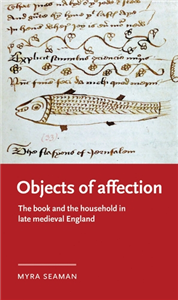
        Objects of affection

        The book and the household in late medieval England

        by Myra Seaman

        Objects of affection recovers the emotional attraction of the medieval book through an engagement with a fifteenth-century literary collection known as Oxford, Bodleian Library Manuscript Ashmole 61. Exploring how the inhabitants of the book's pages - human and nonhuman, tangible and intangible - collaborate with its readers then and now, this book addresses the manuscript's material appeal in the ways it binds itself to different cultural, historical and material environments. In doing so it traces the affective literacy training that the manuscript provided its late-medieval English household, whose diverse inhabitants are incorporated into the ecology of the book itself as it fashions spiritually generous and socially mindful household members.

      • Biography & True Stories
        February 1905

        Anna Karenina

        by Leo Tolstoy

      • September 1904

        Hamlet

        by William Shakespeare

        Hamlet is Shakespeare's longest play, and is considered among the most powerful and influential works of world literature, with a story capable of "seemingly endless retelling and adaptation by others". The play likely was one of Shakespeare's most popular works during his lifetime, and still ranks among his most performed, topping the performance list of the Royal Shakespeare Company and its predecessors in Stratford-upon-Avon since 1879. It has inspired many other writers—from Johann Wolfgang von Goethe and Charles Dickens to James Joyce and Iris Murdoch—and has been described as "the world's most filmed story after Cinderella"

      • Biography & True Stories
        March 1905

        Chopin: The Man and His Music

        by James Huneker

        Chopin: The Man and His Music reflects the intimate, thorough knowledge of Chopin's music that Huneker acquired while studying to be a concert pianist and his unusually keen insight into the character of the great Polish composer whose music he adored.

      • Humanities & Social Sciences
        November 1904

        Common Sense

        Addressed to The Inhabitants of America

        by Thomas Paine

        Published anonymously in 1776, six months before the Declaration of Independence, Thomas Paine’s Common Sense was a radical and impassioned call for America to free itself from British rule and set up an independent republican government. Savagely attacking hereditary kingship and aristocratic institutions, Paine urged a new beginning for his adopted country in which personal freedom and social equality would be upheld and economic and cultural progress encouraged.

      • Business, Economics & Law
        April 1905

        The Acquisitive Society

        by R.H. Tawney

        This 1926 survey, written by a distinguished social and economic historian, examines the role of religion in the rise of capitalism. Arguing that material acquisitiveness is morally wrong and a corrupting social influence, the author draws upon his profound knowledge of labor and politics to show how concentrated wealth distorts economic policies. Colorful but credible, this study offers a timeless vision of alternative means toward a just economic, social, and intellectual order.

      Subscribe to our

      newsletter