Your Search Results

      • Regio Ltd.

        Regio has nearly 30 years of experience in the publication of maps and atlases of all kinds, which have been internationally recognised and awarded on numerous occasions. Regio has two main fields of activity: mapping and geospatial data. We design accurate, up-to-date maps at all scales and for all purposes. In addition to printed maps we provide maps for internet applications, GPS and mobile devices. We are flexible and will assist you in the planning, consultation anddevelopment of all cartographic products. In geospatial data area Regio owns and maintains the most detailed geospatial database of Estonia and the Baltic States, including buildings, address data, points of interest, land cover, road network and navigation datasets.

        View Rights Portal
      • University of Regina Press

        University of Regina Press is located on Treaty 4 Territory, the traditional lands of the Cree, Saulteaux, and Assiniboine, and the homelands of the Métis. A little house on the prairie with big ambitions, University of Regina Press (URP) publishes books that matter--in both academic and trade formats. Our non-fiction trade books tend towards the hard-hitting, while most of our scholarly titles are accessible to non-specialists. We endeavour to develop writers into public intellectuals, encourage debate, and inspire young people to study the humanities by publishing books that are both seen and relevant.  Since our launch in 2013, University of Regina Press has published seven national bestsellers:  After the War: Surviving PTSD and Changing Mental Health Culture by Stéphane Grenier, with Adam Montgomery (2018) Speaking in Cod Tongues: A Culinary Journey by Lenore Newman (2017) Firewater: How Alcohol Is Killing My People (And Yours) by Harold Johnson (2016) Otto & Daria: A Wartime Journey into No Man's Land by Eric Koch (2016) The Education of Augie Merasty: A Residential School Memoir by Joseph Auguste Merasty, with David Carpenter (2015) Children of the Broken Treaty by Charlie Angus (2015) Clearing the Plains by James Daschuk (2014)

        View Rights Portal
      • Trusted Partner
        The Arts
        August 2010

        Art, museums and touch

        by Fiona Candlin, Amelia Jones, Marsha Meskimmon

        Art, museums and touch examines conceptions and uses of touch within arts museums and art history. Candlin deftly weaves archival material and contemporary museology together with government policy and art practice to question the foundations of modern art history, museums as sites of visual learning, and the association of touch with female identity and sexuality. This remarkable study presents a challenging riposte to museology and art history that privileges visual experience. Candlin demonstrates that touch was, and still is, crucially important to museums and art history. At the same time she contests the recent characterisation of touch as an accessible and inclusive way of engaging with museum collections, and argues against prevalent ideas of touch as an unmediated and uncomplicated mode of learning. An original and wide-ranging enquiry, this book is essential reading for scholars and students of museum studies, art history, visual culture, disability, and for anyone interested in the cultural construction of the senses. ;

      • Trusted Partner
        Humanities & Social Sciences
        February 2017

        Curating empire

        Museums and the British imperial experience

        by Sarah Longair, John McAleer

        Curating empire explores the diverse roles played by museums and their curators in moulding and representing the British imperial experience. This collection demonstrates how individuals, their curatorial practices, and intellectual and political agendas influenced the development of a variety of museums across the globe. Taken together, these contributions suggest that museums are not just sites for accessing history but need to be considered as historical sites of significance in themselves. Individual essays examine the work of curators in museums in Britain and the colonies, the historical display and interpretation of empire in Britain, and the establishment of 'museum networks' in the British imperial context. Curating empire sheds new light on the relationship between museums, as repositories for objects and cultural institutions for conveying knowledge, and the politics of culture and the formation of identities throughout the British Empire.

      • Trusted Partner
        Teaching, Language & Reference
        September 2020

        Dividing the spoils

        by Henrietta Lidchi, Stuart Allan, Alan Lester

      • Trusted Partner
        Biography & True Stories
        February 2025

        Unburied

        The true story of Hannah Beswick, the Manchester Mummy

        by Hannah Priest

        The macabre tale of an eighteenth-century woman immortalised in folklore as the 'Manchester Mummy'. In 1835, the Manchester Natural History Society opened the doors of its museum. Taking pride of place in its collection were three mummies: one was Egyptian, one was Peruvian and one was a woman from Cheetham Hill. This is the first time the true story of Hannah Beswick, the so-called 'Manchester Mummy', has been told. Over the years, explanations for the Manchester Mummy have ranged from the chilling - Hannah's fear of being buried alive - to the downright bizarre - the legend of her buried gold - but the truth is more complex. Exploring this fascinating episode from museum history, Unburied sheds light on the Victorian turn to the macabre and changing attitudes to the display of human remains. It debunks the legends and asks what Hannah Beswick can tell us about death and dying, mummies and museums.

      • Trusted Partner
        Humanities & Social Sciences
        March 2017

        Museums and empire

        by John M. Mackenzie

      • Trusted Partner
        Humanities & Social Sciences
        July 2018

        The Victorian soldier in Africa

        by Edward Spiers, Andrew Thompson, John M. MacKenzie

        The Victorian soldier in Africa re-examines the campaign experience of British soldiers in Africa during the period, 1874-1902 - the zenith of the Victorian imperial expansion - and does so from the perspective of the regimental soldier. The book utilises an unprecedented number of letters and diaries, written by regimental officers and other ranks, to allow soldiers to speak for themselves about their experience of colonial warfare. The sources demonstrate the adaptability of the British army in fighting in different climates, over demanding terrain and against a diverse array of enemies. They also uncover soldiers' responses to army reforms of the era as well as the response to the introduction of new technologies of war. Moreover, the book provides commentary on soldiers' views of commanding officers and politicians alongside assessment of war correspondents, colonial auxiliaries and African natives in their roles as bearers, allies and enemies. This book reveals new insights on imperial and racial attitudes within the army, on relations between soldiers and the media and the production of information and knowledge from frontline to homefront. It will make fascinating reading for students, academics and enthusiasts in imperial history, Victorian studies, military history and colonial warfare.

      • Trusted Partner
        Humanities & Social Sciences
        April 2026

        Connoisseurs and conmen

        The contest for cultural authority in early twentieth-century Britain

        by Lewis Ryder

        This book examines John Hilditch (1872-1930), a notorious collector of Chinese art who lied, hoaxed and manipulated in his struggle against museum experts to become a cultural authority. Previously overlooked as a pest with a dubious collection, this book uses Hilditch to interrogate how far the monumental social, cultural and political changes of the early twentieth century unsettled social and cultural hierarchies and how these hierarchies were remade. It shows how the cultural elites were forced to engage with the public and re-draw the boundaries of citizenship, expertise and high and low culture in response to unprecedented social mobility, the democratisation of culture and politics, as well as the effects of British imperialism which brought ordinary Britons access to antiquities as well as confidence to claim expertise over foreign cultures. The book will interest social and cultural historians of Modern Britain, museum scholars and art historians.

      • Trusted Partner
      • Trusted Partner
        Humanities & Social Sciences
        June 2016

        Curating empire

        Museums and the British imperial experience

        by Sarah Longair, Andrew Thompson, John McAleer, John Mackenzie

        Curating empire explores the diverse roles played by museums and their curators in moulding and representing the British imperial experience. This collection demonstrates how individuals, their curatorial practices, and intellectual and political agendas influenced the development of a variety of museums across the globe. Taken together, these contributions suggest that museums are not just sites for accessing history but need to be considered as historical sites of significance in themselves. Individual essays examine the work of curators in museums in Britain and the colonies, the historical display and interpretation of empire in Britain, and the establishment of 'museum networks' in the British imperial context. Curating empire sheds new light on the relationship between museums, as repositories for objects and cultural institutions for conveying knowledge, and the politics of culture and the formation of identities throughout the British Empire. ;

      • Trusted Partner
      • Trusted Partner
        Literature & Literary Studies
        March 2021

        The Victorian aquarium

        by Silvia Granata, Andrew Smith

      • Trusted Partner
        February 2024

        TEAM LUPE ermittelt (4). Eingeschlossen im Museum

        Rate-Krimi zum Selberlesen für Kinder ab 8 Jahren

        by Henriette Wich, Michael Stapper

        Der Krimi-Rätsel-Spaß geht weiter: ein actionreiches Abenteuer mit TEAM LUPE für Leseprofis ab 8 Jahren. Schock! Das Gemälde, das Lulus Oma dem Museum geliehen hat, wurde gefälscht. Wo ist das Original? Bei seinen Ermittlungen wird TEAM LUPE im Museum eingeschlossen. Nun müssen die Detektive nicht nur den Fälschern auf die Spur kommen, sondern auch einen Weg aus dem Museum finden … Ein spannender neuer Fall, perfekt für alle Leseratten und auch zur Ergänzung des Westermann Lehrwerks PASSWORT LUPE. •  Eine Geschichte in kurzen Kapiteln •  Mit Fibelschrift •  Detektivrätsel zum Mitknobeln •  Zwei Lesestufen für den perfekten Lesespaß   Weitere Titel in der Reihe „TEAM LUPE ermittelt“:Der rätselhafte Hundedieb (ab 7 Jahren)Spurensuche um Mitternacht (ab 8 Jahren)Koffer-Klau im Klassenzimmer (ab 8 Jahren)   Der Titel ist auf Antolin.de gelistet

      • Trusted Partner
        Humanities & Social Sciences
        January 2021

        Remaking the urban

        by Naomi Roux

      • Trusted Partner
        The Arts
        September 2009

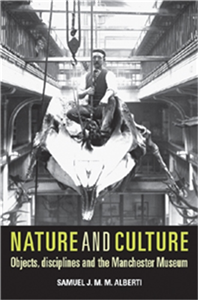
        Nature and culture

        Objects, disciplines and the Manchester Museum

        by Samuel J. M. M. Alberti

        This is a vital new work; the first to take the University of Manchester's Museum as its subject. By setting the museum in its cultural and intellectual contexts, Nature and culture explores twentieth-century collecting and display, and the status of the object in the modern world. Beginning with the origins of the Manchester Museum, accounting for its development as an internationally renowned university museum, and concluding at its major expansion at the turn of the millennium, this book casts new light on the history of museums. How did objects become knowledge? Who encountered museum objects on their way to museums? What happened to collections within the museum? How did visitors use and respond to objects? In answering these questions, Nature and culture illuminates not only the history of one institution, but also contributes to wider discussions in the history of science, cultural history and museology. ;

      • Trusted Partner
      • Trusted Partner
        January 1963

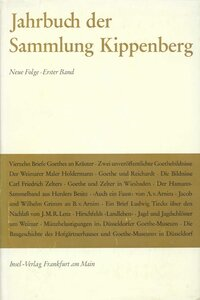
        Jahrbuch der Sammlung Kippenberg. Neue Folge. Herausgegeben vom Vorstand der Anton und Katharina Kippenberg-Stiftung. Goethe-Museum Düsseldorf

        Erster Band:

        by Hellmuth Maltzahn

        Vorwort / Hellmuth von Maltzahn: Vierzehn Briefe Goethes an Kräuter / Jörn Göres: Zwei unveröffentlichte Goethe-Bildnisse / Edwin Redslob, Carl Holdermann / Walter Salmen: Goethe und Reichardt / Irmgard Kräupl, Zelter-Bildnisse / Dora Wahl, Goethe und Zelter / Ernst Schulte Strathaus: Der Sokratische Philolog / Dorothea Streller: Achim von Arnim und ›Auch ein Faust‹ / Jörn Göres: Jacob und Wilhelm Grimms Brief vom 9. Mai 1816 an Bettina von Arnim / Elisabeth Genton: Ein Brief Ludwig Tiecks über die nachgelassenen Schriften von Lenz / Maria Gräfin Lanckoronska, ›Das Landleben‹ von Christian Cay Lorenz Hirschfeld / Hans Herbert Möller: Jagd um Weimar / Lothar Frede: Münzbelustigungen im Düsseldorfer Goethe-Museum / Irene Markowitz: Die Baugeschichte des Hofgärtnerhauses und Goethe-Museums Düsseldorf Tafel I – XXX

      • Trusted Partner
        October 2006

        Heimat und Exil

        Emigration der deutschen Juden nach 1933

        by Stiftung Jüdisches Museum Berlin, Stiftung Haus der Geschichte der Bundesrepublik Deutschland

        Flucht, Vertreibung und Neuanfang der deutschen Juden nach 1933 sind das Thema einer großen Ausstellung des Jüdischen Museums Berlin in Kooperation mit dem Haus der Geschichte in Bonn. Erstmals wird der erzwungene Exodus der deutschen Juden in weltweit über hundert Länder in einer Gesamtschau vor Augen geführt. Der reich illustrierte Begleitband ist wie die Ausstellung biographisch ausgerichtet. Dokumentiert werden vielfältige Flucht- und Lebenswege, die von Deutschland aus bis nach Shanghai oder in die Dominikanische Republik führten und, nach 1945, in einzelnen Fällen auch wieder zurück. Wo konnten die Emigranten unter welchen Bedingungen Zuflucht finden? Wie hat sich ihr Leben in den Zufluchtsländern gestaltet? Unterschiedliche Facetten der Exilerfahrung sowie der emotionalen und geographischen Verortung von »Heimat« werden in den Blick genommen. Zudem wird in einem gesonderten Teil jedes der über hundert Transit- und Aufnahmeländer aus der Perspektive der Emigranten vorgestellt – dieser historische Atlas eröffnet einen einzigartigen Zugang zu der vor über siebzig Jahren sich begründenden deutsch-jüdischen Diaspora in aller Welt.

      • Trusted Partner
        October 1983

        Jahrbuch der Sammlung Kippenberg. Herausgegeben vom Vorstand der Anton-und-Katharina-Kippenberg-Stiftung. Goethe-Museum Düsseldorf

        Vierter Band:

        by Anton-und-Katharina-Kippenberg-Stiftung

        Vorwort / Wolfgang Frhr. von Löhneysen: Goethes Kunstgeschichte / Ursula Rautenberg: Briefe des Grafen Cajus zu Stolberg-Stolberg an Johann Friedrich Heinrich Schlosser / Jost Schneider: Charlotte von Schadows Tagebuch einer Reise durch Italien 1830/31/ Thomas C. Starnes: Goethe und sein Haus. Aus zwei Weimarer Tagebüchern / Ingrid Strohschneider-Kohrs: Vielfache Reflexion. Anmerkungen zu einigen späten Goethe-Briefen / Abbildungen / Erich Trunz: Zelters Grundriß-Skizzen des Goethe-Hauses am Frauenplan / Hans Tümmler: Die Briefe Carl Augusts von Weimar an Sophie von Coudenhove, 1787-1799 / Irmgard Kräupl, Christina Kroll, Hartmut Schmidt, Neuerwerbungen des Goethe-Museums Düsseldorf 1975-1981 / Jörn Göres: Worte, vor der Fürstengruft zu Weimar gesprochen

      Subscribe to our

      newsletter