Your Search Results

      • Trusted Partner
        Literature & Literary Studies
        December 2004

        The revision of Englishness

        by David Rogers, John McLeod

        What is 'Englishness'? Who defines it? What impact have changes to England and the English, as well as England's relationship with the outside world, had on 'Englishness'? Has 'Englishness' become an anachronism at the turn of a new century? These questions and others like them have become familiar ones in recent debates concerning English politics, culture and identity. Diverse and often competing notions of 'Englishness' have been critiqued by a variety of writers and critics who have become concerned about received visions of 'Englishness' in the post-war period. An exciting and provocative collection of essays which registers the changes to Englishness since the 1950s, 'The revisions of Englishness' explores how Englishness has been revised for a variety of aesthetic and political purposes and makes a ground-breaking contribution to the contemporary debates surrounding Englishness in literary and cultural studies. ;

      • Trusted Partner
        Fiction
        September 2017

        A Vision of Battlements

        by Anthony Burgess

        by Andrew Biswell, Paul Wake

        A Vision of Battlements is the first novel by the writer and composer Anthony Burgess, who was born in Manchester in 1917. Set in Gibraltar during the Second World War, the book follows the fortunes of Richard Ennis, an army sergeant and incipient composer who dreams of composing great music and building a new cultural world after the end of the war. Following the example of his literary hero, James Joyce, Burgess takes the structure of his book from Virgil's Aeneid. The result is, like Joyce's Ulysses, a comic rewriting of a classical epic, whose critique of the Army and the postwar settlement is sharp and assured. The Irwell Edition is the first publication of Burgess's forgotten masterpiece since 1965. This new edition includes an introduction and notes by Andrew Biswell, author of a prize-winning biography of Anthony Burgess.

      • Trusted Partner
      • Trusted Partner
      • Trusted Partner
        January 1965

        Die Revision des Marxismus-Leninismus.

        Chancen und Grenzen einer Ideologie.

        by Schack, Herbert

      • Trusted Partner
      • Trusted Partner
        Humanities & Social Sciences
        March 2014

        Lordship in four realms

        The Lacy family, 1166–1241

        by Steve Rigby, Colin Veach

        This book examines the rise and fall of the aristocratic Lacy family in England, Ireland, Wales and Normandy. This involves a unique analysis of medieval lordship in action, as well as a re-imagining of the role of English kingship in the western British Isles and a rewriting of seventy-five years of Anglo-Irish history. By viewing the political landscape of Britain and Ireland from the perspective of one aristocratic family, this book produces one of the first truly transnational studies of individual medieval aristocrats. This results in an in-depth investigation of aristocratic and English royal power over five reigns, including during the tumultuous period of King John and Magna Carta. By investigating how the Lacys sought to rule their lands in four distinct realms, this book also makes a major contribution to current debates on lordship and the foundations of medieval European society.

      • Trusted Partner
      • Trusted Partner
        Humanities & Social Sciences
        March 2012

        John Hume and the revision of Irish nationalism

        by P. J. McLoughlin

        The book, available at last in paperback, explores the politics of the most important Irish nationalist leader of his generation, and one of the most influential figures of twentieth-century Ireland: the Nobel Peace Prize winner, John Hume. Given his central role in the reformulation of Irish nationalist ideology, and the vital part which he played in drawing violent republicanism into democratic politics, the book shows Hume to be one of the chief architects of the Northern Ireland peace process, and a key figure in the making of the 1998 Good Friday Agreement. At the same time, it considers Hume's failure in what he stated to be his foremost political objective: the conciliation of the two communities in Northern Ireland. The book is essential reading for specialists on Irish history and politics, but will also be of interest to academics and practitioners working in other regions of political and ethnic conflict. In addition, it will appeal to readers seeking to understand the crucial role played by Hume in modernising Irish nationalist thinking, and bringing peace to Northern Ireland. ;

      • Trusted Partner
        Literature & Literary Studies
        March 2007

        On the uses of history in recent Irish writing

        by Bernhard Klein

        This book offers a critical reassessment of the uses of history in contemporary Irish literature and culture. It argues that in much recent Irish writing, history is approached not as the proverbial 'nightmare' from which Joyce's Stephen Dedalus tried to awake, but as a rich, imaginative resource. Drawing on recent debates in Irish literary and cultural criticism, On the uses of history in recent Irish writing explores the varied, creative, and often critically challenging forms of rewriting Ireland's troubled past in contemporary prose, drama and poetry. Individual chapters focus on literary treatments of the Tudor reconquest, the Famine, the Northern Irish Troubles and other key events in Irish history, highlighting in a series of close readings the unique forms of historical thought enabled by different literary forms and genres. Canonical works by authors such as Seamus Heaney, Derek Mahon, Tom Paulin, Brian Friel, Stewart Parker and Frank McGuinness are considered alongside lesser known writers and texts, placing each in their wider social, cultural and historical contexts. ;

      • Trusted Partner
      • Trusted Partner
      • Trusted Partner
      • Trusted Partner
        Literature & Literary Studies
        February 2025

        Shakespeare's tutor

        by Darren Freebury-Jones

      • Trusted Partner
        Literature & Literary Studies
        November 2022

        Kate Atkinson

        by Armelle Parey

        This timely in-depth study of award-winning Kate Atkinson's work provides a welcome comprehensive overview of the novels, play and short stories. It explores the major themes and aesthetic concerns in her fiction. Combining close analysis and literary contextualisation, it situates her multi-faceted work in terms of a hybridisation of genres and innovative narrative strategies to evoke contemporary issues and well as the past. Chapters offer insights into each major publication (from Behind the Scenes at the Museum to Big Sky, the latest instalment in the Brodie sequence, through the celebrated Life After Life and subsequent re-imaginings of the war) in relation to the key concerns of Atkinson's fiction, including self-narrativisation, history, memory and women's lives.

      • Trusted Partner
        Literature & Literary Studies
        March 2026

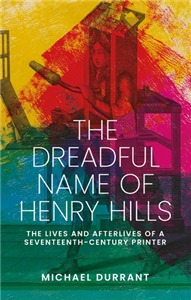
        The dreadful name of Henry Hills

        The lives and afterlives of a seventeenth-century printer

        by Michael Durrant

        1. Introducing the Career of Henry Hills, Printer - What is a printer? - Print output - Insignia - Roles - Partnerships - Cultural configurations of the early modern printer 2. 'Once upon a time': Biographical Encounters with Henry Hills - Henry Hills' Lives: From DNB to ODNB - Cultural biographies of printers - Hugh Dalton's Cave: Reading Henry Hills Part 2: Transformations 3. '[N]othing but the plain truth': The Prodigal Repackaged (1650-51, 1688, 1825) - Henry Hills: Particular Baptist printer / author - The Prodigal as shame management - Henry Hills and the tailor's wife: 'Pressing' at a biographical anecdote - The Prodigal Returned to his Father's House, by Henry Hills (1825): Reprinting a reprint 4. 'Licking himself whole again': Writing and Rewriting Henry Hills' Catholic Conversion (1685, 1686, 1733, 1826) - Henry Hills: Catholic Printer - A View (1685): From runaway apprentice to anti-Catholic book burner - Entering Book (1686): Roger Morrice and the Hills household - Revolution Politicks (1733): Print mediation and and public talk - Hills, last seen at Watten, near Sainte-Omer, 13 February 1689 Part 3: Afterlives 5. Henry Hills, Eikon Basilike, and his Posthumous Role in the Pamela Prayer Conspiracy - Taking the Pamela Prayer interpolation seriously: Eikon Basilike, authorship, and the work of conspiracy - '[T]he Roundhead printer!': Almack, Madan, and Hills' role in the publication of the Eikon - The 'leading witness': Writing and rewriting Hills in Milton scholarship - Finding Henry Hills in Dr Bernard's library 6. Pirates, Parents, and Print: Rewriting Henry Hills' Last Will and Testament - 'Suite Trouble': Contesting Hills' legacy - '[A]n expedient lineage': Henry Hills junior goes to Bombay - Working with what remains

      • Trusted Partner
        July 1998

        New Approaches and Ways of Legal Thinking Revised.

        The Otto Brusiin Lectures 1982–1997. Brusiin-SONDERHEFT. Zeitschrift Rechtstheorie, 28. Band (1997), Heft 2 (S. 141–250).

        by Urheber (sonst.) Minkkinen, Panu; Herausgegeben von Aarnio, Aulis; Herausgegeben von Krawietz, Werner

      • Trusted Partner
        February 2003

        Der Rheinische Revisions- und Kassationshof in Berlin (1819-1852).

        Ein rheinisches Gericht auf fremdem Boden.

        by Seynsche, Gudrun

      Subscribe to our

      newsletter