
Your Search Results
-

-

Bingsha Shatabdi
Established in 1956, Bingsha Shatabdi follows two different trends in publication, It brings out direct translations from various European languages like French, Dutch, German into Bangla. It deals with both contemporary and classical literature. Its second goal is to publish collections of essays in Bangla and English, and its area of concentration is Social Science And Ancient Indian Civilization and Culture.
View Rights Portal
-
Promoted Content

 Literature & Literary StudiesMarch 2017
Asia in Western fiction
by Robin Winks
Any reader who has ever visited Asia knows that the great bulk of Western-language fiction about Asian cultures turns on stereotypes. This book, a collection of essays, explores the problem of entering Asian societies through Western fiction, since this is the major port of entry for most school children, university students and most adults. In the thirteenth century, serious attempts were made to understand Asian literature for its own sake. Hau Kioou Choaan, a typical Chinese novel, was quite different from the wild and magical pseudo-Oriental tales. European perceptions of the Muslim world are centuries old, originating in medieval Christendom's encounter with Islam in the age of the Crusades. There is explicit and sustained criticism of medieval mores and values in Scott's novels set in the Middle Ages, and this is to be true of much English-language historical fiction of the nineteenth and early twentieth centuries. Even mediocre novels take on momentary importance because of the pervasive power of India. The awesome, remote and inaccessible Himalayas inevitably became for Western writers an idealised setting for novels of magic, romance and high adventure, and for travellers' tales that read like fiction. Chinese fictions flourish in many guises. Most contemporary Hong Kong fiction reinforced corrupt mandarins, barbaric punishments and heathens. Of the novels about Japan published after 1945, two may serve to frame a discussion of Japanese behaviour as it could be observed (or imagined) by prisoners of war: Black Fountains and Three Bamboos.
-
Promoted Content
 MedicineNovember 2019
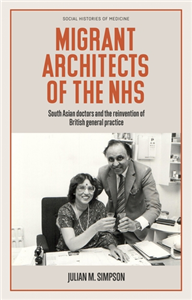
Migrant architects of the NHS
South Asian doctors and the reinvention of British general practice (1940s-1980s)
by Julian Simpson, Keir Waddington
Migrant architects of the NHS draws on forty-five oral history interviews and extensive archival research to offer a radical reappraisal of how the National Health Service was made. It tells the story of migrant South Asian doctors who became general practitioners in the NHS. Imperial legacies, professional discrimination and an exodus of UK-trained doctors combined to direct these doctors towards work as GPs in some of the most deprived parts of the UK. In some areas, they made up over half of the general practitioner workforce. The NHS was structurally dependent on them and they shaped British society and medicine through their agency. Aimed at students and academics with interests in the history of immigration, immigration studies, the history of medicine, South Asian studies and oral history. It will also be of interest to anyone who wants to know more about how Empire and migration have contributed to making Britain what it is today.
-
 Trusted Partner
-
Trusted Partner
-
Trusted Partner
 Cultural studiesJuly 2013
The Asian Financial Crisis
Crisis, reform and recovery
by Shalendra D. Sharma
-
Trusted Partner
-
Trusted Partner
Humanities & Social SciencesJuly 2018
The Asian Financial Crisis
Crisis, reform and recovery
by Shalendra Sharma
-
Trusted Partner
 January 1993
South Asian Archaeology 1991
Proceedings of the eleventh International Conference of the Association of South Asian Archaeologists in Western Europe held in Berlin 1-5 July 1991
by Herausgegeben von Gail, Adalbert J.; Herausgegeben von Mevissen, Gerd J. R.; Überarbeitet von Zehmke, Britta
-
Trusted Partner
Humanities & Social SciencesMay 2020
The Central Asian Revolt of 1916
by Alexander Morrison, Cloé Drieu, Aminat Chokobaeva
-
Trusted Partner
 The ArtsFebruary 2022
"I am Jugoslovenka!"
Feminist performance politics during and after Yugoslav Socialism
by Jasmina Tumbas, Amelia Jones, Marsha Meskimmon
"I am Jugoslovenka" argues that queer-feminist artistic and political resistance were paradoxically enabled by socialist Yugoslavia's unique history of patriarchy and women's emancipation. Spanning performance and conceptual art, video works, film and pop music, lesbian activism and press photos of female snipers in the Yugoslav wars, the book analyses feminist resistance in a range of performative actions that manifest the radical embodiment of Yugoslavia's anti-fascist, transnational and feminist legacies. It covers celebrated and lesser-known artists from the 1970s to today, including Marina Abramovic, Sanja Ivekovic, Vlasta Delimar, Tanja Ostojic, Selma Selman and Helena Janecic, along with music legends Lepa Brena and Esma Redzepova. "I am Jugoslovenka" tells a unique story of women's resistance through the intersection of feminism, socialism and nationalism in East European visual culture.
-
Trusted Partner
 Humanities & Social SciencesNovember 2016
Postcolonial minorities in Britain and France
by Shailja Sharma
-
Trusted Partner
-
Trusted Partner
November 1998
Law in a Changing World: Asian Alternatives
Proceedings of the 4th Kobe Lectures being the first Asia Symposium in Jurisprudence. Tokyo and Kyoto, 10th and 12th October 1996
by Herausgegeben von Yasutomo, Morigawa
-
Trusted Partner
-
Trusted Partner
 Humanities & Social SciencesMarch 2017
'The better class' of Indians
Social rank, Imperial identity, and South Asians in Britain 1858–1914
by A. Wainwright
This is the first book-length study to focus primarily on the role of class in the encounter between South Asians and British institutions in the United Kingdom at the height of British imperialism. In a departure from previous scholarship on the South Asian presence in Britain, 'The better class' of Indians emphasizes the importance of class as the register through which British polite society interpreted other social distinctions such as race, gender, and religion. Drawing mainly on unpublished material from the India Office Records, the National Archives, and private collections of charitable organizations, this book examines not only the attitudes of British officials towards South Asians in their midst, but also the actual application of these attitudes in decisions pertaining to them. This fascinating book will be of particular interest to scholars and general readers of imperialism, immigration as well as British and Indian social history.
-
Trusted Partner
 Humanities & Social SciencesFebruary 2013
Building a neighborly community
Post-cold war China, Japan, and Southeast Asia
by Daojiong Zha, Weixing Hu
Building a neighborly community, available for the first time in paperback, explores the political economy of post-cold war East Asian co-operation by examining the history of intra-regional co-operation, against the background of China's rise and Japan's relative decline, both real and perceived. The book in particular examines how East Asian states have dealt with the South China Sea as a region-wide security challenge and the imperative for self-help after the 1997 economic crisis. The book builds on the explanatory strength of analytical eclecticism, and ultimately concludes that China, South Korea, Japan, and ASEAN states have aimed for constructing a neighborly community. The fundamental differences between a neighborly community and the kind of community that has emerged in Europe and North America are that qualification for membership is not conditional, the process of routine interactions is itself one of reassurance, the aim of inter-state interactions is to foster acceptance of each other, and changes in a member's foreign policy behaviour are accepted. ;
-
Trusted Partner
Literature & Literary StudiesJune 2025
Resistance and its discontents in South Asian women's fiction
by Maryam Mirza
-
Trusted Partner
 Humanities & Social SciencesSeptember 2025
Eclipsing the West
China, India and the forging of a new world
by Vince Cable
As the international order begins to crumble, this incisive book asks what the rise of the Asian superstates means for the future. The Western-dominated world we have known for the past three hundred years is coming to an end. As America withdraws from its role as enforcer of the international order, other countries are moving in to fill the void. Among them are two rising Asian 'superstates'. Accounting for almost half of the world's population, China and India have the potential to wield enormous economic and political power. China is already vying with the US for the top spot in the global economy, and on some measures has surpassed it. By the middle of the century India may be number two. How will these countries navigate their growing roles on the world stage? What are the implications for commerce, international law and the fight against climate change? Vince Cable has followed China and India for decades, first as a professional economist and later as a senior government minister. In Eclipsing the West he draws on the latest data and a lifetime of political and economic experience to offer a compelling account of what the rise of the Asian superstates means for the future.
-
Trusted Partner
Humanities & Social SciencesApril 2023
Monarchies and decolonisation in Asia
by Robert Aldrich, Cindy McCreery
With original case studies of a more than a dozen countries, Monarchies and decolonisation in Asia offers new perspectives on how both European monarchs who reigned over Asian colonies and Asian royal houses adapted to decolonisation. As colonies became independent states (and European countries, and other colonial powers, lost their overseas empires), monarchies faced the challenges of decolonisation, republicanism and radicalism. These studies place dynasties - both European and 'native' - at the centre of debate about decolonisation and the form of government of new states, from the sovereigns of Britain, the Netherlands and Japan to the maharajas of India, the sultans of the East Indies and the 'white rajahs' of Sarawak. It provides new understanding of the history of decolonisation and of the history of modern monarchy.
-
Trusted Partner
 Humanities & Social SciencesNovember 2012
New frontiers
Imperialism's new communities in East Asia, 1842–1953
by Robert Bickers, Andrew Thompson, Christian Henriot, John Mackenzie
In the new world order mapped out by Japanese and Western imperialism in East Asia after the mid-nineteenth century opium wars, communities of merchants and settlers took root in China and Korea. New identities were constructed, new modes of collaboration formed and new boundaries between the indigenous and foreign communities were literally and figuratively established. Newly available in paperback, this pioneering and comparative study of Western and Japanese imperialism examines European, American and Japanese communities in China and Korea, and challenges received notions of agency and collaboration by also looking at the roles in China of British and Japanese colonial subjects from Korea, Taiwan and India, and at Chinese Christians and White Russian refugees. This volume will be of interest to students and scholars of the history and anthropology of imperialism, colonialism's culture and East Asian history, as well as contemporary Asian affairs. ;



