
Your Search Results


-
Promoted Content

 The ArtsJune 2026
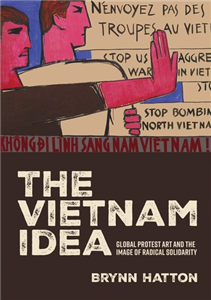
The Vietnam idea
Global protest art and the image of radical solidarity
by Brynn Hatton
The Vietnam idea examines how Vietnam became a potent symbol for global movements fighting colonialism, racism, and imperialism during the American War and its aftermath. Rather than focusing on Vietnam as a place, Brynn Hatton explores how artists and activists around the world used the idea of 'Vietnam' to express political identification and solidarity through posters, films, protest actions, exhibitions, and conceptual art. Drawing on international archives, the book reveals how diverse visual works helped shape the political imagination of the global left, and continue to influence how we see identity, conflict, and solidarity today.
-
Promoted Content
-
 Trusted Partner
 Humanities & Social SciencesJuly 2025
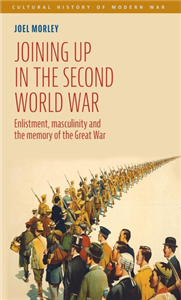
Joining up in the Second World War
Enlistment, masculinity and the memory of the Great War
by Joel Morley
This book connects the First and Second World Wars. It uses oral histories and Mass Observation material to explore men's attitudes to Second World War enlistment and the relationship they perceived between military service and masculinity, and how these were influenced by understandings of the First World War. Locating the cultural legacy of First World War in the subjectivities of men who participated in the Second World War demonstrates the breadth of sources that informed men's understandings of the First World War in interwar Britain. Its cultural legacy was omnipresent and diverse, and informed young men's attitudes and service preferences, but it reinforced Edwardian conceptions of wartime masculinity as often as it undermined them. Two decades after the First World War ended, they remained resilient in the subjective understandings of men who grew up in the Great War's shadow.
-
Trusted Partner

 2024
2024Where is Russia Heading?
by Jens Siegert
Vladimir Putin has been ruling Russia for 25 years. There is no end in sight to his dictatorship. He relies on repression at home and is waging a war of destruction against a neighbouring country. The conflict with the West has long become a systemic conflict between an illiberal-autocratic ideology and liberal-democratic principles. Nothing will change as long as Putin remains in power. Nevertheless, as far as can be ascertained under unfree conditions, the majority of the population seems to be supporting Putin. Does this mean that too many people in Russia do not want democracy or peace? Will everything remain the same after Putin? Or is there a chance that Russia will eventually take a different, more democratic path? Whatever the outcome of the war in Ukraine, Russia is not going to disappear. We will still have to deal with our big neighbour in the east. This makes it all the more important to focus on longer-term developments. As a recognised expert on Russian history and society, the author outlines what the post-Putin era might look like. His in-depth analysis makes it clear that Russia is partly Putin, but Putin is not everything about Russia.
-
Trusted Partner

 1984
1984Vietnam! Vietnam?
Die Entwicklung der sozialistischen Republik Vietnam nach dem Fall Saigons
by Andreas Buro, Karl Grobe
-
Trusted Partner
 Humanities & Social SciencesOctober 2022
Germany's Russia problem
The struggle for balance in Europe
by John Lough
The relationship between Germany and Russia is Europe's most important link with the largest country on the continent. But despite Germany's unparalleled knowledge and historical experience, its policymakers struggle to accept that Moscow's efforts to rebalance Europe at the cost of the cohesion of the EU and NATO are an attack on Germany's core interests. This book explains the scale of the challenge facing Germany in managing relations with a changing Russia. It analyses how successive German governments from 1991 to 2014 misread Russian intentions, until Angela Merkel sharply recalibrated German and EU policy towards Moscow. The book also examines what lies behind efforts to revise Merkel's bold policy shift, including attitudes inherited from the GDR and the role of Russian influence channels in Germany.
-
Trusted Partner
 Business, Economics & LawJuly 2025
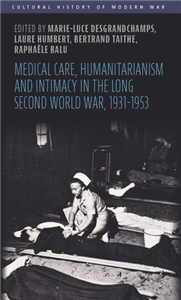
Medical care, humanitarianism and intimacy in the long Second World War, 1931-1953
by Marie-Luce Desgrandchamps, Laure Humbert, Bertrand Taithe, Raphaële Balu
This book offers a micro-global history of humanitarianism and medical care during the 'long' Second World War, which challenges the traditional and Eurocentric chronological boundaries of 1939/1945. It takes as its starting point the Japanese invasion of Manchuria in 1931, which led to the progressive dislocation of the League of Nations, with the Japanese, German and Soviet departures in the 1930s. It ends with the termination of the Korean War in 1953, and the subsequent dismantlement of the first United Coalition and UN Peace enforcement operation. It considers the slow, messy and ambivalent transformation of humanitarian actors' relations to the suffering of distant others through a study of humanitarian encounters, practices, spaces and affects. Paying close attention to a variety of actors, such as French colonial doctors, Swiss ICRC delegates, Egyptian relief workers, Chinese-style physicians, Peruvian and Ecuadorian nurses or American member of the Unitarian Service Committee, the book provides a more holistic story of humanitarianism.
-
Trusted Partner
Humanities & Social SciencesNovember 2024
US public diplomacy in socialist Yugoslavia, 1950–70
Soft culture, cold partners
by Carla Konta
The first comprehensive account of the public and cultural diplomacy campaigns carried out by the US in Yugoslavia during the height of the Cold War, this book examines the political role of culture in US-Yugoslav bilateral relations and the fluid links between information and propaganda. Tito allowed the US Information Agency and the State Department's cultural programmes to enter Yugoslavia, liberated from Soviet control. The exchange of intellectual and political personnel helped foster the US-Yugoslav relationship, yet it posed severe ideological challenges for both sides. By providing new insights into porous borders between freedom and coercion in Tito's regime, this book shows how public diplomacy acted as an external input for Yugoslav liberalisation and dissident movements. Using extensive archival research and interviews, Konta analyses the links between information and propaganda, and the unintended effects of propaganda beyond the control of producers and receivers.
-
Trusted Partner
 Humanities & Social SciencesSeptember 2000
The Vietnam wars
by Kevin Ruane, Harry Bennett
This source book chronicles the history of the most controversial conflict of the 20th century, beginning with the birth of the Vietnamese communist party in 1930 and ending with the Vietnamese revolution in 1975. The text combines short essays with original documents to illustrate the debate. Alongside the dominating American intervention, the study also focuses on the international dimension of the conflict, particularly the role of the Soviet, Chinese and British; but it is the Vietnamese perspective that remains key. ;
-
Trusted Partner
-
Trusted Partner
 Business, Economics & LawMarch 2026
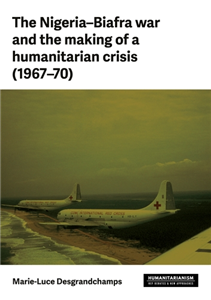
Humanitarianism in Civil War
The Biafra crisis, 1967-1970
by Marie-Luce Desgrandchamps
May 1967, in Nigeria, the Republic of Biafra declared its independence. Soon, civil war and famine ravaged the region and gradually entered the European and American media. Photographs of the conflict arouse considerable emotion in the West. The secessionist enclave and the areas taken over by the Nigerian army then became the scene of major relief operations, developed and financed by multiple organizations and governments. Part of a historiography of humanitarianism in full renewal, this book tells the story of the war, its metamorphosis into an international crisis and the responses that were provided. Based on a large body of sources from French, British, Swiss, Nigerian and American archives, it offers an insight into the world of humanitarian work at the end of the 1960s. It shows the reconfigurations taking place there. in the postcolonial era by proposing complementary scales of observation - international, national and local. The work also revisits some of the controversies which developed around the conflict regarding the instrumentalization of aid, its links with politics, the reception of relief operations on the ground or even the birth of borderlessness and testimony. It thus returns to the place occupied by the Biafran crisis in the history of humanitarian aid.
-
Trusted Partner
 Humanities & Social SciencesFebruary 2022
The unimagined community
by Duy Lap Nguyen, Bertrand Taithe
-
Trusted Partner
 Humanities & Social SciencesJune 2025
Revolution in China and Russia
Reorganizing empires into nation states
by Luyang Zhou
Most scholars believe that China's nationality policy, like that of other socialist states, imitated the Soviet nationality model, a system which has been termed an "affirmative action empire." This book offers two contributions to the literature which run counter to this convention. First, it argues that the People's Republic of China (PRC) and the Soviet Union (USSR) were different; while the PRC was aimed to build an ideal-typical nation-state, the USSR was an open union of nation-states that was only temporarily confined to a physical territory. Second, while scholars who have noted this difference attribute it to contextual factors, such as ethnic structure, geopolitical status, and Russia's intervention into the Chinese Revolution, this book contends that context shaped the Sino-Soviet difference, yet it did not determine it. Rather, there was significant leeway between the implications of the contextual factors, and what the policy-designers ultimately established. This book probes who held agency, and how these individuals bridged this gap.
-
Trusted Partner
 May 2022
In the Shadow of War
Diary notes from Ukraine
by Christoph Brumme
"What can you learn in war? Do you become numb, do you get used to it at some point? Does war make you "hard", uncaring, above pain? No. These are just clichés. Every day brings new horrors. At best, one learns for some time to suppress strong feelings, because to give in to them would weaken one's life instinct." In a very stirring and shocking, but sometimes humorous language, Christoph Brumme tells of the situation in Ukraine, the everyday life of his family and friends, of fears, longings and political assessments. The diary entries of the war and the resistance of the Ukrainians, starting from the first signs of the impending war in mid-January 2022 until the printing of this book, 1st May 2022, impressively bear witness to the brutality of these events.
-
Trusted Partner
 The ArtsJanuary 2019
The war that won't die
The Spanish Civil War in cinema
by David Archibald
The war that won't die charts the changing nature of cinematic depictions of the Spanish Civil War. In 1936, a significant number of artists, filmmakers and writers - from George Orwell and Pablo Picasso to Joris Ivens and Joan Miró - rallied to support the country's democratically-elected Republican government. The arts have played an important role in shaping popular understandings of the Spanish Civil War and this book examines the specific role cinema has played in this process. The book's focus is on fictional feature films produced within Spain and beyond its borders between the 1940s and the early years of the twenty-first century - including Hollywood blockbusters, East European films, the work of the avant garde in Paris and films produced under Franco's censorial dictatorship. The book will appeal to scholars and students of Film, Media and Hispanic Studies, but also to historians and, indeed, anyone interested in why the Spanish Civil War remains such a contested political topic.
-
Trusted Partner
 The ArtsJune 2021
The war that won't die
The Spanish Civil War in cinema
by David Archibald
The war that won't die charts the changing nature of cinematic depictions of the Spanish Civil War. In 1936, a significant number of artists, filmmakers and writers - from George Orwell and Pablo Picasso to Joris Ivens and Joan Miró - rallied to support the country's democratically-elected Republican government. The arts have played an important role in shaping popular understandings of the Spanish Civil War and this book examines the specific role cinema has played in this process. The book's focus is on fictional feature films produced within Spain and beyond its borders between the 1940s and the early years of the twenty-first century - including Hollywood blockbusters, East European films, the work of the avant garde in Paris and films produced under Franco's censorial dictatorship. The book will appeal to scholars and students of Film, Media and Hispanic Studies, but also to historians and, indeed, anyone interested in why the Spanish Civil War remains such a contested political topic.
-
Trusted Partner
-
Trusted Partner
 June 2026
Little wars of empire
British veterans in a colonial world, c.1885–1918
by Taylor Soja
Little Wars of Empire is a group biography of British veterans who experienced multiple wars across the British empire. Throughout the nineteenth century, Britain was constantly at war in its colonies, defending against anti-colonial resistance or trying to expand its influence. The veterans of these wars did not disappear once they were over, and many of them went on to later experience World War I. By using personal sources such as letters, diaries, and photograph albums, this book works to show how colonial violence and British military history depend upon one another, and argues that colonial war fundamentally shaped the British experience of empire. This was true for all kinds of British veterans, from British Army soldiers and officers to nurses and military families, whose experiences demonstrate the central place of colonial violence to British life.
-
Trusted Partner
-
Trusted Partner
 Humanities & Social SciencesJanuary 2022
Exiting war
The British Empire and the 1918–20 moment
by Romain Fathi, Margaret Hutchison, Andrekos Varnava, Michael Walsh, Alan Lester
Exiting war explores a particular 1918-20 'moment' in the British Empire's history, between the First World War's armistices of 1918, and the peace treaties of 1919 and 1920. That moment, we argue, was a challenging and transformative time for the Empire. While British authorities successfully answered some of the post-war tests they faced, such as demobilisation, repatriation, and fighting the widespread effects of the Spanish flu, the racial, social, political and economic hallmarks of their imperialism set the scene for a wide range of expressions of loyalties and disloyalties, and anticolonial movements. The book documents and conceptualises this 1918-20 'moment' and its characteristics as a crucial three-year period of transformation for and within the Empire, examining these years for the significant shifts in the imperial relationship that occurred and as laying the foundation for later change in the imperial system.



