
Troubador Publishing Ltd.
Troubador is an independent UK-based trade and academic publisher which also offers authors a high quality self-publishing services through its imprint Matador for fiction, non-fiction and communications.
View Rights Portal
Troubador is an independent UK-based trade and academic publisher which also offers authors a high quality self-publishing services through its imprint Matador for fiction, non-fiction and communications.
View Rights Portal

Leprosy and colonialism investigates the history of leprosy in Suriname within the context of Dutch colonial power and racial conflict, from the plantation economy and the age of slavery to its legacy in the modern colonial state. It explores the relationship between the modern stigmatization and exclusion of people affected with leprosy, and the political tensions and racial fears originating in colonial slave society, exerting their influence until after the decolonization up to the present day. In the book colonial sources are read from shifting perspectives, of the colonial rulers and, 'from below', the ruled. Though leprosy is today a neglected tropical disease, recognizing influences of our colonial heritage in our global management of health and disease, and exploring the perspectives of other cultures are essential in a time in which migration movements make the permeability of boundaries, and transmission of diseases, more common then perhaps ever before.
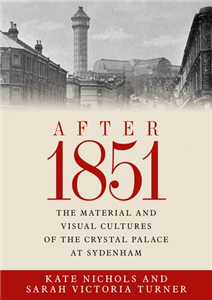
Echoing Joseph Paxton's question at the close of the Great Exhibition, 'What is to become of the Crystal Palace?', this interdisciplinary essay collection argues that there is considerable potential in studying this unique architectural and art-historical document after 1851, when it was rebuilt in the South London suburb of Sydenham. It brings together research on objects, materials and subjects as diverse as those represented under the glass roof of the Sydenham Palace itself; from the Venus de Milo to Sheffield steel, souvenir 'peep eggs' to war memorials, portrait busts to imperial pageants, tropical plants to cartoons made by artists on the spot, copies of paintings from ancient caves in India to 1950s film. Essays do not simply catalogue and collect this eclectic congregation, but provide new ways for assessing the significance of the Sydenham Crystal Palace for both nineteenth- and twentieth-century studies. The volume will be of particular interest to researchers and students of British cultural history, museum studies, and art history.
 Trusted Partner

Imperial power, both formal and informal, and research in the natural sciences were closely dependent in the nineteenth century. This book examines a portion of the mass-produced juvenile literature, focusing on the cluster of ideas connected with Britain's role in the maintenance of order and the spread of civilization. It discusses the political economy of Western ecological systems, and the consequences of their extension to the colonial periphery, particularly in forms of forest conservation. Progress and consumerism were major constituents of the consensus that helped stabilise the late Victorian society, but consumerism only works if it can deliver the goods. From 1842 onwards, almost all major episodes of coordinated popular resistance to colonial rule in India were preceded by phases of vigorous resistance to colonial forest control. By the late 1840s, a limited number of professional positions were available for geologists in British imperial service, but imperial geology had a longer pedigree. Modern imperialism or 'municipal imperialism' offers a broader framework for understanding the origins, long duration and persistent support for overseas expansion which transcended the rise and fall of cabinets or international realignments in the 1800s. Although medical scientists began to discern and control the microbiological causes of tropical ills after the mid-nineteenth century, the claims for climatic causation did not undergo a corresponding decline. Arthur Pearson's Pearson's Magazine was patriotic, militaristic and devoted to royalty. The book explores how science emerged as an important feature of the development policies of the Colonial Office (CO) of the colonial empire.
Trusted Partner
Trusted Partner
Trusted Partner

Backed by Brazil's wealthy agribusiness groups, a growing evangelical movement, and an emboldened military and police force, Jair Bolsonaro took office in 2019. Driven by the former army captain's brand of controversial, aggressive rhetoric, the divisive presidential campaign saw fake news and misinformation shared with Bolsonaro's tens of millions of social media followers. Bolsonaro promised simple solutions to Brazil's rising violent crime, falling living standards and widespread corruption, but what has emerged is Latin America's most right-wing president since the military dictatorships of the 1970s. Famous for his racist, homophobic and sexist beliefs and his disregard for human rights, the so-called 'Trump of the Tropics' has established a reputation based on his polemical, sensationalist statements. Written by a journalist with decades of experience in the field, Beef, Bible and bullets is a compelling account of the origins of Brazil's unique brand of right-wing populism. Lapper offers the first major assessment of the Bolsonaro government and the growing tensions between extremist and moderate conservatives.
Trusted Partner


Henry Miller wurde als Sohn deutschstämmiger Auswanderer am 26. Dezember 1891 in New York geboren und wuchs in Brooklyn auf. Sein Studium am City College of New York brach der rebellische junge Mann nach zwei Monaten ab. 1922 schrieb er sein erstes Buch Clipped Wings, zwei Jahre später widmete er sich ganz der Schriftstellerei zu konzentrieren. Ab 1928 reiste Miller durch Europa, wo er u.a. Anais Nin, T.S. Eliot, Lawrence Durrell und Dylan Thomas kennenlernte. Während seines Aufenthalts in Paris entstand Im Wendekreis des Krebses (Tropics of Cancer, 1934), das zwar jahrelang verboten und umstritten war, mit dem er aber international bekannt wurde. 1940 kehrte Miller zurück in die USA, reiste jedoch später immer wieder nach Europa. Seine Werke waren wegen des Vorwurfs der Obszönität und des Verstoßes gegen die Moral bis in die sechziger Jahre in den USA und Großbritannien verboten. Henry Miller starb am 7. Juli 1980 in Pacific Palisades / Kalifornien.
Trusted Partner


Ernst Haeckel (1834–1919) is one of the most famous and influential researchers of all times. This brilliant biography by Rainer Willmann recounts Haeckel's fascinating life for science and his fight for freedom of thought. Haeckel is a vehement advocate of Darwinian doctrine and develops it further, which is why he is fiercely attacked not only by the church but also by his fellow scientists. Among other things, we owe to Haeckel the freedom of research and teaching that we take so much for granted. That he was also a talented artist is proven by his drawings of marine organisms ... The gripping and highly interesting life story of an extraordinary freethinker and scientist.



