
Thornapple Press
Publisher of bestselling and award-winning books including Polysecure, More Than Two and Love’s Not Color Blind.
View Rights Portal
Publisher of bestselling and award-winning books including Polysecure, More Than Two and Love’s Not Color Blind.
View Rights Portal
Al-Alia Publishing House produces stories for children. Not only the child enjoys the new experience of reading Alia presents, but so as everyone else.
View Rights Portal
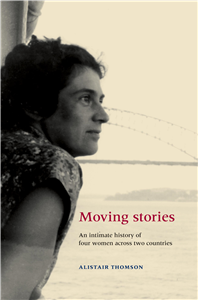
I'm not a good mother - not what Dr. Spock calls a "slow mother" who leaves her chores to make sure junior gets the right treatment. (Dorothy Wright, 1961) I must admit that I am no longer the same person who was tied to the kitchen sink at home. (Phyllis Cave, 1973) This book represents a unique collaboration between a historian and four ordinary women who were extraordinary letters-writers, family photographers and memoirists. As British migrants to Australia these women recorded in intimate detail aspects of everyday life and women's experience that are often lost to history: childcare and housework, housing and domestic appliances, friendship, family and married life. Taken together, their stories enrich and complicate our understanding of key themes in twentieth century women's history. This book will appeal to students and academics interested in British and Australian social history, oral history, women's studies and the lived experience of migration. ;
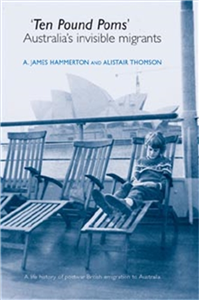
More than a million Britons emigrated to Australia between the 1940s and 1970s. They were the famous 'ten pound Poms' and this is their story. Illuminated by the fascinating testimony of migrant life histories, this is the first substantial history of their experience and fills a gaping hole in the literature of emigration. The authors, both leading figures in the fields of oral history and migration studies, draw upon a rich life history archive of letters, diaries, personal photographs and hundreds of oral history interviews with former migrants, including those who settled in Australia and those who returned to Britain. They offer original interpretations of key historical themes, including: motivations for emigration; gender relations and the family dynamics of migration; the 'very familiar and awfully strange' confrontation with the new world; the anguish of homesickness and return; and the personal and national identities of both settlers and returnees, fifty years on. Accessible and appealing, this book will engage readers interested in British and Australian migration history and intrigued about the significance of migrant memories for individuals, families and nations.
 Trusted Partner
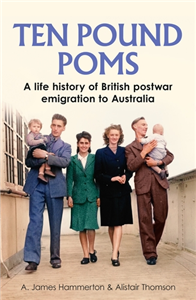
A riveting history of the 'Ten Pound Poms', a wave of British citizens who migrated to Australia and New Zealand after the Second World War. Between the 1940s and 1970s, more than a million Britons migrated to Australia. They were the famous 'Ten Pound Poms' and this is their story. The authors draw on a vast trove of letters, diaries and personal photographs, as well as hundreds of interviews with former migrants, to offer original insights into key historical themes. They explore people's motivations for emigrating, gender relations and family dynamics, the clashing experience of the 'very familiar and awfully strange', homesickness and the personal and national identities of both settlers and returnees. Filled with fascinating testimonies that shed light on migrant life histories, 'Ten Pound Poms' will engage readers interested in British and Australian migration history and intrigued about the power of migrant memories for individuals, families and nations.
Trusted Partner
Trusted Partner
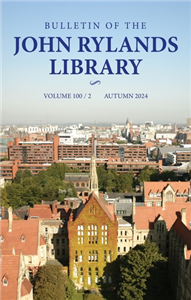
The John Rylands Library houses one of the finest collections of rare books, manuscripts and archives in the world. The collections span five millennia, have a global reach and cover a wide range of subjects, including art and archaeology; economic, social, political, religious and military history; literature, drama and music; science and medicine; theology and philosophy; travel and exploration. For over a century, the Bulletin of the John Rylands Library has published research that complements the Library's special collections.
Trusted Partner
Trusted Partner
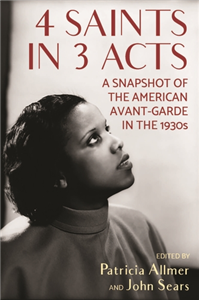
Four Saints in Three Acts by Gertrude Stein and Virgil Thomson was a major avant-garde phenomenon of the 1930s, an experimental opera that nonetheless achieved remarkable popular success. Photography was a key element of that success, but its complex roles in the construction, representation and dissemination of the opera have hitherto received little critical attention. The photographic recording of the all-African American cast in particular affords a unique insight into the complexities of Four Saints in relation to the Harlem Renaissance and the New York avant-gardes of the time. This book, published in collaboration with The Photographers' Gallery, London, presents a wide selection of photographs of the cast, performances, and other material - many images reproduced for the first time - alongside essays by an international range of scholars exploring different aspects of the opera, including dance, fashion, music, and avant-garde writing, as well as photography.
Trusted Partner

Carol Reed is one of the truly outstanding directors of British cinema, and one whose work is long overdue for reconsideration. This major study ranges over Reed's entire career, combining observation of general trends and patterns with detailed analysis of twenty films, both acknowledged masterpieces and lesser-known works. Evans avoids a simplistic auteurist approach, placing the films in their autobiographical, socio-political and cultural contexts and relating these to the analysis of Reed's art. The critical approach combines psychoanalysis, gender theory, and the analysis of form. Archival research is also relied on to clarify Reed's relations with his creative team, financial backers and others. Films examined include Bank Holiday, A Girl Must Live, Odd Man Out, The Fallen Idol, The Third Man, Night Train to Munich, The Way Ahead, Outcast of the Islands, Trapeze and Oliver!.
Trusted Partner
Trusted Partner

The Arctic region has been the subject of much popular writing. This book considers nineteenth-century representations of the Arctic, and draws upon an extensive range of evidence that will allow the 'widest connections' to emerge from a 'cross-disciplinary analysis' using different methodologies and subject matter. It positions the Arctic alongside more thoroughly investigated theatres of Victorian enterprise. In the nineteenth century, most images were in the form of paintings, travel narratives, lectures given by the explorers themselves and photographs. The book explores key themes in Arctic images which impacted on subsequent representations through text, painting and photography. For much of the nineteenth century, national and regional geographical societies promoted exploration, and rewarded heroic endeavor. The book discusses images of the Arctic which originated in the activities of the geographical societies. The Times provided very low-key reporting of Arctic expeditions, as evidenced by its coverage of the missions of Sir John Franklin and James Clark Ross. However, the illustrated weekly became one of the main sources of popular representations of the Arctic. The book looks at the exhibitions of Arctic peoples, Arctic exploration and Arctic fauna in Britain. Late nineteenth-century exhibitions which featured the Arctic were essentially nostalgic in tone. The Golliwogg's Polar Adventures, published in 1900, drew on adult representations of the Arctic and will have confirmed and reinforced children's perceptions of the region. Text books, board games and novels helped to keep the subject alive among the young.
Trusted Partner
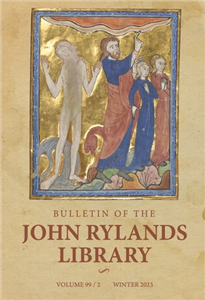
The John Rylands Library houses one of the finest collections of rare books, manuscripts and archives in the world. The collections span five millennia and cover a wide range of subjects, including art and archaeology; economic, social, political, religious and military history; literature, drama and music; science and medicine; theology and philosophy; travel and exploration. For over a century, the Bulletin of the John Rylands Library has published research that complements the Library's special collections. The editors invite the submission of articles in these fields and welcome discussion of in-progress projects.
Trusted Partner
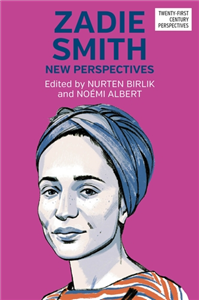
Zadie Smith's fiction reimagines subjectivity, relationality, and the conditions of contemporary life. This book offers a timely reassessment of her work, addressing identity, urban experience, and the category of the human. Moving beyond postcolonial and multiculturalist readings, it brings psychoanalytic, historical, symptomatic, and cultural materialist perspectives to bear across her novels, stories, essays, and plays. The collection explores how Smith's characters, shaped by diverse backgrounds and settings, challenge fixed ideas of Britishness and personhood. It argues that her writing opens up a new ontological space-defined by fluid identities, shifting subjectivities, and evolving forms of relationality. By reconsidering both the human and the spatial in Smith's work, the book makes a valuable contribution to contemporary literary criticism and to current thinking on narrative, identity, and urban life.
Trusted Partner
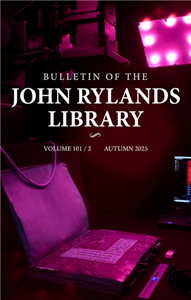
The John Rylands Library houses one of the finest collections of rare books, manuscripts and archives in the world. The collections span five millennia, have a global reach and cover a wide range of subjects, including art and archaeology; economic, social, political, religious and military history; literature, drama and music; science and medicine; theology and philosophy; travel and exploration. For over a century, the Bulletin of the John Rylands Library has published research that complements the Library's special collections. An electronic edition of this issue is freely available under a Creative Commons (CC BY-NC-ND) licence.
Trusted Partner

 Trusted Partner


Mögen Sie Rosenkohl? Lieben Sie Brokkoli? Oder ist Fleisch Ihr Gemüse? Dass die Geschmäcker verschieden sind, ist eine Binsenweisheit. Aber nirgendwo sind die Vorlieben und Abneigungen so ausgeprägt wie beim Essen und so immun gegen gute Argumente. Nicht nur Eltern wissen davon ein Lied zu singen. Warum ist das so? Und was können wir tun, um anders, besser, zu essen? Bee Wilson hat sich auf eine spannende Reise zu den Ursprüngen unserer Ernährungsgewohnheiten begeben, mit der neuesten Forschungsliteratur sowie ihren eigenen Erfahrungen als Mutter von drei Kindern im Gepäck. Sie hat mit Psychologen und Ernährungsexperten gesprochen, Schulkantinen besucht und zahlreiche »Essbiographien« zusammengetragen. Das Ergebnis ist so lehrreich wie ermutigend: Geschmack ist kein Schicksal. Welche Speisen wir mögen, ob wir essen wie ein Spatz oder wie ein Scheunendrescher, ist uns nicht in die Wiege gelegt. Wir lernen es, und zwar in der Kindheit, am Esstisch der Familie, unter Einfluss zahlreicher Faktoren. Und wir können umlernen. Bee Wilson zeigt uns in ihrem neuen Buch, wie das geht, ohne dabei aus den Augen zu verlieren, was vielleicht das Wichtigste ist: die Freude am Essen.
Trusted Partner
Trusted Partner
Trusted Partner
This textbook covers over three centuries of British business history from 1720 to the present day. Wilson argues that company culture has been the most important component in the evolution of business organisations and management practices. The influence of business culture on firms' structure, sources of finance, and the background and training of senior managers are investigated to show its pivotal importance in determining business performance. The book also examines how British business adapted to changing economic, institutional and socio-cultural environments yet failed to develop the kind of managerial hierarchies typified by American and German corporations. Wilson uses an extensive number of case studies to support his conclusions. The book covers the subject chronologically with an extra chapter comparing Britain's experience with the USA, Germany and Japan. ;
Trusted Partner
Trusted Partner



