
Cassava Republic Press
Cassava Republic Presswas founded with the aim of bringing high quality fiction and non-fiction for adults and children alike to a global audience.
View Rights Portal
Cassava Republic Presswas founded with the aim of bringing high quality fiction and non-fiction for adults and children alike to a global audience.
View Rights Portal
Welcome to Kynos, Germany’s dog book specialists. We have been publishing books on dog training, dog behaviour, dog breeds, handling, sports, nutrition, health and other aspects of dog handling since 1980. Our aim is to provide reliable, up-to-date and useful information to both dog owners and dog professionals. We carefully select our authors for their expertise and the use of dog-friendly methods only that are based on scientific knowledge on learning behaviour. Our backlist counts approx. 250 titles and is expanding constantly with 10-12 new books each year. With its revenues from the book sales, we support the charity Kynos Stiftung Hunde helfen Menschen dedicated to the training of assistance dogs.
View Rights Portal

 Trusted Partner
Trusted Partner
Trusted Partner
Trusted Partner
Trusted Partner
Trusted Partner
Trusted Partner


Anfang 1968: Gudrun Ensslin verläßt Bernward Vesper und zieht mit ihrem sieben Monate alten Sohn Felix zu Andreas Baader. Bald darauf brennen in Frankfurt zwei Kaufhäuser; Baader, Ensslin, Horst Söhnlein und Thorwald Proll werden als mutmaßliche Brandstifter verhaftet, Felix ist bei Vesper, die Geschichte der RAF nimmt ihren Lauf. In kaum einem anderen Dokument kommt man ihrer Entstehung so nah wie in den hier erstmals vollständig veröffentlichten Briefen, die Vesper und Ensslin bis zu ihrer bedingten Freilassung und Flucht Mitte 1969 gewechselt haben. Nach allen Glorifizierungen und Pathologisierungen, Verfilmungen und Deutungen besteht nun die Möglichkeit, sich am Original ein eigenes Urteil zu bilden, Epochales und Banales, Mythos und Historie unvoreingenommen zu sondieren und einen großen, tragischen Liebes-Brief-Roman zu entdecken, der zugleich Realität war.
Trusted Partner
Trusted Partner


There are many things in life that we are (more or less) free to choose: our circle of friends, our workplace, our place of residence. However, we have to take some communities as they come: We cannot choose our family or our neighbours, for example. Why this does not only lead to the much-vaunted idyllic sense of belonging and what tensions forced social relationships can cause: This is the subject of this fascinating collection of essays by Bernd Imgrund. It sheds light on a piece of social history that we all know from our own experience: who hasn't had an argument with their immediate neighbour or made fun of the residents of the neighbouring district? But it is by no means only negative aspects that characterise neighbourly relations. Pride in one's neighbourhood, help within a village community: the many advantages of a social community, its importance and its representation in art and literature have also found their way into this book.
Trusted Partner
 Trusted Partner
Trusted Partner
Trusted Partner
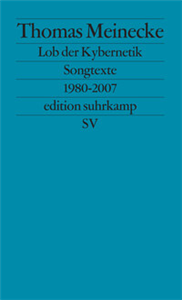
»Heute Disco, morgen Umsturz, übermorgen Landpartie«: Die Band Freiwillige Selbstkontrolle (F.S.K.) betreibt Pop als mobile Anpassung, Camp, dissidente Störung aus unerwarteter Position – und singt auf deutsch. Thomas Meinecke, der sich lange als Nicht-Autor und Nicht-Musiker bezeichnete, schreibt die Texte. Sie sind schräg, bewußt schief und in sich gebrochen genug, um nach 27 Jahren Konzertgebrauch auch alleine stehen zu können. Lyrics: nicht zu verwechseln mit Lyrik. Sie spiegeln die Entwicklung der Band wider, von der subversiven Affirmation und dem Hippie Bashing der Anfängerjahre (»und wir sagen Ja zur Modernen Welt«) über Polka- und Jodel-Transatlantik-Rück-Rück-Übersetzungsspiele (»Wenn du einmal in Liebe bist«) und die wilde Zitathölle bis hin zum Text als quere Metaebende oder Bildunterschrift zur repetitiven analog-handgemachten House-Musik (»Dana International / Arabian Boy a Jewish Girl / gewann den Grand Prix de la Chanson / in eurovisueller Dekonstruktion«). In seinem Nachwort erläutert der Literaturwissenschaftler Eckhard Schumacher die Band- und Text-Prinzipien der permanenten Revolte, der Verfremdung durch Authentizität und des transatlantischen Folklore-Feedback.
Trusted Partner
Trusted Partner
Trusted Partner
Trusted Partner
Trusted Partner
Trusted Partner
Trusted Partner
Trusted Partner

»Zum irdischen Frieden« will jene Erkenntnisse aufbereiten, die für ein zeitgemäßes und differenziertes Verständnis der gegenwärtigen Friedensproblematik von Bedeutung sind. In Beantwortung der Frage, wie und wodurch sich Frieden unter den komplexen Bedingungen der Gegenwart konstituiert, entfaltet Senghaas Definitivbestimmungen zum Frieden, die im Modell des sogenannten »zivilisatorischen Hexagon« ihren Ausdruck finden. Er diskutiert Einwände gegen dieses Modell und vertieft im letzten Teil besondere Aspekte wie Friedenszonen, Implikationen für die Friedenspolitik und die Problematik eines interkulturellen Dialogs unter den Bedingungen der Globalisierung.
Trusted Partner


