
Hunan Literature and Art Publishing House
Publisher of fine Literature and Art books from China.
View Rights Portal
Publisher of fine Literature and Art books from China.
View Rights Portal
People’s Literature Publishing House Co., Ltd., currently a member of China Publishing Group Corporation, is the first and the largest professional national publishing institution in China. Founded in 1951, PLPH has published a vast number of quality literary works, from all time classics to the latest titles, by domestic writers and translated from other languages. PLPH enjoys a great amount of exclusive publishing resources, a high reputation among readers and was awarded many times with national literary and publishing prizes. Along with regular editing and production departments, it has a sub brand, Daylight Publishing, specializing in children’s book and five magazines and journals. We publish over a thousand titles each year, sharing outstanding literary works in a global platform. All-time classics such as the complete works of Shakespeare, Balzac, Tolstoy, Dostoevsky, Kafka, Hemingway, Sartre, and international bestsellers such as Harry Potter series are all introduced to Chinese readers by PLPH.
View Rights Portal
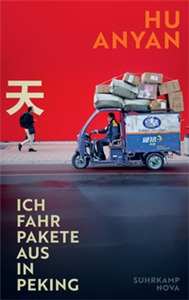
In den zwanzig Jahren nach seinem Highschool-Abschluss hatte Hu Anyan neunzehn verschiedene Jobs. Er arbeitete unter anderem als Verkäufer im 24h-Markt, als Fahrradmechaniker, Pakete-Kurier, Sicherheitsmann, im Logistikzentrum, der Tankstelle, der Kantinenküche. Er zog von einer chinesischen Großstadt zur nächsten, jedes Mal weiter, wenn die Arbeit unerträglich und der Boss zu bossy wurde, und richtete sich wieder in einem winzigen Zimmer ein, mit nicht mehr als seinen zerlesenen Ausgaben von Tschechow und Carver. Von der Psychologie der Hackordnung in einer gigantischen Sortierhalle für Pakete über die kafkaeske Bürokratie der Personalabteilungen bis hin zur idealen Gestaltung einer Lieferroute – mit aufrichtiger Neugier und trockenem Humor erzählt Hu Anyan unerhörte Geschichten der Menschlichkeit vor dem Hintergrund größter Schinderei. Ich fahr Pakete aus in Peking ist ein intimer Bericht über ein Leben als Niedriglohnarbeiter in den anonymen Megastädten des heutigen China. Und gibt zum ersten Mal den Blick frei auf die Massen, die von den gesellschaftlichen Realitäten, von der Art des Wirtschaftens, von der Staatsgewalt, an den Rand, in die Armut, ins Vergessen gedrängt werden.

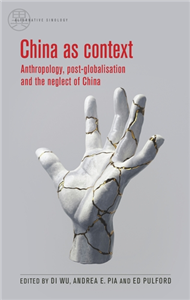
Decades-old calls to promote the significance of China for anthropological theory and the social sciences more generally ring more urgently today given China's importance to social, political and economic life globally. Yet Chinese-grounded ideas remain marginal to the discipline, and scholarly discussions retain a sense of China as an 'Other' apart from the 'real' world, and thus unsuitable or generating widely applicable theoretical ideas. Inspired by East Asian postcolonial scholarship, this volume tackles this unsettling situation head-on, arguing that without taking China seriously as a powerful agent, a locus of knowledge production, and a new discursive topos of an emerging post-global imaginary, anthropologists and other social scientists may fail to adequately analyse the global present and make sense of both the material and immaterial forces that animate it, wherever and however they work. Amid the end of Western globalisation and shifting anthropological understandings of relations between ethnography and theory, we show how 'China' must be understood as the ordinary 'context' for anthropological research practices worldwide.
 Trusted Partner
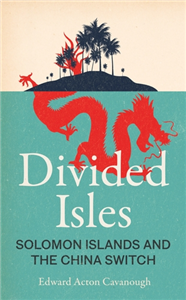
In 2019, Solomon Islands made international headlines when the country severed its decades-old alliance with Taiwan in exchange for a partnership with Beijing. The decision prompted international condemnation and terrified Australian security experts, who feared Australia's historical Pacific advantage would come unstuck. This development is often framed as another example of China's inevitable capture of the region - but this misrepresents how and why the decision was made, and how Solomon Islanders have skilfully leveraged global angst over China to achieve extraordinary gains. Despite Solomon Islands' importance to Australia, local readers know little about the country, a fragile island-nation stretching over a thousand islands and speaking seventy indigenous languages. In Divided Isles, Edward Cavanough explains how the switch played out on the ground and its extraordinary potential consequences. He speaks with the dissidents and politicians who shape Solomon Islands' politics, and to the ordinary people whose lives have been upended by a decision that has changed the country - and the region - forever.
Trusted Partner

This is a study of Britain's presence in China both at its peak, and during its inter-war dissolution in the face of assertive Chinese nationalism and declining British diplomatic support. Using archival materials from China and records in Britain and the United States, the author paints a portrait of the traders, missionaries, businessmen, diplomats and settlers who constituted "Britain-in-China", challenging our understanding of British imperialism there. Bickers argues that the British presence in China was dominated by urban settlers whose primary allegiance lay not with any grand imperial design, but with their own communities and precarious livelihoods. This brought them into conflict not only with the Chinese population, but with the British imperial government. The book also analyzes the formation and maintenance of settler identities, and then investigates how the British state and its allies brought an end to the reign of freelance, settler imperialism on the China coast. At the same time, other British sectors, missionary and business, renegotiated their own relationship with their Chinese markets and the Chinese state and distanced themselves from the settler British.
Trusted Partner

This topical and innovative study is the first book on Algerian cinema to be published in English since the 1970s. At a time when North African and Islamic cultures are of increasing political significance, Algerian National Cinema presents a dynamic, detailed and up to date analysis of how film has represented this often misunderstood nation. Algerian National Cinema explores key films from The Battle of Algiers (1966) to Mascarades (2007). Introductions to Algerian history and to the national film industry are followed by chapters on the essential genres and themes of filmmaking in Algeria, including films of anti-colonial struggle, representations of gender, Berber cinema, and filming the 'black decade' of the 1990s. This thoughtful and timely book will appeal to all interested in world cinemas, in North African and Islamic cultures, and in the role of cinema as a vehicle for the expression of contested identities. By the author of the critically-acclaimed Contemporary French Cinema.
Trusted Partner

This topical and innovative study is the first book on Algerian cinema to be published in English since the 1970s. At a time when North African and Islamic cultures are of increasing political significance, Algerian National Cinema presents a dynamic, detailed and up to date analysis of how film has represented this often misunderstood nation. Algerian National Cinema explores key films from The Battle of Algiers (1966) to Mascarades (2007). Introductions to Algerian history and to the national film industry are followed by chapters on the essential genres and themes of filmmaking in Algeria, including films of anti-colonial struggle, representations of gender, Berber cinema, and filming the 'black decade' of the 1990s. This thoughtful and timely book will appeal to all interested in world cinemas, in North African and Islamic cultures, and in the role of cinema as a vehicle for the expression of contested identities. By the author of the critically-acclaimed Contemporary French Cinema.
Trusted Partner
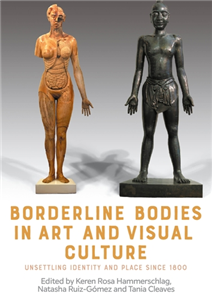
Borderline bodies offers original interpretations of visual representations of human bodies as bounded and unbounded, fortified and permeable, mobile and static-subject to borders and able to traverse and challenge them. It also takes as its focus images and objects that might be considered 'borderline' because they sit at the intersection of disciplines or sit outside accepted notions of what constitutes serious 'art.' By mapping the ways human bodies traverse borders and straddle-even dismantle-categories, this volume's essays approach afresh the relationship of bodies to traditional modes of representation, especially in art and medicine, and encourage us to think anew about how we understand the relationship between human corporeality, identity and place. Critical transdisciplinary and transnational analyses of objects and images from a range of geographies shed new light on the themes of: bodies and identity; typologies of the body; racialised bodies; 'normal' and 'abnormal' bodies; encounters between bodies; bodies in transition; bodies and mobility; and the bounded and unbounded human body. The outcome is a fresh approach to depictions of the human body produced for the purposes of artistic and medical education, aesthetic edification, and scientific and professional advancement, which disrupts assumptions about the normative human body perpetuated through Western image-making traditions.
Trusted Partner
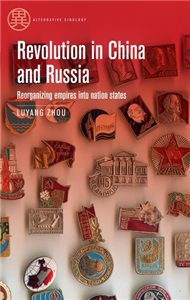
Most scholars believe that China's nationality policy, like that of other socialist states, imitated the Soviet nationality model, a system which has been termed an "affirmative action empire." This book offers two contributions to the literature which run counter to this convention. First, it argues that the People's Republic of China (PRC) and the Soviet Union (USSR) were different; while the PRC was aimed to build an ideal-typical nation-state, the USSR was an open union of nation-states that was only temporarily confined to a physical territory. Second, while scholars who have noted this difference attribute it to contextual factors, such as ethnic structure, geopolitical status, and Russia's intervention into the Chinese Revolution, this book contends that context shaped the Sino-Soviet difference, yet it did not determine it. Rather, there was significant leeway between the implications of the contextual factors, and what the policy-designers ultimately established. This book probes who held agency, and how these individuals bridged this gap.
Trusted Partner
This volume explores the characteristics of the art and literature of the Second Empire in France; it examines the attitudes and positioning of artists and writers of the period in relation to a regime of dubious legitimacy, and the ways in which that regime exploited to its advantage the artistic capital available to it. ;
Trusted Partner
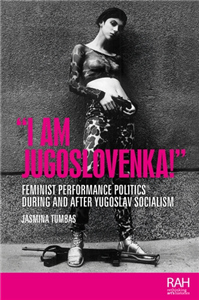
"I am Jugoslovenka" argues that queer-feminist artistic and political resistance were paradoxically enabled by socialist Yugoslavia's unique history of patriarchy and women's emancipation. Spanning performance and conceptual art, video works, film and pop music, lesbian activism and press photos of female snipers in the Yugoslav wars, the book analyses feminist resistance in a range of performative actions that manifest the radical embodiment of Yugoslavia's anti-fascist, transnational and feminist legacies. It covers celebrated and lesser-known artists from the 1970s to today, including Marina Abramovic, Sanja Ivekovic, Vlasta Delimar, Tanja Ostojic, Selma Selman and Helena Janecic, along with music legends Lepa Brena and Esma Redzepova. "I am Jugoslovenka" tells a unique story of women's resistance through the intersection of feminism, socialism and nationalism in East European visual culture.
Trusted Partner
 Trusted Partner
Trusted Partner
Trusted Partner
Trusted Partner
Trusted Partner
Trusted Partner
Trusted Partner
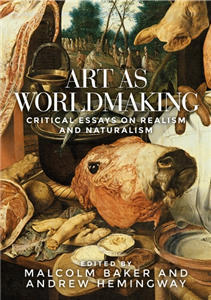
Art as worldmaking is a response to Alex Potts's provocative 2013 book Experiments in modern realism. Twenty essays by leading scholars test Potts's recasting of realism through examinations of art produced in different media and periods, ranging from eighth-century Chinese garden aesthetics to video work by the contemporary Russian collective Radek Community. While the book does not neglect avatars of pictorial realism such as Menzel and Eakins, or the question of nineteenth-century realism's historical antecedents, it is contemporary in orientation in that many contributors are particularly concerned with the questions that sculpture, photography and non-traditional media pose for realism as an aesthetic norm. It will be essential reading for students of art history concerned with art's truth value or more broadly with conceptual problems of representation and the intersections of art and politics.
Trusted Partner
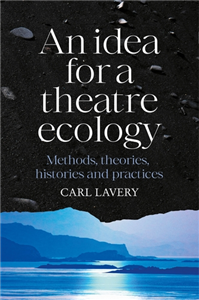
An Idea for a Theatre Ecology is the first book in the discipline of Theatre and Performance Studies to provide a rigorous and coherent theory of the ecology that is immanent to the theatrical medium. Over six clearly written chapters, the book provides a genealogy, outlines a method, provides a lexicon and demonstrates an alternative practice of ecoperformance analysis grounded in the figure of the archipelago. Focusing on Antonin Artaud's theatre of cruelty, the book argues that theatre has no need to provide ecological messages nor to transform itself into a platform for the narration of ecological stories. Instead, more is to be gained, environmentally and politically, by concentrating on the power of images, gestures and voices to create corporeal affects and sensations that implicate the spectators in a terrestrial event.
Trusted Partner

Death in modern theatre offers a unique account of modern Western theatre, focusing on the ways in which dramatists and theatre-makers have explored historically informed ideas about death and dying in their work. It investigates the opportunities theatre affords to reflect on the end of life in a compelling and socially meaningful fashion. In a series of interrelated, mostly chronological, micronarratives beginning in the late nineteenth century and ending in the early twenty-first century, this book considers how and why death and dying are represented at certain historical moments using dramaturgy and aesthetics that challenge audiences' conceptions, sensibilities, and sense-making faculties. It includes a mix of well-known and lesser-known plays from an international range of dramatists and theatre-makers, and offers original interpretations through close reading and performance analysis.
Trusted Partner
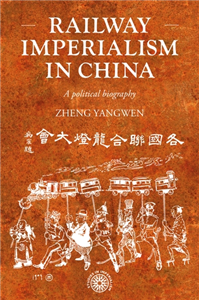
Railway Imperialism in China: a Political Biography is the first and most comprehensive book on history and politics of all major railways in China from the late Qing to the post-Mao era. It investigates the transformation of railways from a bête noire within discussions about reform to the emblematic "engines for empire" as foreign powers used it to carve outspheres of control and exploit the late Qing, and as an instrument of nation making for Chinese regimes. The book introduces new archival sources and a wide range of secondary materials. Boldly conceived, it situates the making of modern China in the context of British, Russian, German, Japanese, American expansion. It traces China's transformation from a victim of railway imperialism in the Age of Empireto a railway expansionist in the twenty-first century.
Trusted Partner
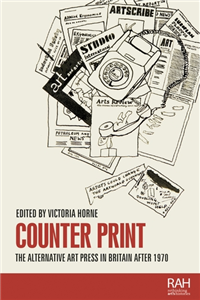
The history of contemporary art is also a history of its newsletters, manifestos, magazines, pamphlets, and journals. Those periodical publications do not simply communicate or record ideas but have worked in exciting ways to shape art's practices, histories and communities. As a new generation of artists, activists and scholars seek to uncover the histories of alternative publishing and artistic networks, this book gathers original archival discoveries while offering methodologies for studying and thinking with those artefacts. As the first essay collection to focus on the periodical art press and the ways we study it, Counter print offers readers an alternative route into the past fifty years of contemporary art, one that is defiantly collaborative, border crossing and disruptive.
Trusted Partner



