
Sprotin
Sprotin has grown intentionally and steadily into one of the major publishers in the Faroes.
View Rights Portal
Sprotin has grown intentionally and steadily into one of the major publishers in the Faroes.
View Rights Portal
Bernd Liske, born in 1956, studied mathematics in Chemnitz and is the owner of Liske information management systems. From its founding in 1998 until May 2015, Bernd Liske was a member of the main board of BITKOM, where he worked in the defense, education and knowledge management working groups. In the course of his efforts to deal with the revelations of Edward Snowden in the NSA affair, he was expelled from BITKOM in 2015. From 1998 to 2003 he was a member of the board of the Association of Organizations and Information Systems (VOI). Bernd Liske has been dealing with socio-political issues for many years. In his analyzes and concepts, he deals with social, political and economic problems in our society in order to make contributions to maintaining Germany as a business location. His book “PRISM A Lesson for our Democracy”, published in September, grew out of this. The diversity of the topics he deals with as well as the systemic principles used for their treatment can be followed on his homepage at and on his TWITTER channels @BerndLiske, @LiskeAphorismen and @LiskeZitate. He now regards his aphorisms as an open source operating system for the analysis and design of social processes and has been using them successfully for years.
View Rights Portal Trusted Partner
Trusted Partner
Trusted Partner
Trusted Partner
Trusted Partner
Trusted Partner
Trusted Partner
Trusted Partner
Trusted Partner
Trusted Partner
Trusted Partner


The book introduces the psychology of disaster scenarios, taking into account national and international research. The title outlines different concepts, like anguish, stress, and resilience, and highlights the importance of psychosocial attention to minimize the consequences of disastrous situations and maintaining good mental health. The book consists of a foreword and four chapters, which include a technical note from the Federal Counsel of Psychology, the main concepts of risk and disaster management, and information on the official agencies and nonprofit organizations that work with disaster risks reduction. Target Group: clinical psychologists, mental health professionals, psychiatrists, students, and teachers
Trusted Partner


This work provides the first complete English translation of works by Toledan archbishop Rodrigo Ximénez de Rada (1170-1247 CE), whose 'Minor Histories' are sequels to his larger 'Gothic History' and thus round off his grand history of Spain project that he began at the request of King Ferdinand III. The 'Minor Histories' include Rodrigo's 'History of the Arabs' that can be considered the first surviving Western monograph focused on Arab and Islamic history and thus occupies a unique position in the medieval Latin corpus of writings. In addition to the translation, this book provides a thorough and accessible introduction to the life and works of Rodrigo, making sense of the context in which he wrote and his historical method. The translations are thoroughly annotated including cross-references to other Latin and Arabic sources for comparison.
Trusted Partner

One in five children in a kindergarten class is at risk for mental health problems. By making a diagnosis as early as possible, the child may receive targeted support and be strengthened in his or her further development. This textbook aims at increasing competence in the expert treatment of mental disorders and behavioral problems in early childhood. After a compact presentation of child development in the first six years of life, possible clinical disorders are presented, stringently structured according to classification, prevalence, causes, diagnosis, and therapy. The disorders that are covered in this book include autism spectrum disorders, ADHD, anxiety and obsessive-compulsive disorders, affective disorders, sleep, eating, and crying disorders, trauma, stress, and deprivation disorders, and attachment and relationship disorders of early childhood.
Trusted Partner
Trusted Partner
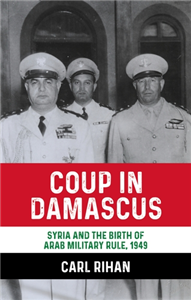
Coup in Damascus is a history of Syria's first military regime. It plots the the fall of Syria's democracy and the rise of its military rulers, particularly Husni al-Zaim, whose brief rule in 1949 represented a profoundly transformative moment for the Syrian nation. It is a history of the thoughts, intentions and motives of political actors underpinning the events that have marked Syria's history after the first Arab-Israeli war, and focuses mainly on the interaction between local, regional and international actors. Unlike most histories of the modern Middle East that tackle broad intervals and that focus on the sequences of events, this history seeks to reconstruct the thought processes behind the events, and anchor them within the epoch's existing political and socioeconomic conditions. It draws on several methodological influences, particularly R.G. Collingwood's 'history as re-enactment of the past'.
Trusted Partner
Trusted Partner
Trusted Partner
Trusted Partner
Trusted Partner
Trusted Partner
Trusted Partner
Trusted Partner



