
ZNN Network Literary and Illustrator Agency
- International Copyright, Licensing, and Literary Agency - International Illustrator Agency and Management Services - Creative Content Development Services
View Rights Portal
- International Copyright, Licensing, and Literary Agency - International Illustrator Agency and Management Services - Creative Content Development Services
View Rights Portal
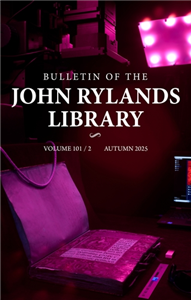
The John Rylands Library houses one of the finest collections of rare books, manuscripts and archives in the world. The collections span five millennia, have a global reach and cover a wide range of subjects, including art and archaeology; economic, social, political, religious and military history; literature, drama and music; science and medicine; theology and philosophy; travel and exploration. For over a century, the Bulletin of the John Rylands Library has published research that complements the Library's special collections. An electronic edition of this issue is freely available under a Creative Commons (CC BY-NC-ND) licence.
 Trusted Partner

The John Rylands Library houses one of the finest collections of rare books, manuscripts and archives in the world. The collections span five millennia, have a global reach and cover a wide range of subjects, including art and archaeology; economic, social, political, religious and military history; literature, drama and music; science and medicine; theology and philosophy; travel and exploration. For over a century, the Bulletin of the John Rylands Library has published research that complements the Library's special collections. An electronic edition of this issue is freely available under a Creative Commons (CC BY-NC-ND) licence.
Trusted Partner
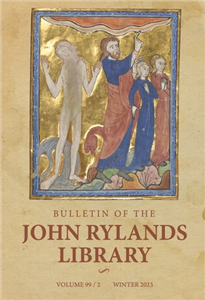
The John Rylands Library houses one of the finest collections of rare books, manuscripts and archives in the world. The collections span five millennia and cover a wide range of subjects, including art and archaeology; economic, social, political, religious and military history; literature, drama and music; science and medicine; theology and philosophy; travel and exploration. For over a century, the Bulletin of the John Rylands Library has published research that complements the Library's special collections. The editors invite the submission of articles in these fields and welcome discussion of in-progress projects.
Trusted Partner
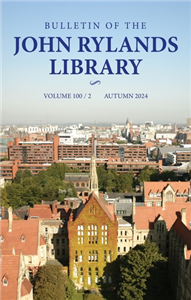
The John Rylands Library houses one of the finest collections of rare books, manuscripts and archives in the world. The collections span five millennia, have a global reach and cover a wide range of subjects, including art and archaeology; economic, social, political, religious and military history; literature, drama and music; science and medicine; theology and philosophy; travel and exploration. For over a century, the Bulletin of the John Rylands Library has published research that complements the Library's special collections.
Trusted Partner
 Trusted Partner


Nach seinen sprachphilosophischen Arbeiten ('Sprechakte', stw 458; 'Ausdruck und Bedeutung', stw 349) hat John R. Searle mit 'Intentionalität' eine Untersuchung zu einem Kernstück der Philosophie des Geistes vorgelegt, die in einem engen thematischen Zusammenhang mit den früheren Arbeiten steht. Intentionalität ist nach Searles Auffassung die Basis sprachlicher Bedeutung. In seiner Theorie der Intentionalität geht es um die begrifflichen Eigenschaften intentionaler Zustände (auf die Frage nach ihrem ontologischen Status geht er ausführlicher ein in 'Geist, Hirn und Wissenschaft', stw 591). Zwei Aspekte stehen dabei im Vordergrund der Untersuchung: die Logik der Repräsentation und der Kausalität intentionaler Zustände. Doch Searle entwickelt in dieser Arbeit nicht nur eine Theorie der Intentionalität und des Zusammenhangs zwischen sprachlichem und geistigem Inhalt. In einem vornehmlich kritischen Teil setzt er sich ausführlich mit konkurrierenden Auffassungen aus dem Bereich der analytischen Philosophie auseinander, insbesondere mit derzeit sehr einflußreichen 'nicht-deskriptivistischen' Theorien des Bezugs, wie sie von S. Kripke, H. Putnam, K. Donnellan, T. Burge und D. Kaplan vertreten und angeregt wurden.
Trusted Partner
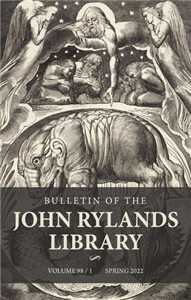
This special issue of the Bulletin of the John Rylands Library is devoted to William Blake. It explores the British and European reception of Blake's work from the late nineteenth century to the present day, with a particular focus on the counterculture. Opening with two articles by the late Michael Horovitz, an important figure in the 'Blake Renaissance' of the 1960s, the issue goes on to investigate the ideological struggle over Blake in the early part of the twentieth century, with particular reference to W. B. Yeats. This is followed by articles on the artistic avant-garde and underground of the 1960s and on Blake's significance for science fiction authors of the 1970s. The issue closes with an article on the contemporary Belgian art collective maelstrÖm reEvolution.
Trusted Partner
 Trusted Partner
Trusted Partner
Trusted Partner

Charles Dickens called his sister-in-law Georgina Hogarth his 'best and truest friend'. Georgina saw Dickens as much more than a friend. They lived together for twenty-eight years, during which time their relationship constantly changed. The sister of his wife Catherine, the sharp and witty Georgina moved into the Dickens home aged fifteen. What began as a father-daughter relationship blossomed into a genuine rapport, but their easy relations were fractured when Dickens had a mid-life crisis and determined to rid himself of Catherine. Georgina's refusal to leave Dickens and his desire for her to remain in his household led to rumours of an affair and even illegitimate children. He left her the equivalent of almost £1 million and all his personal papers in his will. Georgina's commitment to Dickens was unwavering but it is far from clear what he did to deserve such loyalty. There were several occasions when he misused her in order to protect his public reputation. Why did Georgina betray her once much-loved sister? Why did she fall out with her family and risk her reputation in order to stay with Dickens? And why did the Dickenses' daughter Katey say it was 'the greatest mistake ever' to invite a sister-in-law to live with a family?
Trusted Partner
The Arctic region has been the subject of much popular writing. This book considers nineteenth-century representations of the Arctic, and draws upon an extensive range of evidence that will allow the 'widest connections' to emerge from a 'cross-disciplinary analysis' using different methodologies and subject matter. It positions the Arctic alongside more thoroughly investigated theatres of Victorian enterprise. In the nineteenth century, most images were in the form of paintings, travel narratives, lectures given by the explorers themselves and photographs. The book explores key themes in Arctic images which impacted on subsequent representations through text, painting and photography. For much of the nineteenth century, national and regional geographical societies promoted exploration, and rewarded heroic endeavor. The book discusses images of the Arctic which originated in the activities of the geographical societies. The Times provided very low-key reporting of Arctic expeditions, as evidenced by its coverage of the missions of Sir John Franklin and James Clark Ross. However, the illustrated weekly became one of the main sources of popular representations of the Arctic. The book looks at the exhibitions of Arctic peoples, Arctic exploration and Arctic fauna in Britain. Late nineteenth-century exhibitions which featured the Arctic were essentially nostalgic in tone. The Golliwogg's Polar Adventures, published in 1900, drew on adult representations of the Arctic and will have confirmed and reinforced children's perceptions of the region. Text books, board games and novels helped to keep the subject alive among the young.
Trusted Partner

John Devine würde am liebsten abhauen. Raus aus Kilcody, dem irischen Provinznest, weg von seiner ewig besorgten, kettenrauchenden Mutter Lily, die ihn mit morbiden Bibelsprüchen erzieht. Doch dann tritt Jamey Corboy in sein Leben, ein Jahr älter, mehr Stil als ganz Kilcody zusammen, Rimbaud in der Manteltasche und gute Beziehungen zu finsteren lokalen Gangstern. Mit einem Mal ist Johns Leben voller Möglichkeiten – und voller Abgründe. Ich, John kombiniert einen hypnotischen Erzählstrom mit der unheimlichen Stimmung eines Tim-Burton-Films. - Coming of Age in der märchenhaften Atmosphäre der irischen Landschaft - Lesereise von Peter Murphy in Deutschland - „So erfrischend und originell, so aufwühlend und mutig! Ein absolut wunderbares Buch.“ Colm Tóibín
Trusted Partner

The irresistible story of a one-man cultural phenomenon. Minister for the Counterculture, Mancunian mainstay and alternative national treasure John Robb has lived a life in music. In this book he charts his adventures on the cultural frontline, chronicling the making of a DIY icon. Robb's quest began in his hometown of Blackpool - where punk was a battle against the odds - and went international when he toured the world with his band. The first person to interview Nirvana, he also discovered The Stone Roses for weekly newspaper Sounds and did early interviews with The Jesus and Mary Chain and The Manics, before moving on to legends such as Mark E. Smith, Nick Cave and Patti Smith. Along the way, he became an on-screen commentator and author of bestselling books. Robb's memoir tells of deep friendships with figures from Poly Styrene to Chris Packham. Packed with riotous stories, it provides an alternative account of British musical and cultural history and a triumphant blueprint for a punk rock life.
Trusted Partner
The John Rylands Library houses one of the finest collections of rare books, manuscripts and archives in the world. The collections span five millennia, have a global reach and cover a wide range of subjects, including art and archaeology; economic, social, political, religious and military history; literature, drama and music; science and medicine; theology and philosophy; travel and exploration. For over a century, the Bulletin of the John Rylands Library has published research that complements the Library's special collections.
Trusted Partner

Carol Reed is one of the truly outstanding directors of British cinema, and one whose work is long overdue for reconsideration. This major study ranges over Reed's entire career, combining observation of general trends and patterns with detailed analysis of twenty films, both acknowledged masterpieces and lesser-known works. Evans avoids a simplistic auteurist approach, placing the films in their autobiographical, socio-political and cultural contexts and relating these to the analysis of Reed's art. The critical approach combines psychoanalysis, gender theory, and the analysis of form. Archival research is also relied on to clarify Reed's relations with his creative team, financial backers and others. Films examined include Bank Holiday, A Girl Must Live, Odd Man Out, The Fallen Idol, The Third Man, Night Train to Munich, The Way Ahead, Outcast of the Islands, Trapeze and Oliver!.
Trusted Partner
Trusted Partner
Trusted Partner
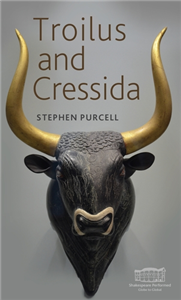
A history of Shakespeare's play in performance, from John Dryden's Restoration adaptation to the rediscovery of the play in the twentieth century. What made this play so relevant to audiences who had lived through the horrors of two world wars and the rise of fascism? Why did it speak so directly to the 'angry young men' of the post-war generation and to the countercultural movements of the 1960s? This book investigates the many ways in which modern directors and actors have found their own world reflected in the play, from anti-war protests and the sexual revolution to feminism and postcolonialism. In doing so, it explores the play's own complexity and its refusal to give easy answers.
Trusted Partner
This volume on Norman Italy (southern Italy and Sicily, c. 1000-1200) honours and reflects the pioneering scholarship of Graham A. Loud. An international group of scholars reassesses and recasts the paradigm by which Norman Italy has been conventionally understood, addressing varied subjects across four key themes: historiographies, identities and communities, religion and Church, and conquest. The chapters revise and refine our understanding of Norman Italy in the eleventh and twelfth centuries, demonstrating that it was not just a parochial Norman or Mediterranean entity but also an integral player in the medieval mainstream.



