
Your Search Results
-

-

RANOK Corporation
Ukrainian Publishing House “RANOK” founded in 1997 is prominent for its endless love for books and reading.
View Rights Portal
-
Promoted Content
-
Promoted Content

 June 2017
Wer, wenn nicht wir?
Vier Dinge, die wir jetzt für Europa tun können
by The Young European Collective
-
 Trusted Partner
-
Trusted Partner

 1988
1988Unser Körper - Unser Leben
The New Our Bodies, Ourselves. Ein Handbuch von Frauen für Frauen
by The Boston Women's Health Book Collective
-
Trusted Partner
 1981
1981Unsere Kinder - unser Leben
Ein Handbuch von Eltern für Eltern
by The Boston Women's Health Book Collective
-
Trusted Partner

 September 2011
In der Stille hörst du dich selbst
Meine 12 Jahre in einem Schweigekloster
by Pot, Miek / Übersetzt von Heitzer-Gores, Waltraud
-
Trusted Partner
-
Trusted Partner

 August 2019
Die Ökonomie des Alltagslebens
Für eine neue Infrastrukturpolitik
by Foundational Economy Collective, Stephan Gebauer, Wolfgang Streeck
Duschen, Radio an, Espressokanne auf den Herd, Kinder in die Kita, ab in die U-Bahn: Alle diese Handlungen, die wir für selbstverständlich halten, wären ohne komplexe Infrastruktur nicht möglich. Ähnliches gilt für Gesundheitsversorgung und Bildung, die ohne staatliche Investitionen in Gebäude und Personal nicht funktionieren würden. Doch in den vergangenen Jahrzehnten wurden in ganz Europa immer mehr Krankenhäuser, Schulen, Bahnstrecken oder gleich ganze Verkehrsnetze privatisiert und so der Profitlogik unterworfen – mit bisweilen dramatischen Folgen. Inzwischen wächst der Widerstand; in vielen Ländern formieren sich Bewegungen für eine Rekommunalisierung z. B. der Wasserversorgung. Was wir brauchen, so die Autorinnen und Autoren, ist eine neue, progressive Infrastrukturpolitik. Wir müssen die Ökonomie wieder als etwas begreifen, das zuallererst dem guten Leben der Bürgerinnen und Bürger verpflichtet ist.
-
Trusted Partner

 Humanities & Social SciencesApril 2025
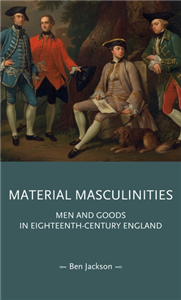
Material masculinities
Men and goods in eighteenth-century England
by Ben Jackson
Material Masculinities examines the material and consumer practices of over 1000 men from the middling and upper ranks of eighteenth-century society, c.1650-1850. It draws upon evidence from over 35 archives and museum collections to detail how material objects were integral for men in forming identities and shaping experiences. For men of all social ranks, ages, and geographic locations, material knowledge was imperative for masculine social identities to operate in a commercial society. Before the centralised factory and widespread mass-produced goods, men personalised and repaired their goods; products were shaped by men's attitudes and concerns. Objects were tools in men's identity formation and the exercise of social and gendered power. There was a reciprocal relationship between men and goods in this period; men were active agents of material and commercial change driving product and aesthetic innovation.
-
Trusted Partner
-
Trusted Partner
-
Trusted Partner
 April 2007
Der achtzehnte Brumaire des Louis Bonaparte
by Karl Marx, Hauke Brunkhorst
Die neue Reihe Suhrkamp Studienbibliothek ist ideal als erste Orientierung für Theorieeinsteiger und schafft eine fundierte Grundlage für Lektürekurse an Schulen und Universitäten. In informativer und leicht lesbarer Form erschließen die von renommierten Wissenschaftlerinnen und Wissenschaftlern stammenden Kommentare den historischen und theoretischen Hintergrund der Werke. Alle nötigen Informationen sind in kompakter und übersichtlicher Weise gebündelt.
-
Trusted Partner

 January 2016
Embodied Communication
by Maja Storch, Wolfgang Tschacher
The idea that people can understand each other is based on the assumption that there is such thing as the “correct” meaning of a message that simply needs to be found. According to the theory of embodied communication, however, a message has no fixed meaning that can be extracted or deciphered. There is merely the mutually produced feeling of agreement on a linguistic form, which arises spontaneously and anew from the interaction and which is not present in the beginning. Psychologists Maja Storch and Wolfgang Tschacher have at last supplied a new theory of communication that is in line with the latest research – and that can be applied in real-life situations. In addition to a section on the theory of embodied communication, the book contains detailed practical comments and a workshop section. The practical section describes a selection of everyday situations in which communication skills are called for. The methods can be applied to promote authentic and spontaneous behavior in real life situations. Target Group: Psychologists, communication experts, trainers, coaches, managers, teachers, marketing experts, and anyone who needs to communicate effectively at work or in their private life.
-
Trusted Partner
 Humanities & Social SciencesJuly 2015
Corporate and white-collar crime in Ireland
A new architecture of regulatory enforcement
by Joe McGrath, Rob Kitchin
This book explores the emergence of a new architecture of corporate enforcement in Ireland. It is demonstrated that the State has transitioned from one contradictory model of corporate enforcement to another. Traditionally, the State invoked its most powerful weapon of state censure, the criminal law, but was remarkably lenient in practice because the law was not enforced. The contemporary model is much more reliant on cooperative measures and civil orders, but also contains remarkably punitive and instrumental measures to surmount the difficulties of proving guilt in criminal cases. Though corporate and financial regulation has become an area of significant interest for academics, researchers and those with an interest in corporate affairs, this sudden surge of interest lacks a tradition of scholarship or any deep empirical and contextual analysis in Ireland. This book provides that foundation. It is likely to stimulate an extensive conversation on corporate regulation and governance in Ireland. It is also likely to provide a platform for researchers further afield with an interest in comparative study with Ireland. ;
-
Trusted Partner
 Science & MathematicsNovember 2022
Trust in the system
by Adam Hedgecoe, Des Fitzgerald, Amy Hinterberger
-
Trusted Partner
-
Trusted Partner
 October 2017
Bonaparte
1769-1802
by Patrice Gueniffey
An Biographien über Napoléon herrscht kein Mangel. Die neue umfangreiche Schilderung seines Lebens von Patrice Gueniffey unterscheidet sich fundamental von den bisherigen Darstellungen. Sie rückt Bonaparte in den Zusammenhang der Moderne. Für Gueniffey ist diese historische Gestalt beispielhaft für die Neuzeit: Er repräsentiert jenen Typus, der seiner Meinung nach selbst die widrigsten Umstände bezwingen kann, vorausgesetzt, er hat die entsprechende Begabung, Energie und Tatkraft. Diese Vorstellung des modernen Menschen ist, wie diese Biographie für Bonaparte belegt, mit den historischen Gegebenheiten nicht vereinbar: Sie deckt hinter den Intention von Bonaparte die Selbstlogik unabhängiger Prozesse wie die Initiierung solcher angeblich historischen Abläufe die Spuren subjektiven Handelns auf.Bonaparte zeigte sich in relativ kurzer Zeit in vielen, voneinander abweichenden, Rollen: er war unter anderem korsischer Patriot, (während der Französischen Revolution) Verfechter des Jakobinismus, Thermidorianer, ein »Feldherr«, er war Diplomat, Schöpfer eines neuen Rechts, republikanischer Diktator, Begründer einer Erbmonarchie: Die vorliegende Biographie widmet sich in aller Ausführlichkeit und Genauigkeit diesen Positionen: von der des jungen Napoléon bis zur Selbstermächtigung als Konsul auf Lebenszeit im Jahre 1802. Damit macht Patrice Gueniffey, verständlich, unterhaltsam, anhand neuer Forschungsergebnisse und überraschender Einblicke und Synthesen, nachvollziehbar, warum Bonaparte zu Napoléon wurde.
-
Trusted Partner
 Humanities & Social SciencesJune 2010
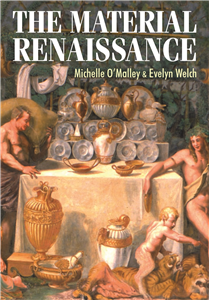
The Material Renaissance
None
by Michelle O'Malley, Christopher Breward, Evelyn Welch, Bill Sherman
Despite the recent interests of economic and art historians in the workings of the market, we still know remarkably little about the everyday context for the exchange of objects and the meaning of demand in the lives of individuals in the Renaissance. Nor do we have much sense of the relationship between the creation and purchase of works of art and the production, buying and selling of other types of objects in Italy in the period. The material Renaissance addresses these issues of economic and social life. It develops the analysis of demand, supply and exchange first proposed by Richard Goldthwaite in his ground-breaking Wealth and the demand for art in Renaissance Italy, and expands our understanding of the particularities of exchange in this consumer-led period. Considering food, clothing and every-day furnishings, as well as books, goldsmiths' work, altarpieces and other luxury goods, the book draws on contemporary archival material to explore pricing, to investigate production from the point of view of demand, and to look at networks of exchange that relied not only on money but also on credit, payment in kind and gift giving. The material Renaissance establishes the dynamic social character of exchange. It demonstrates that the cost of goods, including the price of the most basic items, was largely contingent upon on the relationship between buyer and seller, shows that communities actively sought new goods and novel means of production long before Colbert encouraged such industrial enterprise in France and reveals the wide ownership of objects, even among the economically disadvantaged. ;
-
Trusted Partner
 Business, Economics & LawMarch 2008
Cultural warfare and trust
Fighting the Mafia in Palermo
by Carina Gunnarson, Kim Stringer
Cultural warfare and trust: fighting the Mafia in Palermo concentrates on a central issue in research on democratic processes: the development of generalised trust. The existence of generalised trust and confidence in a society is decisive for economic development and an effective democracy. Is it possible to fight persistent values of distrust and non-cooperation? Is it possible to support the development of generalised trust through public action and education? The book addresses these questions by examining political efforts to combat Palermo's Mafia-controlled heritage and to turn a tradition of non-cooperation and distrust into cooperation and trust. In particular, it focuses on the school program launched in Palermo during the mid-1990s, which was designed to break the Mafia's territorial and mental control. Combining theories on social capital and civic education, the author presents and analyses new quantitative and qualitative research carried out in seven public schools in Palermo. This book will be valuable to students, academics and researchers interested in social capital and trust, Italian politics, civic education, organised crime, local government and democratic practice. ;
-
Trusted Partner
 Industrial / commercial art & designApril 2017
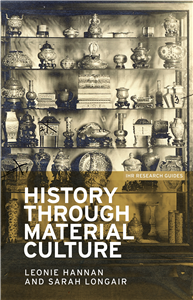
History through material culture
by Series edited by Simon Trafford, Leonie Hannan, Sarah Longair
History through material culture is a unique, step-by-step guide for students and researchers who wish to use objects as historical sources. Responding to the significant, scholarly interest in historical material culture studies, this book makes clear how students and researchers ready to use these rich material sources can make important, valuable and original contributions to history. Written by two experienced museum practitioners and historians, the book recognises the theoretical and practical challenges of this approach and offers clear advice on methods to get the best out of material culture research. With a focus on the early modern and modern periods, this volume draws on examples from across the world and demonstrates how to use material culture to answer a range of enquiries, including social, economic, gender, cultural and global history.



